|
Drought-Tolerant Crops for Drylands
View as PDF File
The vast majority of the poor in drylands depend on agriculture.
And drought is the principal constraint of crop production in these
areas. It may be defined as periods in the natural cycle of stress
and renewal during which the amount of moisture in the soil no
longer meets the needs of a particular crop . Drought occurs
frequently in drylands, partly because average rainfall is low,
ranging across locations and years from an average of about 300 to
800 millimeters per annum, but also because it may be highly
erratic, with torrential storms during the cropping season,
followed by long dry spells.
|
Photo: ICRISAT. Sorghum in
Africa.
|
The regions most vulnerable to drought are located in
Sub-Saharan Africa and Central Asia. Over the last four decades,
the African continent has suffered seven major drought episodes. In
two regions- the Sahel and the Horn of Africa- droughts in 1972-74
and 1981-84 caused massive social disruption and human suffering.
And the problem is likely to become worse, according to recent
studies, if trends in climate change play out as expected.
Given the severity of drought in dry areas, a central challenge
for researchers is to devise technologies that lend greater
resilience to agricultural production under this stress. One way in
which they have responded successfully to the challenge is by
developing varieties of major food crops that are drought tolerant
or escape drought through early maturity.
|
Various staples have withstood harsh dryland conditions for
thousands of years. Exploiting the drought-tolerance genes they
possess, national and international plant breeding programs have
scored important gains in improving some crops for this trait, as
described below. Nonetheless, progress has been slow, and much
remains to be done.
To speed the progress of breeding for drought tolerance,
scientists are actively employing two sets of cutting-edge tools.
One is derived from molecular biology and involves the use of
molecular markers to better understand the genetic basis of drought
tolerance and to select more efficiently for this trait. The other,
called participatory plant breeding, offers a more active role to
farmers, who are keen observers of plant performance and can
contribute importantly to selection for better drought
tolerance.
Selected Highlights from Research for Dryland
Development
Millet and sorghum, hardy dryland
staples:
Pearl millet, the most inherently
drought-tolerant of all the major staples, together with sorghum,
are key cereal grain crops in the drylands, providing food, feed
and, in the case of millet, fuel and construction material as well.
Despite formidable obstacles to improvement of these crops for
drylands, plant breeders at the International Crops Research
Institute for the Semi-Arid Tropics (ICRISAT) and in national
partner organizations have made important gains, and farmers are
adopting new varieties. In southern Africa, for example, about 34
percent of the total millet area is now planted to improved
materials and 23 percent of the sorghum area.
Early maturing varieties of these crops have proved especially
useful for helping dryland communities get through the "hungry
season." This is the period before harvest, when the previous
year's grain supplies have been exhausted. The millet variety
'Okashana 1', for example, which was selected by farmers in
Namibia and matures 4-6 weeks earlier than traditional varieties,
spread in just a few years during the mid-1990s to cover half the
country's millet area. The US$3 million investment required to
develop and disseminate the variety was estimated in 1998 to be
yielding annual benefits worth $1.5 million. At about the same time
in southern Chad, an improved sorghum variety, which shows a 50
percent yield advantage over local materials, also spread quickly,
generating benefits worth almost $4 million annually.
Multipurpose grain legumes:
These
crops are vital sources of low-cost protein in drylands, and the
sale of excess grain generates significant farm income. Grain
legumes also help restore soil fertility, since their roots fix
nitrogen from the air in forms that can be used by subsequent
crops. In addition, the stems and stalks of these crops are valued
as livestock feed. Cowpea is the most widely grown grain legume in
the dry areas of Africa, while chickpea and pigeonpea predominate
in much of the Asian drylands. More than 60 countries have released
improved cowpea varieties with support from the International
Institute of Tropical Agriculture (IITA). Chickpea and pigeonpea
varieties resulting from the work of ICRISAT are having a major
impact in India, Nepal, Pakistan and increasingly in China.
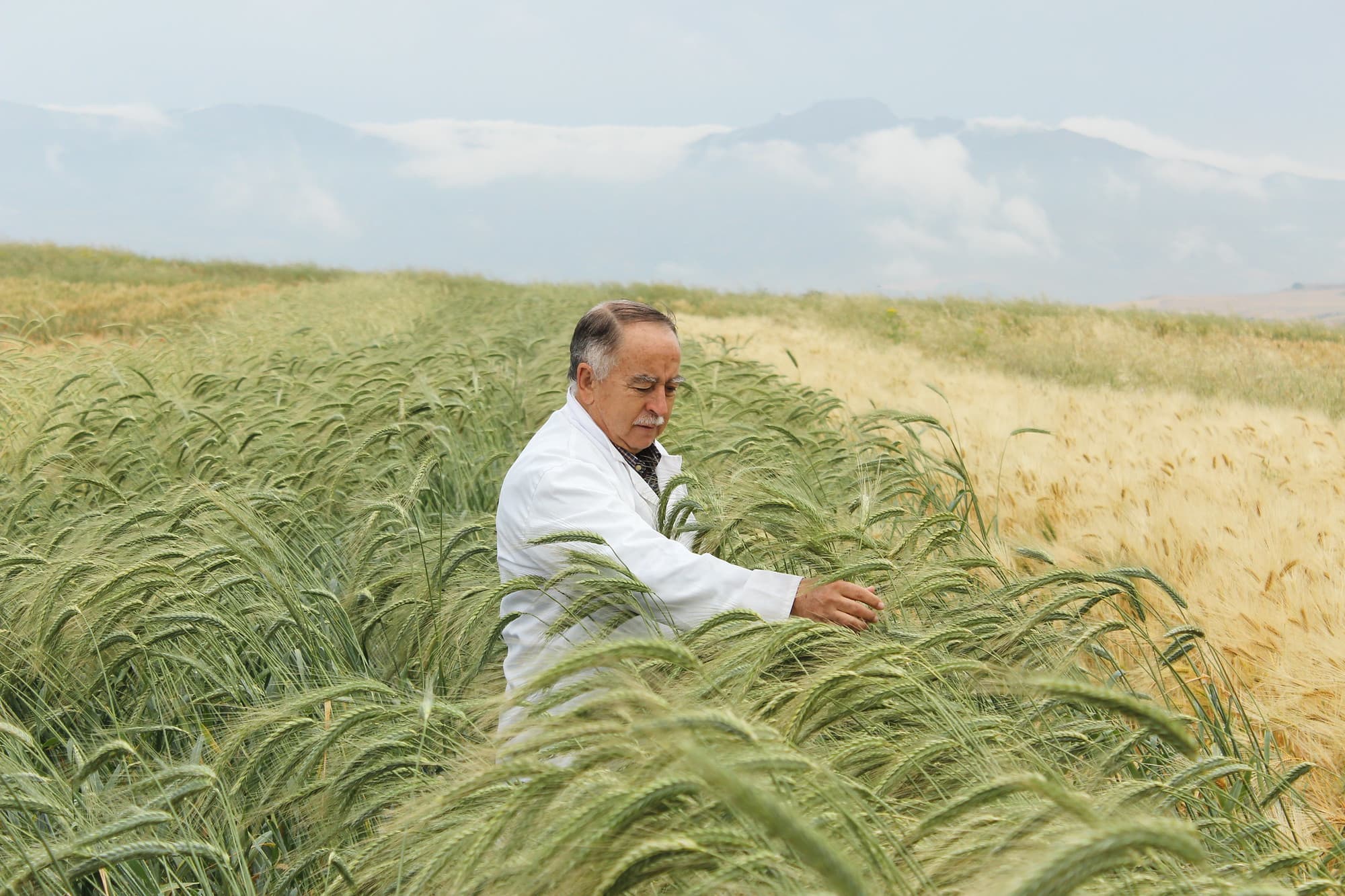
Farmer participation in barley
improvement:
Barley is the world's fourth most
important cereal crop, and drought affects its yields severely.
During 2000 in Syria, for example, when rainfall dropped 20 to 30
percent below the long-term average, the crop produced little or no
grain in some areas. Nonetheless, at four dry experimental sites, a
few barley lines were able to produce grain. Based on these
materials, a new drought-tolerant barley variety was developed,
with the participation of farmers, through a plant breeding program
coordinated by the International Center for Research in the Dry
Areas (ICARDA). The economic benefit so far of participatory barley
improvement in Algeria, Egypt, Ethiopia, Iraq, Jordan, Morocco,
Tunisia and Syria was estimated at about US$91 million in 1997.
Maize and molecular biology:
Maize is
the world's third most important cereal crop (after rice and
wheat), and drought is second only to soil infertility as a
constraint of maize production in developing countries. The
International Maize and Wheat Improvement Center (CIMMYT) has
achieved important progress in developing drought-tolerant maize
through conventional plant breeding. And the Center has widely
tested and disseminated improved materials in drought-prone areas
of Africa. CIMMYT scientists believe they can make further gains by
using tools from molecular biology. With the aid of a genomic map
that combines data for different types of tropical maize in diverse
environments, they are identifying genetic "hot spots" in
maize, that is, areas of the crop's chromosomes that confer
drought tolerance.
This work is critical in light of a recent study that examined
the likely impact of climate change on maize yields in Africa and
Latin America during the coming decades. The study was conducted
jointly by the International Center for Tropical Agriculture (CIAT)
and International Livestock Research Institute (ILRI). In parts of
southern Africa, the study predicted drastic yield declines,
requiring major adjustments in maize-based systems.
|