
- From
-
Published on
15.11.19
- Impact Area
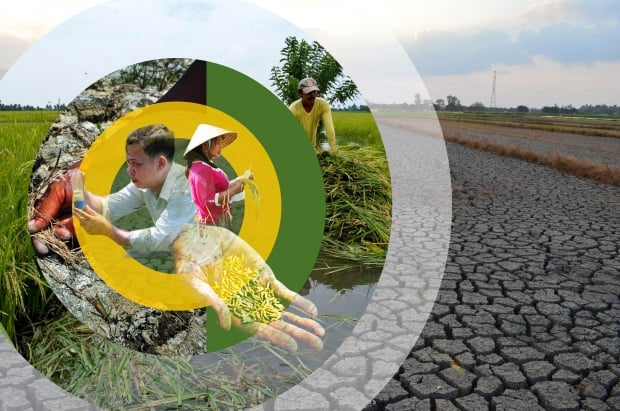
Southeast Asian countries are subjected to extreme climatic events such as massive floods or droughts. To help them prepare for future ENSO* events, the World Bank, in collaboration with the International Food Policy Research Institute (IFPRI)**, produced country reports for Lao PDR, Cambodia, Vietnam, the Philippines and Myanmar. These reports were also supported in part by the CGIAR Research Program on Climate Change, Agriculture and Food Security (CCAFS).
In the Exposure story below, we give an overview on how ENSO affects agriculture in the five Southeast Asian countries and provide recommendations to prepare for future ENSO events.
* What is ENSO? El Niño-Southern Oscillation (ENSO), a major force in the global climate system, is the interaction between the tropical Pacific Ocean and the atmosphere by which eastern and central Pacific sea surface temperatures cycle between above and below average, with cascading effects on weather and climate across the globe.
** The reports were prepared by a team led by William R. Sutton, Lead Agricultural Economist in the World Bank’s Agriculture Global Practice, East Asia and Pacific Region, together with Jitendra P. Srivastava, Ioannis Vasileiou, and Maximillian Ashwill, and in collaboration with a team from the International Food Policy Research Institute (IFPRI) led by Mark Rosegrant and James Thurlow.
The authors gratefully acknowledge the generous financial support provided by the contributors to the Multi-Donor Global Food Price Crisis Response Trust Fund: the governments of Australia, Canada, the Republic of Korea, and Spain. The team also acknowledges the support provided by the CGIAR Research Program on Climate Change, Agriculture and Food Security (CCAFS).
Related news
-

CGIAR Climate Security team pilots a new research approach for the development of Nature-based Solutions in fragile settings
27.11.25-
Climate adaptation & mitigation
Responding to complex crises requires new systemic research approaches that help identify entry poin…
Read more -
-

Drones prove their worth in measuring livestock methane in Africa
26.11.25-
Mitigation
In May 2024, the International Livestock Research Institute (ILRI) and partners shared news of the…
Read more -
-

Pioneer adaptation farmers inspire adoption of climate-smart innovations in Bomet County, Kenya
24.11.25-
Adaptation
In Bomet County, Kenya, where agricultural traditions run deep, two families and their farms are…
Read more -