

Launch of “The Business Case for Investment in Rangeland Restoration” at IUCN World Conservation Congress, Abu Dhabi
In October 2025, conservationists, policymakers and academics gathered in Abu Dhabi for IUCN’s World Conservation Congress, to establish a 20-year Strategic Vision for nature conservation, titled “United for Nature”. This vision aims to ensure that societies around the world conserve nature’s integrity and diversity, use natural resources equitably and build a just and nature-positive future for all. An important part
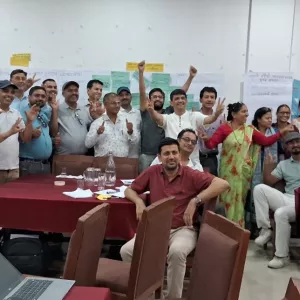
Launch of “The Business Case for Investment in Rangeland Restoration” at IUCN World Conservation Congress, Abu Dhabi
In October 2025, conservationists, policymakers and academics gathered in Abu Dhabi for IUCN’s World Conservation Congress, to establish a 20-year Strategic Vision for nature conservation, titled “United for Nature”. This vision aims to ensure that societies around the world conserve nature’s integrity and diversity, use natural resources equitably and build a just and nature-positive future for all.
An important part of this vision is that rangelands and those dependent on rangelands receive adequate investment and support for more sustainable livelihoods as well as building resilience to climate change, the conservation of globally important biodiversity and ecosystem services.
Restoring rangelands that have been degraded by invasive species or others, is a key investment area. The launch of The Business Case for Investment in Rangeland Restoration produced by the Economics of Land Degradation Initiative (ELD) and ILRI, financed by the German Federal Ministry for Economic Cooperation and Development with in-kind support from the GEF-funded STELARR project lays out a roadmap for how this can be achieved.

Rangeland restoration: An investment case with high potential ELD’s Business Case for Investment in Rangeland Restoration report shows that restoring degraded rangelands is not only viable from an environmental and social perspective but also can generate economic returns. Rangelands cover more than half of the Earth´s land surface. They feed hundreds of millions of people, store vast amounts of carbon and diverse biodiversity including many IUCN Red List species. Yet investment in protection and restoration of rangelands is far behind that of forests. The report highlights that rangelands can deliver multiple benefits from improved livestock production to carbon sequestration, water regulation or tourism opportunities among others.

To unlock this potential, it calls for:
· Stronger land tenure and governance
· Targeted restoration measures and economic incentives
· Innovative financing and market infrastructure
· Inclusive participation of pastoralist communities
· Better cost–benefit analysis and monitoring systems
Restoring rangelands does not come with a one-size-fits-all solution. Costs vary widely depending on the type and severity of degradation. By combining revenue streams from livestock production carbon and biodiversity credits, eco-tourism and renewable energy among others. Diversifying revenues can reduce risk and attract investors. Pastoralists the main users and custodians of these lands are co-investors through their labour, knowledge and stewardship of the land. Supporting them strengthens the social foundations of restoration and ensures that economic returns can be shared more fairly.
Positioning rangeland restoration as a key priority under the IYRP 2026
The Business Case for Investment in Rangeland Restoration lays a strong foundation for positioning rangeland restoration as a key priority under the upcoming International Year of Rangelands and Pastoralists (IYRP) 2026. The year offers a significant opportunity to raise awareness on the importance of rangelands and the dire need for investment in restoration. Initiatives such as STELARR and UNCCD’s Business4Land provide openings for greater private sector investment. By working together, we can ensure that these valuable land use ecosystems receive the attention that the deserve.
The report can be accessed on ELD´s website :
Acknowledgement
Funded by the Global Environment Facility, STELARR is being implemented by IUCN and executed by ILRI in partnership with the Alliance of Bioversity International and CIAT, International Center for Agricultural Research for Dry Areas (ICARDA), Center for International and World Agroforestry Centre Forestry Research (CIFOR-ICRAF), the Secretariat of the UN Convention to Combat Desertification (UNCCD), and the Sustainable Fibre Alliance. Additional research support is provided by the CGIAR Science Program on Multifunctional Landscapes. ILRI thanks all its donors including those that contribute to the CGIAR Trust Fund.
Author: Lennart Hientz – Global Livestock Value Chain Investment Development Specialist (ILRI)
Contributors: Fiona Flintan – Senior Scientist – Rangelands Governance Specialist (ILRI)
Abdrahmane Wane – Regional Director, ILRI West and Central Africa (ILRI)
