

Scaling for Impact

Overview
We address global poverty, food insecurity, and climate risk by translating rigorous science into solutions that are used at scale. Scaling for Impact works across disciplines to align research with policy, markets, and investment, generating decision-ready evidence and coordinating partners to deliver integrated solutions. This approach accelerates uptake, strengthens national delivery systems, and reduces fragmentation and duplication across the development landscape.
As CGIAR's first Program fully dedicated to scaling land, food, and water systems innovations, Scaling for Impact focuses on overcoming the practical constraints that limit adoption and sustained use. The Program brings together scientific excellence, delivery expertise, and financing pathways to support inclusive and responsible scaling. By aligning innovations with country priorities and large-scale public and private investment, Scaling for Impact strengthens CGIAR's role as a trusted partner for governments, development actors, and investors seeking measurable, durable outcomes at scale.
Technical Report

Delivering CGIAR's 2030 Impact Goals
Scaling for Impact contributes to CGIAR's 2030 Impact Goals by embedding proven innovations into the systems that deliver at scale. By 2030, these efforts will support:
- More than 51 million people benefiting from CGIAR innovations
- 5 million hectares under biodiversity-friendly and climate-smart practices
- Improving access to healthier diets for 2 million consumers
- Over US$5 billion in aligned public and private investment supporting sustained scaling
These outcomes are achieved through five connected scaling pathways:
- Public delivery systems – integrating research and evidence-based innovations into national policies, extension services, seed systems, and climate and nutrition programs.
- Market and enterprise systems – enabling private-sector delivery through value chains, service providers, and digital platforms.
- Public and development finance – embedding CGIAR innovations in large-scale government and multilateral bank and private sector financed programs.
- Policy and institutional change – addressing regulatory, coordination, and capacity constraints to sustained use of innovations.
- Evidence and learning – using data and learning to guide decisions on what to scale, where, and how.
Where we bring benefits
The countries and locations listed below reflect where CGIAR and its partners reasonably expect their work to generate benefits:
- Global
- Countries: Bangladesh, Cambodia, Colombia, Côte d'Ivoire, DR Congo, Egypt, Ethiopia, Guatemala, India, Kenya, Malawi, Mexico, Morocco, Nepal, Nigeria, Philippines, Tanzania, Uzbekistan, Vietnam, Zambia
Challenges we address
CGIAR has generated a wealth of high-quality science, yet too often this science does not translate into sustained impact at scale. The core challenges are systemic and persistent.
- From strong science to weak delivery at scale
Many proven innovations stall after pilots because they are not sufficiently aligned with country priorities, delivery systems, or the institutions responsible for implementation. - Fragmented pathways across policy, markets, and institutions
Scaling is constrained by policy gaps, regulatory barriers, limited coordination, and underdeveloped markets, which prevent innovations from being adopted and sustained beyond individual projects. - Insufficient connection to large-scale public and development finance
Innovations frequently sit outside government programs and investment pipelines, limiting reach, durability, and value for money. - Rising pressure from climate, conflict, and inequality
Climate risk, environmental degradation, instability, and widening inequality increase urgency while making scaling more complex and risk-sensitive. - Limited systemwide learning on what works at scale
Evidence on scaling pathways is uneven, feedback loops are weak, and learning is not consistently used to adjust portfolios, leading to repetition and missed opportunities.
Our publications
Explore research, analytical products, and practical guidance produced by Scaling for Impact. These outputs support decision-making on how agricultural innovations can be taken to scale through policies, markets, and investment programs.
-

Postharvest grain system in Ecuador and smallscale farmers perceptions of gender roles and postharvest loss
Smallholder farmers in Ecuador are the main producers of staple grains, yet postharvest losses remain one of the major constraints they face. This...
-

Hidden allies The role of belowground soil macrofauna in sustainable cropping production in Zimbabwe
Soil biological activity is crucial for sustainable agriculture, serving as a key indicator of soil health by regulating nutrient cycling and organic...
-
Do additional legumes enhance system performance Exploring doubledup legume systems under conservation agriculture in Malawi
Background: Conservation agriculture (CA) systems and legume diversification are increasingly promoted as pathways for sustainable intensification of...
-

Digital climate services for agricultural risk management Evidence from codesigning and scaling voicebased harvest advisories for mung bean farmers in coastal Bangladesh
Extreme precipitation during critical harvest periods is a major source of agricultural losses and damage for smallholder farmers, particularly for...

Areas of work
Engage and Empower
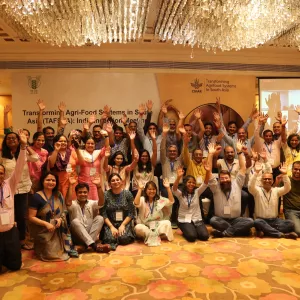
Scaling for Impact embeds research and scaling efforts within regional, national, and local innovation systems so that CGIAR innovations respond directly to stakeholder priorities and delivery realities. This Area of Work focuses on strengthening how demand is articulated, coordinated, and acted upon across governments, markets, and civil society.By working with public institutions, private-sector actors, and community stakeholders, Engage and Empower helps bridge persistent gaps between research, adaptation, adoption, and sustained use. The emphasis is on building shared ownership, aligning incentives, and supporting partnerships that enable innovations to be taken up, adapted, and maintained at scale.
Grand Challenges and Scaling Flagships
Supports the scaling of innovations from across CGIAR's Portfolio of Science Programs and Accelerators by organizing scaling support around three Grand Challenges, each corresponding to a transformation pathway within the food system.
First, Scaling for Impact helps close the climate adaptation gap by advancing scalable climate services and smart water management. This includes expanding digital climate services for resilient farm and enterprise management and scaling smart irrigation and climate-resilient water systems, enabling Portfolio innovations to be deployed through climate services, water institutions, and investment programs.
Second, the Program supports innovations that deliver inputs and services at scale through inclusive market systems. This pathway strengthens resilient, nutritious, and biodiverse seed and soil systems, enables entrepreneurship through mechanization and postharvest services, and improves genetics, inputs, and service delivery for animals and aquaculture, providing clear market-based pathways for Portfolio innovations to reach farmers and enterprises.
Third, Scaling for Impact works to drive demand, shape behavior, and activate policy for nutrition, by catalyzing demand for nutritious diets through markets, institutions, and policy. This pathway enables nutrition-relevant innovations from across the Portfolio to translate into sustained consumption and policy outcomes.
By structuring scaling support in this way, Scaling for Impact provides a common framework through which innovations from across CGIAR can be prioritized, packaged, aligned with delivery systems and finance, and taken to scale with durable impact.

Enabling Environment Lab
The Enabling Environment Lab focuses on removing the policy, market, and institutional barriers that prevent innovations from being adopted and sustained at scale. It supports governments, market actors, and delivery partners to address regulatory constraints, coordination failures, and incentive structures that shape how scaling actually happens in practice. Through applied analysis, experimentation, and targeted technical support, the Lab strengthens the effectiveness, inclusivity, sustainability, and cost-efficiency of scaling pathways. It equips regional innovation and scaling hubs with practical tools, evidence, and insights to design, test, and implement enabling conditions that allow innovations from across CGIAR to be taken to scale with durable impact.
Achieving Impact by Unlocking Finance and Partnerships
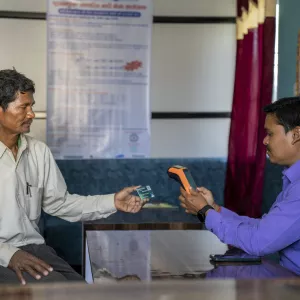
This Area of Work focuses on converting proven innovations into financed, large-scale delivery by aligning CGIAR science with government programs, international financial institutions, and market actors. It strengthens partnerships that connect innovation pipelines to public investment, policy priorities, and implementation capacity. Scaling for Impact works with governments, IFIs, private investors, and delivery partners to integrate innovations into investment design, financing mechanisms, and implementation platforms. By leveraging private-sector engagement and collaboration with international NGOs and humanitarian organizations, this Area of Work helps mobilize and direct finance toward scalable solutions, ensuring innovations move beyond pilots and generate sustained development impact at scale.

Learning for Impact
Strengthens how CGIAR and its partners learn from scaling in practice and use evidence to improve decisions. It advances scaling science, applies robust monitoring, evaluation, learning, and impact assessment approaches, and supports coordinated portfolio management across innovations and contexts. Learning for Impact emphasizes experiential learning and adaptive management, combining analytical evidence with hands-on engagement through capacity building, South–South exchange, and peer learning. By systematically documenting what works, where, and why, this Area of Work helps refine scaling strategies, improve accountability, and inform training and practice across regions, ensuring that learning directly contributes to more effective and durable impact at scale.

Gender Equality & Social Inclusion
We will prioritize gender equality and social inclusion through a transformative agenda and targeted interventions,integrating these priorities into its research and co-develop responsible scaling strategies with partners to ensure equitable access to resources and opportunities for marginalized groups..
Our approach
Interlinked support across CGIAR’s portfolio
We will work closely with the Better Diets and Nutrition, Breeding for Tomorrow, Climate Action, Food Frontiers and Security, Multifunctional Landscapes, Policy Innovations, Sustainable Animal and Aquatic Foods, and Sustainable Farming programs, and the Digital Transformation, Gender Equality and Social Inclusion, and Shared Capacity accelerators.
Working to share our capacity with
- governments and international financial institutions
- agribusinesses and agrifood system players
- scientists and students
Our expertise
- Robust relationships with regional and national stakeholders
- A mandate and experience in scaling science, combined with access to multistakeholder networks and scaling hubs
- Global and local transdisciplinary expertise with decades of in-country policy presence and a track record in enabling scaling research
- A mastery in mobilizing transformative finance and forming impactful collaborations with governments, private-sector actors, and international organizations.
Events
News
-

19 scaling pathways: What makes innovation stick?
-

Six-Step Approach to a €6M investment
-

Regional Experts Explore Climate-Smart Rice–Potato Production in Vietnam
A regional field exchange at Nam Cuong Cooperative in Vietnam brought together Asian research partners to explore low-emission rice production,...
-

Delta Talks Explores Care and Resilience in the Mekong Delta
The 19th installment of the Delta Talks explored how approaches to the delta have evolved from colonial and management practices toward caretaking,...