

How we work
CGIAR is the world’s largest global agricultural innovation network. We provide evidence to policy makers, innovation to partners, and new tools to harness the economic, environmental and nutritional power of agriculture.
Strategy
A new strategy for a new era
The 2030 Research and Innovation Strategy situates CGIAR in the evolving global context, which demands a systems transformation approach for food, land, and water systems. Covering all research for development programming across CGIAR, it provides an overview of how CGIAR will develop and deploy its capacities, assets, and skills to address priority global and regional challenges with partners over the decade. And importantly, it builds on CGIAR’s track record of collaborating with partners to deliver impacts for more than 50 years, lifting hundreds of millions of people out of hunger and poverty and supporting low-income producers and consumers.
CGIAR’s vision and mission
Vision
A world with sustainable and resilient food, land, and water systems that deliver diverse, healthy, safe, sufficient, and affordable diets, and ensure improved livelihoods and greater social equality, within planetary and regional environmental boundaries.
Mission
To deliver science and innovation that advance the transformation of food, land, and water systems in a climate crisis.
What we will deliver

CGIAR is targeting multiple SDG benefits across five Impact Areas. Working with others, for each of the Impact Areas CGIAR contributes to collective global targets for the transformation of food, land, and water systems across local, regional, and global levels. In each Action Area, designated Platforms will foster critical thinking and use of evidence to improve their focus on the scaling of innovation and impact from research.
2030 Global Collective Targets for Five Impact Areas
Click on the icons to learn more.

Impact Pathways
CGIAR measures its effective contributions from research to impact along three main pathways within innovation systems:
- Science-based innovation: This is a co-development of sets of knowledge products, technologies, services, and other solutions along a scaling pathway.
- Targeted capacity development: This includes working with individuals, firms, and organizations — designed to improve the utility and use of technological and institutional solutions.
- Advice on policy: This pathway includes business strategies, institutional arrangements, and investment programs, together with more formal public policy sector instruments.
Regions
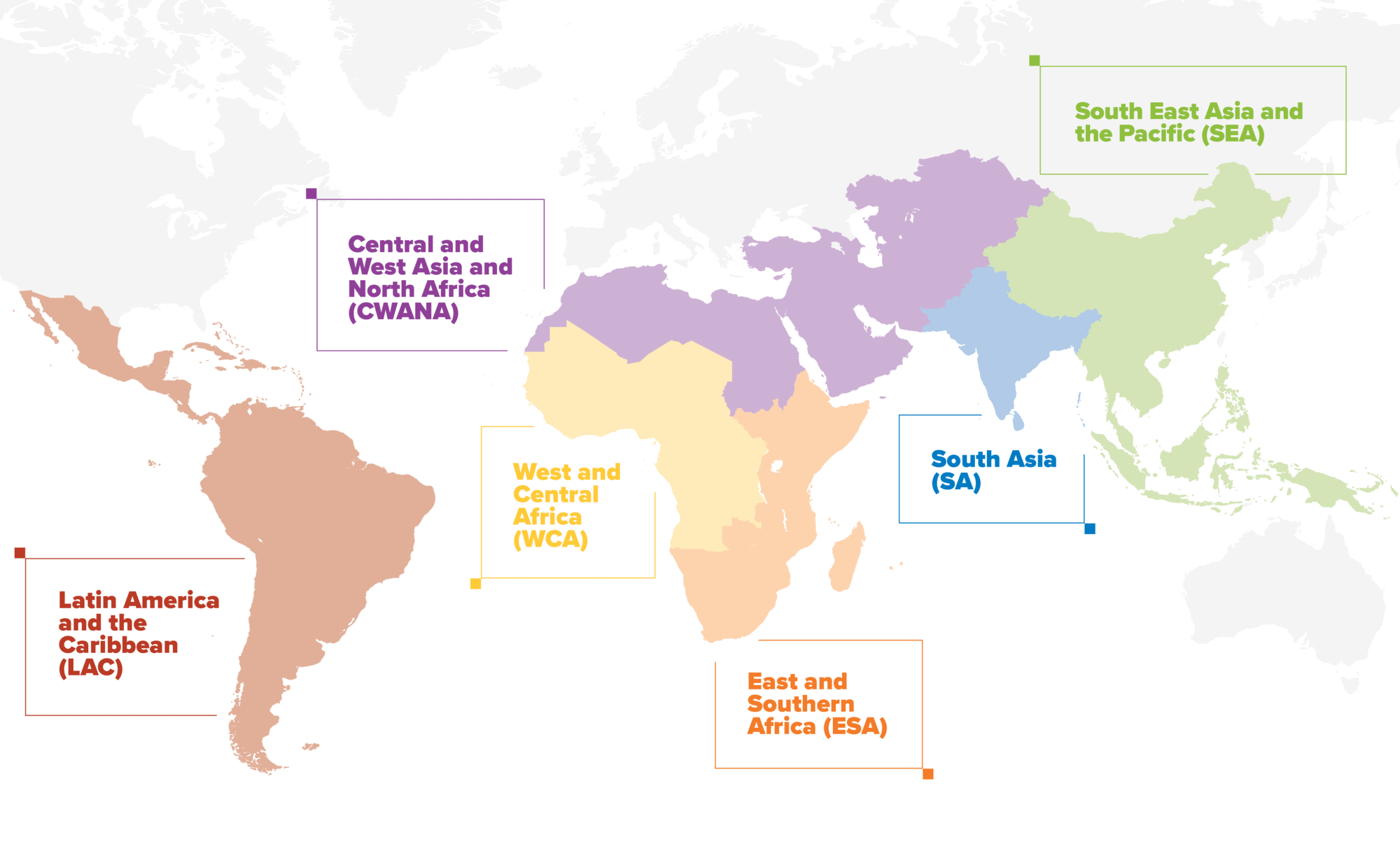
CGIAR works in six regions: Central and West Asia and North Africa, Latin America and the Caribbean, West and Central Africa, East and Southern Africa, South Asia, Southeast Asia and Pacific.
Action Areas
CGIAR strives for global and regional impact by organizing its work along three Action Areas in which accelerated innovation is required to create sustainable and resilient food, land, and water systems and to meet SDG targets. The three Action Areas, which build on the firm foundation of CGIAR’s traditional strengths in genetics and farming systems with a more ambitious agenda around food, land, and water systems, are:
- Systems Transformation
- Resilient Agrifood Systems
- Genetic Innovation
Learn more about our priorities for research and innovation in each Action Area.
Ways of Working
The 2030 Research and Innovation Strategy sets the stage for doing business differently to ensure that research provides real solutions for development. CGIAR is changing the way it works, following seven new implementation approaches:
- Embracing a systems transformation approach, seeking multiple benefits across five SDG-linked Impact Areas
- Leveraging ambitious partnerships for change in which CGIAR is strategically positioned
- Positioning regions, countries, and landscapes as central dimensions of partnership, worldview, and impact
- Generating scientific evidence on multiple transformation pathways
- Targeting risk-management and resilience as critical qualities for food, land, and water systems
- Harnessing innovative finance to leverage and deliver research through new investment and funding models
- Making the digital revolution central to our way of working
Current Performance and Results Management System
CGIAR’s current Performance and Results Management System delivers responsible stewardship and assurance for funders, providing timely and robust evidence of CGIAR’s value, return on investment and delivery against expectations. It also provides the basis for learning and adaptive management through strengthened use of theory of change, projected benefits and stage-gates.
A new, collaboratively designed CGIAR Performance and Results Management Framework 2022–2030 has been developed, providing a streamlined CGIAR results architecture aligned to the Sustainable Development Goals.
CGIAR 2022–24 Investment Prospectus
The CGIAR 2022–24 Investment Prospectus provides a body of research and innovation — a portfolio of CGIAR Research Initiatives — to deliver on the priorities set out in the CGIAR 2030 Research and Innovation Strategy.
The Research Initiatives are prioritized areas of investment that bring capacity from within and beyond CGIAR to bear on well-defined, major challenges. They are organized by the three Action Areas presented in the CGIAR 2030 Research and Innovation Strategy and are designed to contribute to all five Impact Areas.
To learn more about CGIAR Research Initiatives, visit our Portfolio by clicking below.
Accountability
CGIAR has a deep commitment to partnership, transparency and accountability. This is reflected in the CGIAR governance structure which focuses on enabling CGIAR’s Research Centers and Partners to conduct high-quality research for development based on a solid foundation of clearly defined roles, responsibilities and accountabilities.
Partnership, transparency and accountability is a priority across all CGIAR activities. For example:
- CGIAR is committed to Open Access and Open Data, with all 15 Research Centers signing on to the Open Access and Data Management Policy in 2013
- CGIAR works in accordance with a range of policy and guidance documents that set the overall environment for the system and how it operates
- CGIAR receives advice from a range of advisory services which help to provide accountability, contribute to system-wide learning and support decision making
- CGIAR management of intellectual assets works towards maximizing global accessibility and impact of CGIAR research.
- CGIAR publishes system-wide grant data to the International Aid Transparency Initiative (IATI) Standard.
In 2018, the Chairs of CGIAR’s Audit Committees agreed to commission a single firm to carry out an External Quality Assessment (‘EQA’) of all Center Internal Audit services. That work was overseen by the CGIAR System Internal Audit Function, and a copy of the Executive Summary of the Consolidated Report was shared with the System Management Board and its Audit and Risk Committee in April 2019.
In 2018, CGIAR developed an annual ‘CGIAR Integrity Report’, providing summarized analysis on financial irregularity matters reported to the System Organization.
Our Policies
The CGIAR System operates according to a set of guidance documents that establish the overall policy and operational environment for the System. Typically, Frameworks set out overall guidance and have underlying Policies and/or Guidelines which guide implementation.
The CGIAR System Council approves documents that are critical to maintaining the reputation of the CGIAR System and the System Board approves other System wide documents.
Frameworks*
- CGIAR Performance and Results Management Framework
- CGIAR Integrated Partnership: Risk Management and Internal Controls Framework
- CGIAR Integrated Partnership: Risk Appetite
- CGIAR Ethics Framework
- Framework for Gender, Diversity and Inclusion in CGIAR’s Workplaces
- CGIAR Evaluation Framework
Policies/Guidelines/Principles*
- CGIAR Evaluation Policy
- Intellectual Assets Management Principles
- Implementation Guidelines for the CGIAR Principles on the Management of Intellectual Assets
- CGIAR Open and FAIR Data Assets Policy
- CGIAR Integrated Partnership: Risk Management and Internal Controls Policy
- Guidelines on the Nagoya Protocol for CGIAR Research Centers
- Lignes directrices sur le Protocole de Nagoya destinées aux Centres de recherche CGIAR
- Directrices sobre el Protocolo de Nagoya para los Centros de Investigación del CGIAR
- CGIAR IFRS Compliant Reporting Guidelines
- CGIAR Procurement Guidelines
- CGIAR System Cost Financing Policy
- CGIAR Cost Principles and Indirect Cost Guidelines
- CGIAR Auditing Guidelines
- CGIAR Code of Conduct for Governance Officials
- CGIAR Code of Ethics and Business Conduct for CGIAR Staff
- CGIAR Research Ethics Code
- CGIAR Policy on Protection Against and Prevention of Harassment and Discrimination
- CGIAR Safeguarding Policy – Protection Against and Prevention of Sexual Misconduct, Exploitation and Abuse, and Human Trafficking
- CGIAR Policy on Whistleblowing and Protection from Retaliation
- CGIAR Branding Guidelines
- CGIAR Funder Acknowledgement Guidelines
- CGIAR Procedure for the Operational Designation of Pooled Funding
- One CGIAR Implementing Arrangement No. 1
- CGIAR Technical Reporting Arrangement
- CGIAR Technical Reporting Arrangement 2025-30
- Process for Developing, Tracking, and Reporting of Management Responses to Evaluations
Good Practice Notes And Other Tools*
These Good Practice Notes and other tools were developed in collaboration with subject matter experts in CGIAR; they build on experience accumulated by Research Centers and leverage knowledge, tools and approaches developed externally. Their purpose is to provide reference tools to support Research Center and System Organization management in their efforts to establish efficient and effective business processes.
- Control Self Assessment
- Project Management
- Risk Management
- Research Data Management
- CGIAR Questions and Answers on Genetic Engineering
- CGIAR Questions and Answers on Genome Editing
* Please take note that most policies, guidelines, notes, and frameworks listed on this page are currently under review.
Governance and Management
CGIAR’s governance and management structure distributes strategic direction, governing and advisory functions among several entities, reflecting the diversity of stakeholders within the CGIAR System and the critical importance of ensuring that the voices of our partners inform our actions and decisions.
Built on a strong partnership between CGIAR’s Funders and Centers, our governance and management structure focuses on enabling Centers and CGIAR System.
Partners to conduct high-quality research for development based on a solid foundation of clearly defined roles, responsibilities and accountabilities.
CGIAR System Council
The System Council has strategic oversight for the vision, direction, impact, continued relevancy, adequate governance, and programmatic performance of the Integrated Partnership in a rapidly changing landscape of food land and water systems research for development. The System Council ensures appropriate resources to support the delivery of the CGIAR Strategy and Results Framework while ensuring the adequate assurance of use of funds.
Integrated Partnership
The Integrated Partnership is a federated group of Centers and the CGIAR System Organization, united by common values and principles, and committed to achieving, through integration and coordination, synergies that enhance the Centers’ individual and collective contributions to fulfilling the purpose of the CGIAR System.
CGIAR System Organization
The System Organization is the international organization governed by the Charter of the CGIAR System Organization, with its organs being the Integrated Partnership Board and System Management Office. Read more.
CGIAR Integrated Partnership Board
The CGIAR Integrated Partnership Board is the governing body of the System Organization and of the Integrated Partnership. Its composition, function and operational procedure are outlined in the Charter of the CGIAR System Organization. Read more.
CGIAR System Management Office
The System Management Office, headed by the Executive Managing Director, shall be responsible for the day-to-day operations of the System Organization, for supporting the System Council, the Integrated Partnership Board and the General Assembly of Centers, and for facilitating integration and collaboration within the Integrated Partnership. Read more.
General Assembly of the Centers
The General Assembly of the Centers is a forum for CGIAR Research Centers to discuss issues related to the CGIAR System. Its roles are set out in Article 5.6 of the Charter of the CGIAR System Organization. Read more.
Partnership Forum
The Partnership Forum provides stakeholders who actively support the CGIAR System with a forum to express their views on CGIAR’s operations. Its scope and frequency are set forth in the CGIAR System Framework.
Integration Framework Agreement
On February 22, 2023, the CGIAR Integration Framework Agreement (IFA) was approved by the boards of all One CGIAR Centers and signed by their Board Chairs.
The IFA, developed by Center Boards and CGIAR leadership, was created to confirm and clarify the path to One CGIAR. Its successful completion paves the way for a united CGIAR to move forward with confidence.
As called for in the IFA, an independent review of CGIAR’s unified governance arrangements was undertaken during 2023. The overall process was overseen by the Ad Hoc Committee on Governance, and the review carried out by an external specialist consultant firm, Morrow Sodali.
CGIAR Unified Governance Review – Final Report
CGIAR Unified Governance Review – Annex 2 to the Final Report
Based on Morrow Sodali’s report, a set of proposed texts to implement the recommendations was developed through a consultative and multi-stakeholder process. The Memorandum setting out these texts was approved by all IFA Parties and the System Council in December 2023, for implementation in 2024.
CGIAR Memorandum on the implementation of governance recommendations
The recommendations were implemented in 2024 by changing and updating the CGIAR System Framework and the Charter of the CGIAR System Organization. The changes come into effect on 1 October 2024.
2025 CGIAR Governance Calendar
See and download the latest version of the 2025 Governance calendar here
2026 CGIAR Governance Calendar (Draft)
See and download the latest version of the 2026 Governance calendar (draft) here
CGIAR Ombuds Office
Independent Resource for Conflict Resolution and Support
About the Ombuds Office
The Ombuds Office is your confidential and neutral resource at CGIAR for navigating workplace challenges. We provide a safe space to discuss concerns, offer impartial guidance, and facilitate conflict resolutions.
Our mission:
- Foster a respectful, fair, and inclusive work environment.
- Enhance CGIAR’s goal of being a civil and responsive organization.
- Identify and draw leadership’s attention to system issues within CGIAR.
Our services:
- Confidential Listening: Share your concerns without fear of reprisal.
- Conflict Resolution: We help you explore options and find solutions.
- Mediation: We facilitate communication between parties in conflict.
- Problem-Solving Support: We assist you in developing strategies to address workplace issues.
- Referral Services: We can connect you with relevant resources within CGIAR.
In addition to working with individuals, the Ombuds Office notes and addresses systemic concerns by elevating systemic trends and concerns to the attention of leadership to improve the organization’s fairness and effectiveness.
How we work:
- We listen attentively and clarify issues.
- We serve as a thought partner and conflict coach to all parties in dispute.
- We gather information, explore options, and facilitate difficult conversations.
- We assist in resolving conflicts or mediating between parties as an impartial, neutral resource.
The Ombuds Office is not a replacement for formal channels such as your supervisor, Human Resources, or the Office of Ethics and Business Conduct. However, it can be a valuable resource before, during, or after pursuing those options.
Contact Us:
To schedule an appointment with Dr. Anu Rao, the Ombudsperson, please contact us at ombuds@cgiar.org
Dr. Anu Rao is based in Houston, USA, and is available for consultations.
How the Ombuds Office Works
The Ombuds Office is an independent, impartial, informal, and confidential communications channel for all CGIAR leaders and staff. The Ombudsperson does not take sides or advocate for individuals. It is designed to be “off the record.” and does not store identifying information but does track trends and concerns. It supplements, rather than replaces, existing formal channels like supervisors, Human Resources, or the Office of Ethics and Business Conduct.
Some staff members have raised concerns about the office’s independence, given that the Ombuds staff are paid by CGIAR. However, the Ombuds Office is modeled after over 1,000 Ombuds Offices worldwide, which follow the Standards of Practice set by the International Ombudsman Association (IOA). The association’s best practices recommend that the Ombudsperson should report to the highest executive of the organization, such as the President, the CEO, or the Executive Managing Director.
The Role of the Ombuds Office
All conversations with the Ombuds are confidential. When a visitor seeks support, the Ombuds Office will listen, serve as a thought partner, help plan or develop options that can be used to surface an issue or to carry out a difficult conversation. The Ombuds person can provide resources and information about CGIAR policies and systems, and assist with informal conflict resolution and problem-solving.
The Ombuds Office uses non-adversarial and informal approaches to resolve difficult work-related problems. The Ombudsperson will go back and forth between parties to clarify misunderstandings (we call this shuttle diplomacy) and when needed, the Ombuds can facilitate discussions and mediation as an impartial third party.
The Ombuds Office notes trends and patterns to provide systemic feedback to the leadership of CGIAR. This feedback on critical incidents and systemic issues is shared without divulging the identity of individuals. The Ombudsperson thus helps to identify and address organizational and systemic issues within CGIAR by elevating the concerns to the leadership. The Ombuds also can provide information and referrals to organizational resources and processes such as Human Resources, the Office of Ethics and Business Conduct, and Grievance and other formal policies envisaged in your Center’s HR Policies.
On a day-to-day basis, the Ombuds fulfills the purpose and mission of the Office by confidentially receiving inquiries, concerns or questions from staff, and tailors the Office’s response based on the specific needs of each situation.
The Services of the Ombuds Office
- Listen and clarify issues.
- Serve as a thought-partner and conflict coach.
- Make informal inquiries, gather additional information, and provide referrals.
- Offer information on available resources, identify available pathways and options to address or raise concerns.
- Provide shuttle diplomacy, wherein the Ombuds clarifies intentions and issues between two or more persons to improve relationships, without face-to-face contact between parties in dispute.
- Facilitate difficult conversations.
- Mediate with parties in conflict as an impartial and neutral resource.
The Ombuds Office is an independent, impartial, informal, and confidential channel for communication for all CGIAR leaders and staff. The Ombudsperson does not take sides or advocate for individuals. The office is not an office of notice and is designed to be “off- the-record.” The Ombuds Office does not keep records of individuals with identifying information but keeps notes of issues and concerns.
The Ombuds office is an alternate mechanism that supplements existing formal channels such as one’s own supervisor, People and Culture, Human Resources, or institutional grievance mechanisms.
Another important feature of The Ombuds Office is that it is independent of the management structure of the organization and reports directly to the organizational chief executive. The Ombuds works outside the chain of command and has access to documents and information that is relevant to the case at hand. The Ombuds Office at CGIAR is set up according to the Standards of Practice of the International Ombudsman Association (IOA) like other International Ombuds Offices around the world. More than a 1000 Ombuds Offices, worldwide, practice according to the Standards of Practice of the International Ombudsman Association which recommends that the Ombudsperson should report to the highest executive in the organization—such as the President, CEO, or Managing Director.”
The Ombuds Office is a resource for informal dispute resolution and problem-solving services only. The Ombud Office functions on an informal basis by such means as listening, clarifying, providing, and receiving information—the Ombuds Office facilitates dispute resolution and provides mediation services as part of its range of solutions.
The Ombuds does not make binding decisions and will not participate in formal investigative or adjudicative procedures, whether internal or external. The Ombuds will not serve as a witness or participate in any process which is formal. The Ombuds will, however, endeavor to provide visitors with information about relevant formal grievance or complaint processes to help educate them about their options. Use of the Ombuds Office will be voluntary and is not a required step in any grievance process or policy.What are the "Standards of Practice"?
The following Standards of Practice and Code of Ethics for Ombuds are provided by the International Ombudsman Association, which include:
- Independence: The Ombuds Office is functionally independent and reports directly to the Executive Managing Director of CGIAR. Its duties are not part of the Institution’s management, ensuring that it remains free from interference. This provides employees with an alternative and confidential space to discuss workplace conflicts or concerns outside of formal channels and without fear of retaliation.
- Impartiality: The Ombuds Office advocates for a fair process, not for any individual or group of people . It seeks to provide balanced, timely assistance for resolving workplace issues.
- Informality: The Ombuds Office is an informal and organizational resource. It does not make management or policy decisions, arbitrate claims, or conduct formal investigations. It helps individuals explore informal pathways for resolving disputes. It does not keep records and has no authority to receive notice of claims against CGIAR. If an individual wants to notify CGIAR of an issue, the Ombuds can discuss the available formal options.
- The Ombuds Office will be a resource for informal dispute resolution and problem-solving services only. The Ombuds does not make binding decisions and will not participate in formal investigative or adjudicative procedures, whether internal or external. The Ombuds will not serve as a witness or participate in any formal process. However, the Ombuds will endeavor to provide visitors with information about relevant formal grievance or complaint procedures to help educate them about their options. Use of the Ombuds Office will be voluntary and is not a required step in any grievance process or policy.
Confidentiality
Confidentiality is a defining feature of the Ombuds Office. All communications and discussions with the Ombuds Office are confidential. Visitors agree to be bound by the same confidentiality provision, and their identity is not revealed.
If the conflict resolution process requires information about the individual, then the Ombuds Office will seek the caller’s permission before moving forward. In case there is an imminent risk of serious harm, and no other option is available, the confidentiality of the individual may not be protected.
- Provide patient, non-judgmental listening.
- Address concerns, analyze problems, and propose alternatives.
- Identify options, gather information, and coach all parties.
- Facilitate mediation, negotiations, and team building.
- Offer feedback to management to improve the work environment.
- Provide active listening without judgement.
- Conduct conflict analysis and conflict mapping.
- Guide problem-solving and strategize next steps.
- Facilitate mediation and difficult conversations.
- Facilitate difficult conversations.
- Practice shuttle diplomacy.
- Facilitate communication between parties who may not be aware of each other’s identity.
- Offer coaching to all levels (executives, teams, and individual staff).
- Provide training on conflict management when requested.
- Help build a risk-aware culture.
- Recommend changes to address systemic issues within the organization.
- Create policies.
- Conduct formal investigations.
- Offer legal advice.
- Provide psychological counselling.
- Participate in formal processes.
- Overrule decisions of authorized individuals that have the authority to make them.
- Serve as an advocate for any party.
About Dr. Anu Rao, Ombuds
Dr. Anu Rao is a systems thinker, organizational ombudsman consultant, diversity and race relations trainer, and facilitator. She currently serves as the Organizational Ombudsperson at CGIAR.
Prior to this role, Anu worked as an Ombudsperson for 22 years at several organizations, including:
- Consulting/Founding Ombuds at OMV Petrom in Romania
- Founding Ombudsperson at the Asian Development Bank in the Philippines
- Director of the Ombuds Office at M.D. Anderson Cancer Center in Houston, USA
- Ombuds at Coca-Cola Enterprises in Atlanta
- University Ombuds at Princeton University, USA
Anu integrates her values of equity, fairness, and mutual respect with her knowledge of human behavior and organizational cultures.
She has experience in Human Resources Development at the University of Pennsylvania, University of Pennsylvania Health Systems, and Princeton University. Additionally, Anu taught Social Policy and Practice at the Graduate School of Social Work at UPenn and at Bryn Mawr College.
She earned her Ph.D. at the University of Pennsylvania through the Graduate Group in City Planning and Wharton. She also holds an MA in Planning and an MSW degree from UPenn and Bangalore University in India, respectively. Her Ph.D. Dissertation is an organizational ethnography that studied the culture of academic science and medicine.
Anu is a native of India and a US citizen.