

Policy Innovations


Overview
We aim to strengthen markets, policies, and institutions through evidence-based research, capacity sharing, and pioneering tools like the AI-driven Policy Advisor, contributing directly to global poverty reduction and enhanced food and water security.
Leveraging six interconnected work areas, the Program drives change by setting global development agendas, supporting countries, and building institutional capabilities with cutting-edge capacity tools.
Our goal
Our work contributes through
Technical Report

Where we bring benefits
The countries and locations listed below reflect where CGIAR and its partners reasonably expect their work to generate benefits:
- Global
- Regions: Eastern Africa, Western Africa
- Countries: Bangladesh, Brazil, Côte d'Ivoire, Egypt, Ethiopia, Ghana, India, Kenya, Malawi, Malaysia, Nepal, Nigeria, Pakistan, Rwanda, Senegal, Sri Lanka, Syrian Arab Republic, Tanzania United Republic, The Socialist Republic of Viet Nam, Uganda
Challenges
Challenges we address
- Poverty: Slow progress in poverty reduction & job creation exacerbated by growing uncertainties and poly-crises
- Food and water insecurity: Growing geoeconomic complexities and climate risks coupled with malfunctioning markets and underperforming institutions
- Knowledge gaps: Lack of credible and timely evidence for decision making to transform food, land and water systems
Our publications
Identify, locate and download research and other outputs produced by our program/accelerator
-

Strengthening market linkages and SRP certification to support agroecological transition in Vietnams Mekong Delta rice sector
In 2025, the Alliance of Bioversity International and CIAT and Rikolto International Vietnam supported rice cooperatives in Đồng Tháp Province,...
-

Aggregate gains and cropdriven tradeoffs in the carbon and nitrogen footprints of Chinas interprovincial trade in rice wheat and maize
-
Communitybased targeting of social protection programs Key findings from Ethiopia
Targeting is a critical component of social protection programs, influencing not only their effectiveness but also perceptions of fairness,...
-
AI and lowincome countries Choices constraints and the role of CGIAR
The monthly campus-wide seminar was held on September 30, 2026, at the Konso Meeting Room, ILRI Campus, featuring a presentation by Alemayehu Seyoum...

Areas of work
Foresight and Prioritization
We will work with partners to develop advanced foresight modeling and data systems and use these to inform decisions on policies, budgets, and investments to drive transformation in food, land, water, and economic systems to enhance nutrition, livelihoods, gender equity, social inclusion, climate resilience, and environmental sustainability.
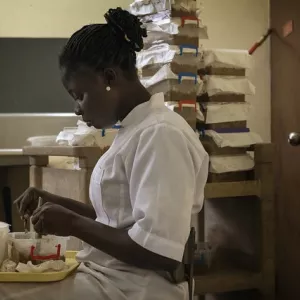
Market-Led Transformation
We identify and test innovations for transformative change in food systems. We focus on innovations in policies, institutions, and technologies that bring greater efficiency, inclusive economic benefits, resilience to shocks and environmental sustainability.
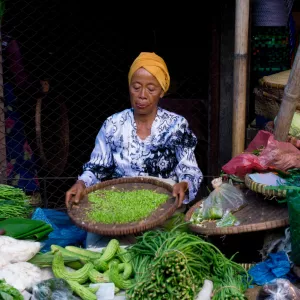
Governance and Political Economy
We will address governance and political economic challenges in strengthening food, land, and water systems amid global mega trends. We will collaborate with partners to provide advanced insights on the governance and institutions that best promote integrated food systems, the political economy of policymaking and implementation, and policy coherence and metrics.
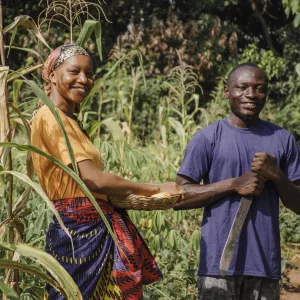
Water, Energy, Food, and Environment (WEFE) Nexus
We provide solutions for improving water productivity while tackling fragmented policy approaches that disproportionately burden the poorest and most marginalized populations. We will advance climate resilient water management and irrigation policies and share institutional capacity on water management and nexus methods.
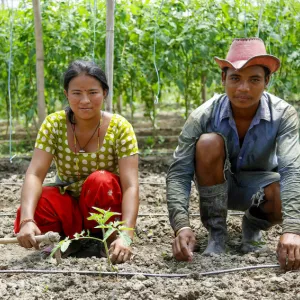
Policy Innovation Hubs & Engagement
We work closely with national governments, think tanks, and regional organizations throughout the policy cycle, from agenda setting and policy design to policy adoption, implementation and reform. We co-create knowledge products with national and regional think tanks to rapidly respond to policy demand and enhance institutional capability, and foster regional and cross-country learning.
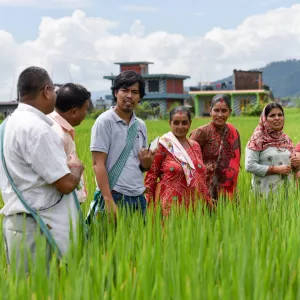
Social Policy and Employment
We are supporting governments, international organizations, and non-governmental organizations in the design and evaluation of large-scale anti-poverty and job creation policies and programs. We are particularly focusing on recommendations that improve cash transfers and graduation programs and programs that foster employment, especially for the youth.
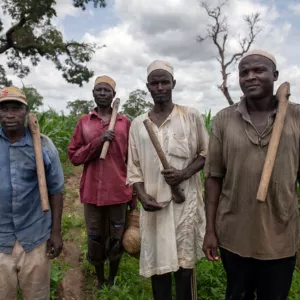
Gender Equality & Social Inclusion
This research program will ensure that women, youth and other often marginalized groups participate meaningfully in policy processes and that public policies advance progress towards gender equality, youth empowerment and social inclusion.
Our approach
Interlinked support across CGIAR’s portfolio
Our program will support the whole CGIAR 2025-30 portfolio, with specific initial collaboration with the Better Diets and Nutrition, Breeding for Tomorrow, Scaling for Impact, Sustainable Animal and Aquatic Food Systems, and Sustainable Farming programs, as well as the Digital and Gender Equality & Inclusion Accelerators.
We are working to share our capacity with an initial focus on National think tanks.
Our expertise
- Our commitment to providing food system-related public goods at multiple geographic and time scales for low- and middle-income countries
- A locally informed and embedded research staff with access to state-of-the-art analytical tools and capacity in multiple disciplines
- Our global linkage to key research and policy-making partners with complementary research and institutional capacities
Events
News
-

The evolution of an idea: 15 years of the water–energy–food–environment nexus
Experts at Stockholm World Water Week showcased how digital tools, evidence-based interventions, and innovative finance are breaking down silos to...
-

El Niño is coming and the time for Malawi to prepare is running short
Malawi faces a high El Niño risk heading into the 2026/27 growing season. Past El Niño events have reduced maize production, increased food...
-

CGIAR Policy Innovations at AFS Forum: Africa’s Food Sovereignty Strategy
At the Africa Food Systems Forum 2026 in Kigali, CGIAR Policy Innovations and AGRA convened leaders and researchers to discuss how Africa can...
-

New Delhi Marks UN Day for South-South Cooperation with Push to Scale Dryland Innovation Across the Global Sout
A major international push to accelerate agricultural innovation across the Global South took centre stage in New Delhi today, as the United Nations...