

Turning dairy farming into a business opportunity
As the world celebrates World Milk Day 2026 and recognizes the women in dairy, we’re sharing the story of Caroline, a proud mother and one of many women farmers waking up every morning to care for cows, feed families and build better futures through dairy farming.

My name is Caroline Tanui, and I live in Sachangwan village in Bomet County, in Kenya’s Rift Valley. I keep dairy cows and grow maize and sweet potatoes that help me support my family.
Today, when I look at my cows, my silage stores and the small improvements I continue making on my farm, I feel proud of how far I have come. But my dairy journey started very small. I began with just one cow.
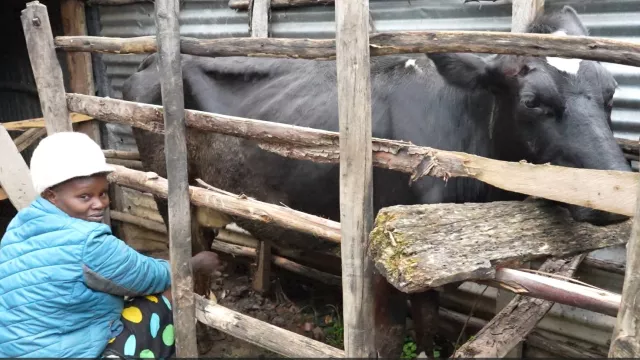
When I first started, I was inspired by another farmer from Kaplong, a neighbouring village, whom I visited several years ago. He practiced zero grazing - a farming method where livestock are kept indoors in a confined area, and their food and water brought to them.
He showed me that dairy farming was not just about keeping cows, it was also a business. That visit changed how I thought about farming.
Today I keep four cows. I have a Friesian, an Ayrshire and two local breeds that I am gradually improving through artificial insemination. Each breed serves a different purpose on my farm.
I chose the Friesian mainly for commercial purposes because it gives me more milk that I can sell. My Friesian cows produce between 15 and 20 litres of milk a day depending on feeding and the age of the calf. In the morning, I can get seven to eight litres and in the evening another five litres or more. I earn about 800 Ksh (USD 6) per day from milk sales.
My Ayrshire cow produces less milk, about five litres per day, but I value it because the milk has high butter content and good quality. This is the milk I use at home for my family.
The local breeds are also important to me. One of them is a Sahiwal breed that I bought from Maasai farmers in Narok. Even though they product less milk, the milk is thick, tasty and rich in nutrients. I continue improving these breeds through artificial insemination because I want better production in future generations.
One of my favourite cows is my Friesian called Chelingi. She has already produced three calves. She is getting older now, but I still hope to get another good calf from her through artificial insemination so that I can continue improving my herd.

Importance of proper feeding
Over the years, I have learned that successful dairy farming depends heavily on feeding and proper management. My cows are kept under zero grazing, so feed preparation is very important. I mainly use silage, dairy meal supplements, salt and wilted Napier grass.
In the mornings after milking, I give the cows dairy meal and salt before feeding them silage later in the day. I also make sure they have clean water because hygiene is very important for dairy cows. I keep the watering containers raised so the cows do not dirty the water. I also ensure other animals like chickens or dogs do not access the water because diseases can spread easily.
Income from milk is even better than selling maize
One of the biggest lessons I learned in dairy farming is that the more nutritious the feed, the more milk the cows produce. That lesson completely changed my thinking. I also learned the importance of silage making and storage. Previously, after harvesting maize from my one-and-a-half-acre farm, I used to keep dry maize stalks for feeding cows. But through learning from other farmers and trainings, I discovered that silage made when maize is still green and milky has more nutrients. Now when my maize reaches the correct stage, I harvest some for silage and leave the rest for-family consumption. The income I get from milk is even better than if I sold the maize.

I have also improved how I store silage. Some I keep in containers while others are stored in polythene bags. During a recent farmer field day organized by the International Livestock Research Institute (ILRI), I learned that silage containers should be stored upside down to prevent air from entering and spoiling the silage. That is one of the changes I will now implement on my farm.
At the farmer field day I learned a lot from other farmers who were teaching us about their practices. I learned about high protein fodder crops like lucerne and desmodium. I also learned how to improve Napier grass silage using molasses, a by product of sugar production, and how to better harvest and process silage, and how to make better use of paddocks, even though I currently don’t have any. ILRI has been working with farmers in Bomet County for several years to better understand their solutions for feed management, and to make sure other farmers can learn from the pioneer farmers. The knowledge reaches us through field days organised and held by pioneer farmers.
I also connected with people providing artificial insemination services, savings and credit groups and livestock management. These interactions are very important because they help us farmers continue improving.
Nothing goes to waste
For me, dairy farming is connected to every part of my farm. I use cow waste in a biogas system that I use for cooking at home. After producing gas, the waste becomes good manure for crops.
My family plays a very important role in supporting my dairy work. My children help clean the cowshed and carry silage to storage areas. Dairy farming is not something I do alone.
Even during difficult times, dairy farming helps us survive. During droughts, my silage stores help me continue feeding my cows. Sometimes I even buy maize from other farmers and convert it into silage.
I still believe there is room for improvement. Every training I attend gives me new knowledge. Every farmer I meet teaches me something new.
Related content
https://hdl.handle.net/10568/172408
Acknowledgement
This activity has been supported by the HABITAT project and the CGIAR Sustainable Animal and Aquatic Foods Science Program (SAAF). The HABITAT project is funded by the Global Centre on Biodiversity for Climate (GCBC). GCBC is a UK Official Development Assistance (ODA) programme that aims to support developing countries to shape decision-making and develop policies that better value, protect, restore and sustainably manage biodiversity in ways that tackle climate change resilience and poverty alleviation. The CGIAR Sustainable Animal and Aquatic Foods Science Programme (SAAF) is supported by contributors to the CGIAR Trust Fund. CGIAR is a global research partnership for a food-secure future dedicated to transforming food, land, and water systems in a climate crisis.