Scaling Week Day 3: Impatient for scaling - Who pays, and what happens next?

The final day of CGIAR Scaling Week 2026 asked a direct question: “So what now?” Across the closing discussions, the answer began with a changing map of finance, and ended with the people and systems needed to turn promising innovations into lasting use.
Read all the daily recaps at CGIAR Scaling for Impact

“Nostalgia is not a strategy.” The title of Thursday’s Who pays for scale now? session set the terms for a conversation that a week devoted to scaling could not avoid. Aid budgets are under pressure. Governments face difficult choices between urgent humanitarian needs and longer term development. Investment, trade, philanthropy and partnerships are taking a larger place alongside grants. If the sources of money are changing, how should the work of scaling change with them?
The discussion offered no neat replacement for the old funding model. Development banks can bring finance at a scale that grants cannot, but they need credible delivery plans, partners and evidence of risk and returns. Private businesses need a viable reason to stay involved. Governments can carry innovations into public systems, but have their own priorities and budget cycles. Philanthropic funding can help unlock a market or test an approach; it cannot support every promising idea indefinitely.
That makes prioritisation unavoidable. Evelyn Maris, Deputy Head of Mission and Head of Cooperation at the Department of Foreign Affairs, Ireland, described the difficulty of maintaining humanitarian commitments as needs rise and budgets tighten. Speaking alongside H.E. Tom Neijens, Ambassador of Belgium to Kenya, Evelyn said funding spread across too many small activities can also make it harder to demonstrate impact. From the audience, a foundation representative made a related point: even substantial philanthropic resources require choices about which innovations to back, which partners can help take them further, and what will sustain them after the initial support ends.
The sharpest tension concerned time. A participant asked how research that may take seven, ten or fifteen years to mature can survive a political climate impatient for visible results. A response from the panel was to show where science has already built the knowledge and relationships that a new investment can use, while assembling evidence, proof of concept and partners around emerging work. That still leaves a hard question for funders and researchers alike: who supports the earlier stages before an innovation is ready for investment?
The conversation also widened the meaning of partnership. One audience member asked that civil society and rural communities have a place in the new financing picture. Another raised the particular pressures facing fragile and conflict affected settings. A new map of funders will achieve little if it overlooks the organisations that reach people, or the places where commercial returns are hardest to establish.

What the rooms added
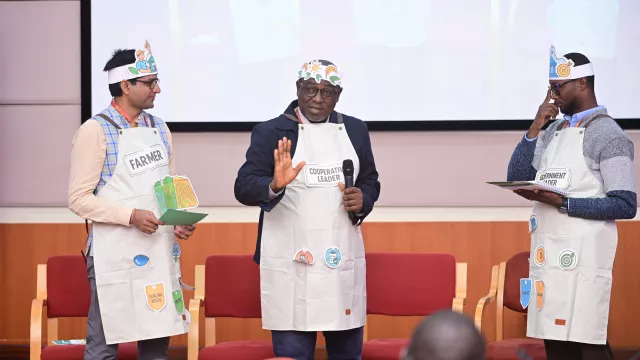
The morning’s Open Space sessions made those financing questions concrete. In Market-led scaling through demand-led seed systems, participants described breeding beans for what consumers and traders actually want, then connecting seed producers, food processors and farmers along regional market corridors. The session’s lesson was that adoption can move faster when a new variety has both a route to farmers and a buyer for what they grow.
In Feet on the ground, the focus moved to the people who make that route work. Village-Based Advisors can demonstrate practices, connect farmers with inputs and markets, and provide support after an initial introduction. Participants argued that these trusted local roles need training, recognition and a way to earn a living if they are to endure beyond a project.
A session on rice innovations across Asia and Africa reached a similar conclusion from another direction. Participants saw value in exchanging experience across regions, while cautioning against copying a model without understanding its setting. Seed, agronomic advice, mechanisation and markets have to function together. Private companies may help provide an affordable service within that system, even when they are not its principal funder.
Other rooms asked whose needs shape the system in the first place. From frameworks to farms challenged teams to involve women with different circumstances in decisions, test their assumptions about access and household roles, and anticipate unintended harm before expanding an intervention. In a session for future impact scalers, participants returned to trust: building a digital service and getting farmers to keep using it are different tasks. People often engage through extension agents and others they already know.
There was work on the infrastructure for learning, too. Participants tested an early scaling training repository and asked for better language and cost filters, offline access and quality checks. A discussion on connected scaling hubs called for more visible links between regions, stronger involvement from national institutions and universities, and spaces where partners can share failures as well as successes.
Taken together with the rest of the week, these sessions complicated any simple promise to “reach more farmers.” The closing synthesis pointed to innovations that worked technically but stalled because nobody could repair the equipment, supply a missing input, buy the resulting produce or continue a service after delivery. It asked participants to look beyond an initial count of people reached: who tries an innovation, who continues using it, who benefits, and what survives when a project ends?
Day One asked people to make their needs known. Day Two examined how they respond when scaling proves difficult. Day Three brought those conversations to a decision point. The question is no longer only whether an innovation works. It is ready for whom, what will each partner put on the table, and who will carry the work when the project leaves?
Those questions remain open. They are also a practical place to start on Monday morning.