

Promoting gender-inclusive, farmer-centric precision nutrient management
The workshop highlighted practical strategies for creating an enabling environment that supports women and marginalized farmers in accessing and adopting precision nutrient management within Vietnam’s One Million Hectares Program.

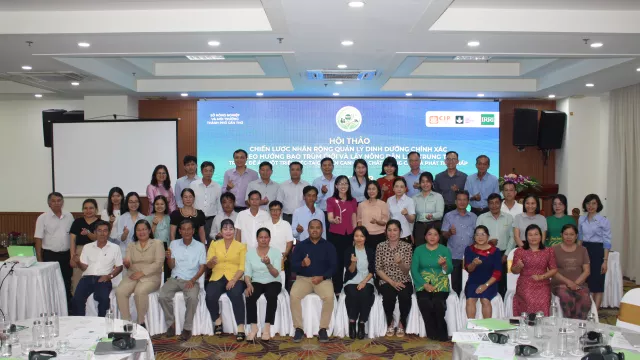
CAN THO, VIETNAM (August 19, 2026) — Vietnam’s One Million Hectares of High-Quality and Low-Emission Rice (1Mha) Program is taking an important step toward greater equity in farming communities by expanding inclusive access to precision nutrient management (PNM) innovations. The International Rice Research Institute (IRRI) and the International Potato Center (CIP), in cooperation with the Can Tho Department of Agriculture and Environment, organized a workshop on “Gender-Inclusive, Farmer-Centered Strategies for Scaling Precision Nutrient Management in the 1Mha Program.”
The workshop brought together farmers, cooperatives, government officials, extension workers, women’s organizations, researchers, and private-sector representatives to develop practical, context-specific strategies for the inclusive scaling of PNM. Discussions emphasized the importance of creating an enabling environment for underrepresented groups, such as women and smallholder farmers, to participate in training and apply PNM in their fields.
During the panel discussion, Mr. Truong Huu Tri, Head of Go Gon Cooperative in Tay Ninh Province, emphasized that women’s participation in cooperatives is not only about gender equality but also about improving productivity. Women bring diverse perspectives, strong listening skills, and valuable connections among members. “The initiative is not to replace men; it is to bring different strengths together and add value to rice production.”
Drawing on field-level findings collected during a workshop with women and men farmers, participants explored how PNM interventions could respond more effectively to farmers’ differing roles, concerns, and circumstances. They were divided into four stakeholder groups, such as retailers, companies, and traders; farmers and cooperatives; commune-level extension workers and Women’s Union representatives; and officials from Departments of Agriculture and Environment, to develop practical strategies for scaling gender-inclusive and farmer-centric PNM.

The group discussions found that women, young people, people with disabilities, farmers with limited land and resources, low-income households, and geographically isolated communities are frequently overlooked in agricultural training and support programs. Women face additional barriers because training is often oriented toward men, schedules conflict with their farming and household responsibilities, and their financial and unpaid contributions are not always fully recognized.
Participants recommended setting clear targets for women’s and marginalized groups’ participation, identifying why certain groups are excluded, and tailoring invitations, schedules, training content, and communication channels to their circumstances. Women’s Unions proposed integrating PNM training into their regular activities, offering training designed for women and providing opportunities to apply their knowledge in practice. In this way, women can build confidence and positively influence household decisions.

Female participants from cooperatives stressed that men’s support and understanding are essential for women to attend training and participate in field visits, as women often need to consider their household responsibilities when spending time away from home. Participants also referenced existing agricultural policies on gender and social inclusion, such as those that facilitate women-led start-up businesses and support women-led activities. Provincial officers also proposed policy incentives, such as prioritizing women-led cooperatives for funding.
Reflecting on the way forward, Ms. Huynh Kim Dinh, Deputy Director of the National Agricultural Extension Center at the Ministry of Agriculture and Environment, reaffirmed the center’s commitment to embedding farmer-centric and gender-inclusive principles in its nationwide programs. This includes identifying and addressing the specific barriers faced by women and marginalized farming groups and strengthening tailored advisory services, field demonstrations, and inclusive technology-transfer models.

Dr. Nozomi Kawarazuka, a scientist and gender expert from CIP, highlighted that the challenges of PNM dissemination and adoption are not only technical. Creating an enabling environment for women farmers, who can bring additional value to approaches and decisions, is equally important.
The post-workshop survey showed that 93% of participants agreed or strongly agreed that gender-inclusive scaling can improve the overall adoption of PNM. All respondents confirmed that they recognized their roles and had plans to take action toward inclusive PNM scaling in their work.
By placing the experiences, knowledge, and voices of diverse farmers at the center of innovation, PNM can achieve broader and more sustainable adoption. More importantly, an inclusive approach can help ensure that Vietnam’s transition toward high-quality, low-emission rice production creates meaningful opportunities for women, men, and farming communities that have traditionally been left behind.

This work is part of the CGIAR Scaling for Impact Project and the TaiwanICDF-supported Capacity Building for Sustainable and Low-Carbon Rice Innovations in Southeast Asia (CABIN) Project.