

Dutch partners rethink how agricultural innovation delivers impact
At World Food Day in The Hague, CGIAR and partners explored how to finance lasting scale, what research investment delivers, and why responsible design determines who benefits.

An innovation can reach a million farmers and still change very little. A message received is not necessarily advice acted upon. A successful demonstration does not guarantee a viable business. And a promising pilot can stall when project funding ends.
Across three sessions at World Food Day on 20 October, Dutch and international partners joined CGIAR to examine how agricultural innovations achieve lasting scale, what investment in research delivers, and who benefits.
The event, hosted by The Netherlands Food Partnership, connected practical questions about adoption and inclusion with a changing European investment landscape. With Global Gateway part of that conversation, participants considered how research partnerships can deliver lasting benefits for farmers while generating wider economic and scientific value.

Designing for continued use
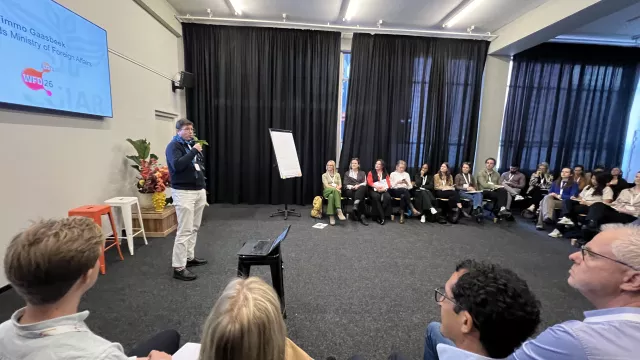
Opening the session, Timmo Gaasbeek of the Netherlands Ministry of Foreign Affairs framed the case for engaging with CGIAR’s scaling work around a practical challenge: making innovations fit farmers’ constraints on land, labour and finance.
For Evan Girvetz, a principal scientist at the Alliance of Bioversity International and CIAT, scaling means getting validated innovations into continued use, supported by actors who can sustain their delivery.
That requires understanding incentives throughout a system. An innovation may increase farm income, but suppliers, service providers and public agencies also need the resources and motivation to keep delivering it.
Girvetz outlined how CGIAR’s Scaling for Impact Program applies this thinking through 19 Solution Tracks. These connect innovations with specific demands, places and partners, identifying the barriers preventing wider uptake. Investment decisions follow evidence, including adapting approaches or redirecting resources when prospects for scale remain weak.
In Nepal’s western Terai, a US$5.25 million maize buyback agreement backed by bank credit connects farmer cooperatives to a private buyer. Drying and grading infrastructure helps supply maize that meets buyers’ requirements, while the purchasing agreement provides a basis for financing.
Yet machinery and irrigation remain constraints. Further progress depends on cooperatives joining without continued facilitation by CIMMYT.
Kenya’s digital climate advisory initiative illustrates a different arrangement. The Kenya Meteorological Department owns the forecasts, counties support extension, and delivery partners translate information into services farmers can use. CGIAR helps connect the system, while Kenyan institutions and businesses carry responsibility for delivery.

Financing scale through partnerships
Participants’ experiences reinforced the importance of understanding markets early. One described commercial considerations arriving too late in a project. Another explained how employment training and matchmaking created value, but businesses were unwilling to pay the fees intended to sustain the service.
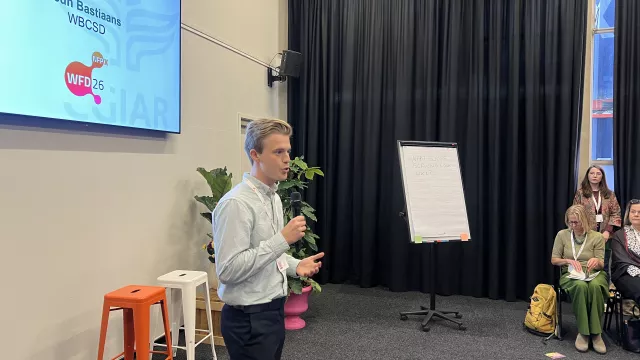
Teun Bastiaans of the World Business Council for Sustainable Development emphasised measurable outcomes, appropriate investment structures and farmers’ interests. Senni Alho of Clim-Eat highlighted how a partnership’s purpose—and the barrier it seeks to remove—should determine who participates.
Nicolaas van der Wilk of CGIAR connected these challenges to the evolving financing landscape, including Global Gateway. Which parts of scaling require public grants? Which could draw on commercial finance, development banks or companies’ investment?
He also highlighted tensions around where benefits accrue: to European companies, local enterprises or farmers. Who convenes a partnership helps shape its agenda and potentially the distribution of benefits.
Closing reflections from Janet Lawson of the Gates Foundation reinforced the importance of prioritisation, understanding the whole system and evaluating whether reaching farmers translates into stronger benefits.

The returns from agricultural research
The second session, “It’s Not Just About the Money”, examined how international agricultural research benefits the Netherlands alongside its contribution to development overseas.
Rui Benefica of IFPRI and Nina Mennies of Wageningen University & Research presented emerging findings from an assessment commissioned through the NL–CGIAR Strategic Partnership, facilitated by the Netherlands Food Partnership.
The draft study estimates that CGIAR-driven income growth in low- and middle-income countries generates €778 million in additional Dutch exports annually. It also estimates that CGIAR-derived wheat varieties contribute €12.2 million annually to Dutch wheat production, while improvements in global food supply reduce the cost of a healthy diet in the Netherlands by 1.2%.
Mennies highlighted benefits that monetary estimates cannot fully capture, including shared knowledge, researcher development, international networks and policy influence. Scaling Readiness, developed through WUR–CGIAR collaboration and subsequently adopted across CGIAR, illustrates how that exchange strengthens scaling practice.
The findings, still undergoing validation, showed how research investment can support development abroad while generating value at home.

Responsibility begins before scale
The afternoon session, convened with TU Delft and the International Institute of Social Studies’ International Center for Frugal Innovation, examined how early design choices shape those benefits.
Mar Palmeros Parada explored emerging protein technologies. Potential environmental benefits sit alongside questions about energy requirements, cultural acceptance, ownership and how value will be distributed.
Oane Visser shared research on digital platforms for smallholders in Ghana and Kenya. Subscription figures could conceal limited use, while assumptions about farmers’ capabilities sometimes misdiagnosed the problem. Farmers wanted relevant information and opportunities to ask questions.
CGIAR’s Marc Schut illustrated how design can exclude intended users. Solar irrigation may remain inaccessible to poorer farmers without suitable financing. Digital water-management tools requiring continuous connectivity can fail where internet access is unreliable or unaffordable.
Participants stressed early testing with users, understanding local contexts and adapting when evidence challenges established approaches.
In closing, Timmo Gaasbeek of the Netherlands Ministry of Foreign Affairs urged partners to examine whose problems an innovation addresses. Higher yields alone do not establish value if additional costs leave a household worse off. Innovations must fit constraints on land, labour and money.
Together, the sessions offered an agenda for Dutch and European collaboration with CGIAR: understand users, identify the binding constraint, involve delivery partners early and establish who carries the work forward. Lasting impact depends on credible financing and deliberate choices about who benefits.
