

Decades of collaboration advances breeding efforts in high-yielding aflatoxin-resistant maize
The collaboration between IITA’s Maize Improvement Program, Pathology and Mycotoxin/Aflasafe Unit, and the University of Ibadan
- breeding
- smallholder farmers
- Products
- breeding for tomorrow
- Aflatoxin
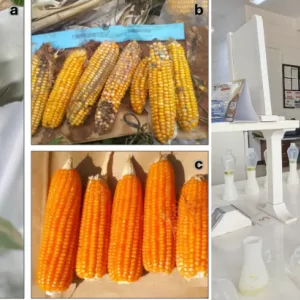
Cover Image: Field and laboratory evaluation of maize genotypes for resistance to aflatoxin accumulation. (a) Field inoculation of maize ears with a highly toxigenic Aspergillus flavus isolate; (b) susceptible genotype showing severe ear rot approximately one month after inoculation; (c) resistant genotype showing no visible ear rot at the same time point despite inoculation; and (d) extraction of aflatoxins from maize samples in the IITA Pathology and Mycotoxin Laboratory prior to quantification by thin-layer chromatography coupled with scanning densitometry.
The collaboration between IITA’s Maize Improvement Program, Pathology and Mycotoxin/Aflasafe Unit, and the University of Ibadan has generated new evidence that resistance to aflatoxins can be combined with productivity and agronomic stability—bringing host-plant resistance closer to becoming a practical component of integrated aflatoxin mitigation.
Aflatoxins, produced primarily by the fungus Aspergillus flavus, are a major food safety challenge across the tropics and subtropics. Although breeding for resistance has been pursued for decades, developing high-yielding maize that consistently limits aflatoxin contamination has remained elusive.