

CGIAR Policy Innovations at AFS Forum: Africa’s Food Sovereignty Strategy
At the Africa Food Systems Forum 2026 in Kigali, CGIAR Policy Innovations and AGRA convened leaders and researchers to discuss how Africa can overcome climate and geopolitical crises by asserting strategic agency over its agricultural future.
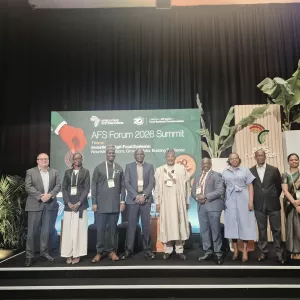
The global food system stands at a critical juncture, caught between compounding climate shocks, geopolitical turmoil, and changing trade dynamics. Against this backdrop, leaders, policymakers, and researchers invited by CGIAR Policy Innovations Science Program and AGRA gathered at the Africa Food Systems Forum 2026 in Kigali, Rwanda on 1 September to confront a defining question: How can Africa move beyond reactive crisis response and exercise true strategic agency over its agricultural future? Below is a synthesis of the key insights, debates, and commitments from this session.
Main Highlights
In her opening remarks, Dr Sandra Milach, Chief Scientist at CGIAR, framed the global landscape as one threatened by conflict and climate change. Food sovereignty is not about every country producing everything; rather, it is a combination of domestic production plus international trade. Foresight analysis can help governments so avoid future crises. Africa has diverse agro ecologies that support both domestic production of most of its food and international/continental trade. However, Africa spends $75 billion annually on food imports, a figure projected to rise to $120 billion by 2050. Strategic agency cannot be imported, and CGIAR should provide the necessary support to Africa to ensure food sovereignty and create better capacity to reduce vulnerability to future shocks. Science, policy, and partnership must come together so Africa can better withstand disruptions.
Keynote speaker James Thurlow, Lead for Foresight and Policy Modeling Area of Work at CGIAR Policy Innovations, highlighted that undernourishment in Africa is not caused by insufficient production, but by poor distribution. This gap runs from the continental level down to the household level, compounded by huge post-harvest loss and food waste. African agriculture must grow at 6% to address the existing undernourishment. Furthermore, Africans lack healthy diets due to low incomes and under-production of fruits and vegetables. Trade provides diverse, cheaper options, but dependency on external sources predisposes countries to shocks. Food self-sufficiency is not a sustainable option. On the other hand, because growth in domestic food processing yields higher returns than primary production alone, policy debates must shift toward processing and selective protection without introducing inefficiencies.
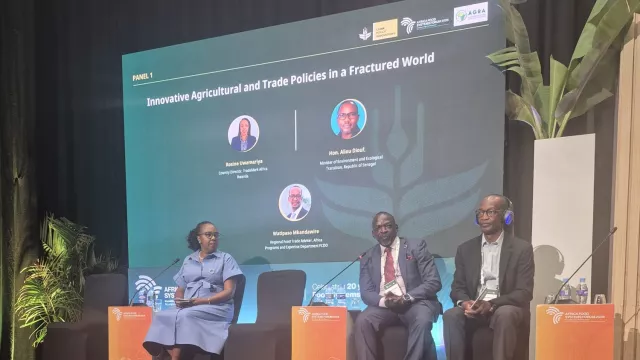
Panel one
Addressing Innovative Agricultural and Trade Policies in a Fractured World, panelists noted that imported cereals could be produced and processed within Africa. The African Continental Free Trade Area (AfCFTA) connects 55 African Union member countries into a single market, creating immense opportunities for intra-Africa food trade. Speaker Watipaso Mkandawire, Regional Food Trade Adviser, Africa Directorate at FCDO, observed that blanket rice self-sufficiency policies ignore agro-ecological challenges, undermining competitiveness and basic trade concepts. While self-sufficiency relies strictly on local soil and labor, food security focuses on whether people can access safe, nutritious food at all times regardless of origin. AfCFTA acts as a vital framework to eliminate regional trade barriers and tariffs.
Speaker Rosine Uwamariya, Country Director, Rwanda at Trademark Africa, outlined three focus areas for facilitating regional trade: corridors, infrastructure, and standards. Implementing a cargo tracking system cut food corridor costs by 50%, while one-stop border posts significantly reduced border waiting times and costs. Harmonizing regional standards prevents them from acting as trade barriers. Because detaching Africa from global trade is impossible, countries must work together to simplify trade processes and lower cross-border tariffs.
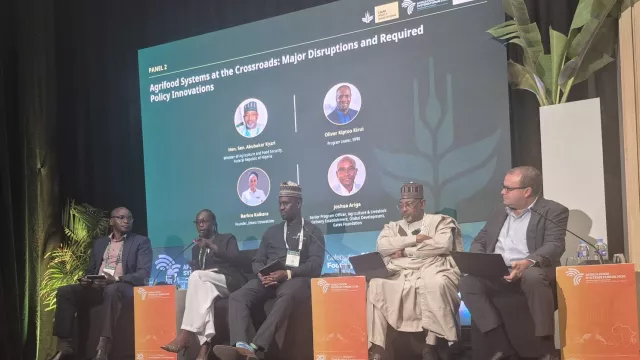
Panel 2
Moderated by James Thurlow, the second panel addressed Agrifood Systems at the Crossroads: Major Disruptions and Required Policy Innovations. Hon. Sen. Abubakar Kyari, Minister of Agriculture and Food Security of the Federal Republic of Nigeria, detailed compounding disruptions in Nigeria, including the 2022 floods, COVID-19, the Russia-Ukraine war, and a Central Bank currency redesign during harvest season. The resulting cash shortage because of the currency redesign at the major crop harvest time led to severe production losses, prompting government interventions such as distributing over USD 134 million in fertilizer and renaming the ministry to reflect multisectoral food security. These steps increased crop production, reduced crop prices threefold, and lowered grain imports, while Nigeria channeled its growing youth population into agribusiness to support a 4.5% annual economic growth rate.
Speaker Oliver Kiptoo Kirui, Program Leader at IFPRI, stressed that CGIAR is shifting toward responsive, policy-oriented research, scenario and foresight analysis. We must move beyond generating evidence and supporting policy formulation to active policy implementation on the ground, he added. Speaker Barbra Kaikara, Founder of Imaro Innovations, called for increased access to finance, market certification support, and direct inclusion of business leaders in policy creation. Speaker Joshua Ariga, Senior Program Officer, Agriculture & Livestock Delivery Enablement, Global Development, at the Gates Foundation, added that policy success is measured by real-world implementation rather than published documents. Sustainable success requires building capacity in foresight, creating AI-driven decision-support tools for ministers, and securing long-term government commitment.
Key Challenges
The session highlighted multiple systemic shocks including conflict, climate change, floods, and cash shortages that disrupt agrifood markets. Severe undernourishment persists across the continent primarily due to poor food distribution networks, significant post-harvest losses, and critical dietary deficits in fruit and vegetable production rather than aggregate supply failures. High import dependence, with Africa spending $75 billion annually on food imports, leaves nations vulnerable to global shocks while blanket self-sufficiency targets fail to match local agro-ecological realities. High tariffs, weak transportation infrastructure, and cumbersome administrative procedures continue to restrict intra-regional trade under AfCFTA. Additionally, agribusiness startups face severe hurdles acquiring costly certifications and accessing capital, while an evidence-to-policy gap persists when research fails to translate into direct implementation on the ground.
Innovations Proposed
To counter these disruptions, participants proposed scaling foresight analysis and scenario modeling to assist governments in anticipating future crises. Fully leveraging the AfCFTA across all 55 member states offers a single market framework to expand regional trade. Practical trade innovations already in motion include cargo tracking systems that cut transport corridor costs by 50% and one-stop border posts that reduce cross-border delay. Further proposals emphasize the harmonization of regional trade standards, the deployment of AI-enabled decision-support tools directly to sector ministers, and the strategic implementation of selective protection policies tailored to boost domestic food processing.
Recommendations
Stakeholders recommended strengthening evidence-based policymaking by delivering timely, responsive research and scenario modeling directly to decision-makers. Institutional focus must shift away from publishing and shelving policy documents toward driving transformation and implementation on the ground. Rather than pursuing blanket self-sufficiency, countries should promote regional specialization based on comparative agroecological advantages linked through AfCFTA trade networks. Governments need to invest in efficient trade corridors by reducing tariffs, simplifying procedures, and expanding border infrastructure. To foster value addition, policies must support domestic agribusinesses with finance, market access, and certification assistance while maintaining globally credible standards. Finally, donor funding must focus on building sustainable national policy capacity and foresight capabilities fully owned by national governments.