

AICCRA and Livestock and Climate support participatory rangeland management scaling opportunities discussed at Africa Agricultural Ministerial Conference 2023
AICCRA (Accelerating Impacts of CGIAR Climate Research for Africa) and the CGIAR Research Initiative on Livestock and Climate are working together to strengthen participatory rangeland management (PRM) as a key innovation to build the capacities of communities to better manage, govern, secure and restore their lands. With five sites in Kenya, three sites in Ethiopia and four sites in Tanzania.

AICCRA and Livestock and Climate support participatory rangeland management scaling opportunities discussed at Africa Agricultural Ministerial Conference 2023
AICCRA (Accelerating Impacts of CGIAR Climate Research for Africa) and the CGIAR Research Initiative on Livestock and Climate are working together to strengthen participatory rangeland management (PRM) as a key innovation to build the capacities of communities to better manage, govern, secure and restore their lands. With five sites in Kenya, three sites in Ethiopia and four sites in Tanzania. ILRI with local partners RECONCILE (Resources Conflict Institute), Kenya and KINNAPA Development Programme, Tanzania, key lessons on improving implementation and opportunities for spillover into neighboring countries are being generated. The Africa Agriculture Ministerial Conference held in Kampala, Uganda on May 17 2023 was a key opportunity for sharing these lessons.
Irene Aloo Mukalo, Head of Programs at RECONCILE, presented these PRM lessons to the attendant ministers and other stakeholders. Mukalo emphasized, ‘PRM serves as both a methodology and a procedural approach that allows communities and governments to acknowledge the profound impact of factors such as land subdivision, population growth, climate change, droughts, land degradation, and unsustainable land-use practices on rangeland productivity. The PRM process has demonstrated its effectiveness in enhancing community engagement, awareness, and participation in rangeland conservation and sustainability.’
PRM, a core innovation of the Livestock and Climate Initiative guides communities in developing and implementing rangeland management plans, employing a climate-smart approach that blends local knowledge with scientific methodologies to combat degradation and preserve rangeland resources.
Originally formulated in Ethiopia, PRM has undergone piloting in Kenya and Tanzania with notable progress, yielding local and national guidelines, capacity-building of communities, civil society organizations, and government entities, and improved productivity of 337,015 hectares of rangelands. Women’s participation in rangeland management decision making processes has increased, reinforcing commitment to inclusivity and sustainable resource use.
Presentation of lessons learned at the Africa Agricultural Ministerial Conference provided an opportunity to share these experiences and results, garner support from key potential partners and encourage the uptake of the approach in other countries.
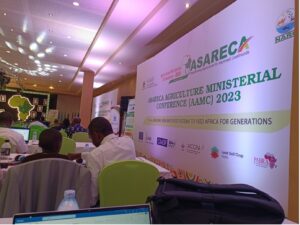
Header image: Ministers and supporting stakeholders gathered in Uganda to discuss the building of resilience food systems to feed Africa. Photo by I.Mukalo/RECONCILE.