

Advancing gender-inclusive precision nutrient management in Vietnam's rice–shrimp systems
In Vietnam, CGIAR and partners are strengthening farmer-centered approaches to precision nutrient management, ensuring that women and ethnic minority farmers have a stronger voice in shaping sustainable agricultural practices.

Ca Mau, Vietnam, 19 October 2026 — Scaling agricultural innovations requires more than introducing improved technologies. It also means understanding farmers' needs, recognizing the roles of women and men in agricultural production, and ensuring equitable opportunities to access knowledge and resources.
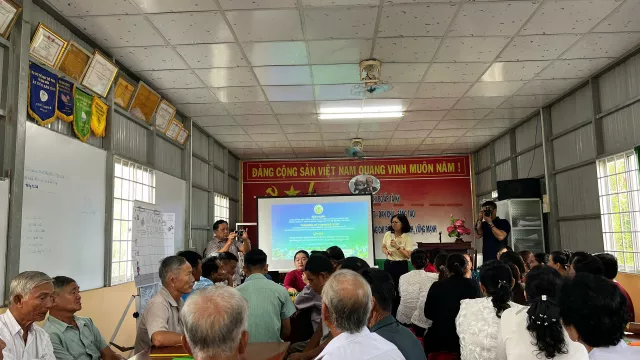
This principle was at the heart of a training workshop on Integrating Gender-Inclusive and Farmer-Centered Approaches into Precision Nutrient Management (PNM) in Rice–Shrimp Farming Systems, held on 19 October in Hong Dan Commune, Ca Mau Province.
Organized by the International Rice Research Institute (IRRI) and the International Potato Center (CIP), in collaboration with the Ca Mau Department of Agriculture and Environment and the Vietnam Rice Sector Association (VIETRISA), the activity brought together farmers from Hoa Phat and 14/10 cooperatives, including women and members of the Khmer ethnic community.
Supported by CGIAR's Scaling for Impact (S4I) Program, the workshop contributes to Vietnam's initiative to sustainably develop one million hectares of high-quality, low-emission rice by 2030.
Understanding farmers' realities to improve nutrient management
Ca Mau's rice–shrimp farming systems present unique challenges related to soil and water conditions, nutrient management, seasonal variability, and household resources.
PNM promotes efficient fertilizer use by applying the right nutrients, at the right rates, at the right time, and in the right place and via the application of mechanized direct seeded rice combined with fertilizer deep placement (mDSR-FDP) technology. These practices can help farmers optimize fertilizer use, reduce production costs, and minimize environmental impacts.
However, successful adoption depends on more than technical recommendations. Access to information, financial resources, labor availability, and household decision-making arrangements influence whether improved practices can be implemented and sustained.
Recognizing these realities, the workshop emphasized tailoring PNM approaches to farmers' needs and production conditions.

Giving women and Khmer farmers a stronger voice
A central feature of the training was its participatory approach, designed to provide opportunities for different groups of farmers to share their experiences.
Participants included Khmer people, an ethnic minority group in Vietnam. The participants were organized into four discussion groups: Kinh men, Kinh women, Khmer men, and Khmer women. They discussed farming responsibilities, access to agricultural information, household decision-making, and challenges in adopting new technologies.
Dr. Nozomi Kawarazuka, Gender Specialist at CIP, emphasized the importance of understanding farmers' perceptions, gender roles, and cultural practices when designing agricultural interventions. These insights can help determine whom to engage and how technical recommendations can be communicated effectively.

Ms. Le Kieu Hieu, representing Ca Mau's Sub-Department of Crop Production and Plant Protection, highlighted that listening to women, Khmer farmers, and households with different circumstances can help local authorities adapt agricultural extension services to their specific needs.
Meanwhile, Ms. Nguyen Thi Kieu, Head of VIETRISA's Division for Social Affairs and Women in Green Agriculture, emphasized that gender equality involves improving women's access to information, strengthening their technical skills, and ensuring they have a greater voice in agricultural production decisions.
These perspectives reinforced that farmer-centered extension is not simply about delivering information but also about listening to farmers and identifying practical solutions together.
Celebrating Vietnamese Women's Day: Recognizing women's contributions
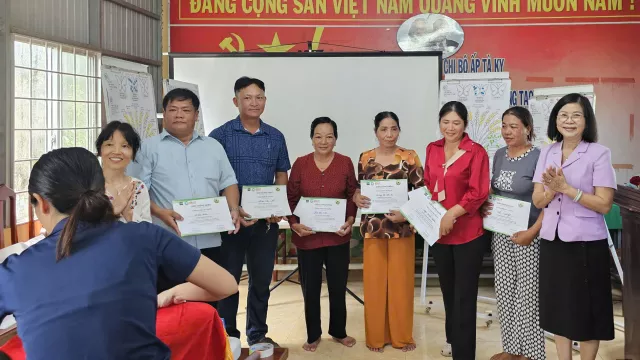
The workshop also celebrated Vietnamese Women's Day, observed annually on 20 October, recognizing women's invaluable contributions to agriculture, families, communities, and society.
In a meaningful gesture, male farmers presented flowers to female participants, expressing gratitude for their dedication and contributions to agricultural production and community life.
The celebration reinforced an important message: women are not merely supporting actors in agriculture. They are farmers, decision-makers, innovators, and leaders whose contributions are essential to resilient rural communities.
The symbolic exchange of flowers reflected the workshop's broader commitment to gender equality, emphasizing that recognizing women's contributions must go hand in hand with strengthening their participation and opportunities in agriculture and society.

Creating an enabling environment for inclusive scaling
As Vietnam advances its One Million Hectares of High-Quality, Low-Emission Rice Program, the challenge is ensuring that agricultural innovations are accessible, relevant, and beneficial to diverse farming communities.
Ms. Dinh Thi Kim Dung, Head of Partnerships and Engagement of the IRRI Vietnam Office, emphasized moving beyond conventional, one-way agricultural extension toward collaborative approaches where farmers actively identify needs, test solutions, and provide feedback.
The experiences gathered during the workshop will help IRRI, CIP, and their partners refine training materials, communication approaches, and farmer-support mechanisms to better respond to different farming groups.
By integrating gender-inclusive and farmer-centered approaches into PNM, CGIAR and its partners are helping bridge the gap between research innovations and their practical application.
The Ca Mau experience reinforces a key lesson for scaling agricultural innovation: sustainable transformation is not only about what technologies are scaled, but also about who participates, who benefits, and whose voices are heard along the way.

This activity was supported by CGIAR's Scaling for Impact (S4I) Program and Sustainable Farming (SF) Program as well as Taiwan-ICDF Capacity Building for Sustainable and Low-Carbon Rice Innovations in Southeast Asia (CABIN) Project.