

International Network of Multifunctional Living Landscapes Network (INALL)

The CGIAR Multifunctional Landscapes (MFL) Science Program works with partners to address interconnected challenges across food, land, water and ecosystems. Its work takes place in Multifunctional Living Landscapes, where research, policy, investment and local action come together to respond to local priorities. The network connects these landscapes, supporting shared learning and collaboration among the people and institutions working within them.
While implementation begins at the plot and farm level—where producers make daily management decisions—these actions are designed to contribute to landscape-scale transformation, where ecological processes, governance, markets, and social dynamics interact. By linking local action with landscape-level change, the Program supports resilient food systems, healthy ecosystems, and sustainable livelihoods.
Multifunctional Living Landscapes
The MFL Science Program works through Multifunctional Living Landscapes—dynamic socio-ecological systems where land, water, biodiversity, food production, and livelihoods are managed together to deliver multiple environmental, social, and economic outcomes. These are operational landscapes where research, policy, investment, and local action intersect.
Multifunctional Living Landscapes are place-based territories for integrated landscape transformation that are:
- Integrated: Connecting agriculture, ecosystems, and livelihoods across scales.
- Inclusive: Bringing together farmers, Indigenous Peoples, local communities, governments, researchers, and the private sector through collaborative governance.
- Investment-ready: Aligning public and private finance to support long-term landscape transitions.
- Evidence-based: Using monitoring, learning, and adaptive management to guide decision-making and demonstrate impact.
Within the Multifunctional Living Landscapes, CGIAR researchers work with partners to:
- co-design context-specific solution bundles across production, restoration, and conservation activities,
- align land, water, food, and ecosystem management,
- improve landscape governance and institutional arrangements,
- Engage in policy processes and developing enabling environment,
- Strengthen agency and inclusive participation (GEYSI),
- mobilize and align finance mechanisms,
- generate evidence for scaling and transfer across similar systems.
Through this approach, Multifunctional Living Landscapes provide scalable solutions that reconcile ecological integrity with human development while contributing to national and global sustainability commitments.
Illustration 1: Flagship Living Landscapes are in Colombia, Peru, Tunisia, Ethiopia, Kenya, India. Strategic Living Landscapes are in Senegal, Côte d’Ivoire, Zimbabwe, and Laos-Cambodia-Vietnam.
In the MFL Science Program, we differentiate two types of Multifunctional Living Landscapes:
- Flagship Living Landscapes: These are the Program's primary investment platforms, where integrated research is implemented across multiple Areas of Work (AoWs) to generate transformative outcomes.
- Strategic Living Landscapes: Strategic Living Landscapes provide opportunities to test innovations, strengthen partnerships, and expand the portfolio into emerging priority regions. Investments are guided by scientific priorities, partnerships, and available resources.
International Multifunctional Living Landscapes Network
The International Network of Multifunctional Living Landscapes Network (IMLLN) connects the Living Landscapes in the 12 countries where the Science Program operates for co-learning, exchange, and knowledge co-creation activities (see map) - and similar institutional vehicles and initiatives from around the world.
The aim is for the diverse stakeholders engaged in the Living Landscapes to share and co-create knowledge, skills, and experiences that can be mobilized to support the transition to multifunctional landscapes.
The Science Program facilitates this community of reflection and action to increase peer-to-peer learning and co-development of knowledge among Living Landscape stakeholders. It fosters sharing, co-learning, capacity building, and collective action with and among research and development practitioners of selected international networks and initiatives on Agroecology.
From Vision to Action
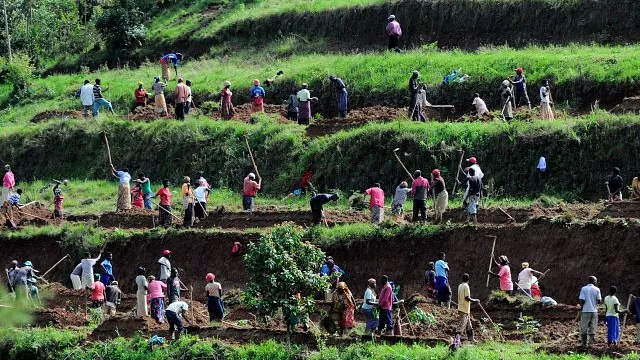
The Program engages stakeholders through the Landscape Vision-to-Action (LV2A) approach—a structured, participatory process that enables landscape actors to:
- Develop a shared vision for their landscape.
- Identify the behavioral, institutional, and governance changes needed to achieve that vision.
- Design realistic transition pathways and action plans.
- Establish participatory monitoring, evaluation, and learning (MEL) systems.
The LV2A approach helps diverse stakeholders collectively address complex challenges related to land use, biodiversity, restoration, livelihoods, governance, and food systems.
Strong country teams work with national and local partners to implement these landscape processes using the scientific approaches, methods, and tools developed through the Program's Areas of Work (AoWs). This ensures that research is translated into practical solutions that respond to local priorities while contributing to CGIAR's global research agenda.
Contacts
- Langat Kipkorir, Research Associate, INALL Community Coordinator, Alliance Bioversity-CIAT, [email protected]
- Lisa Elena Fuchs, Social and Agroecological Systems’ Scientist, Alliance Bioversity-CIAT, [email protected]