Search Results
9040 search results
-
-
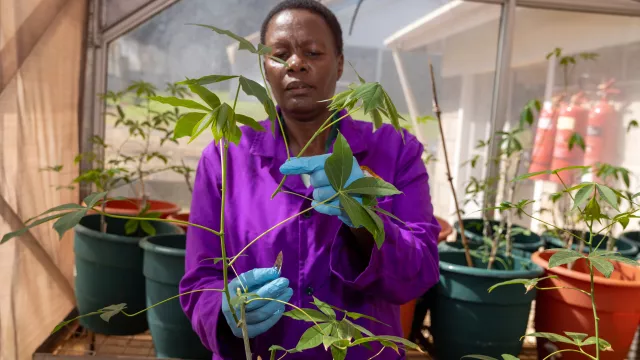
Crops to End Hunger
Crops to End Hunger (CtEH) is a global initiative modernizing CGIAR-national crop breeding programs by upgrading research stations, building staff capacity, and deploying tools to improve breeding efficiency.
-

Overview Science Programs
Lorem through research and innovation, CGIAR aims to address these challenges and contribute to collective global targets for Climate Adaptation and Mitigation:
-

CGIAR System Council
The CGIAR System Council is the strategic decision-making body of the CGIAR System that keeps under review the strategy, mission, impact and continued relevancy of the System as a whole.
-

Can simpler, cheaper poverty graduation programs still deliver? Evidence from Ethiopia
A randomized evaluation of a lower-cost poverty graduation-style program in rural Ethiopia finds modest gains in savings and livestock income but no sustained improvements in consumption or food security, suggesting that smaller cash transfers and lighter support may be insufficient to help extremely poor households escape poverty, particularly in shock-prone settings
-

As AI reshapes development research, investing in data must be a key priority
In the early 1600s, the German polymath Johannes Kepler studied years of astronomical observations and discovered that planets move in ellipses. But Kepler had no idea why planets moved that way. He had found a pattern in the data. A few decades later, Isaac Newton identified the mechanism underlying Kepler’s laws of planetary motion—gravity.
-

What will it take to make food systems work for women?
Thirty years after the adoption of the Beijing Declaration and Platform for Action — what many hailed as a landmark global framework for gender equality—progress remains uneven and inequalities still exist in many spheres. The Declaration, adopted by 189 nations, made one thing clear: development will not be advanced unless we also advance women’s empowerment. However, progress has been slow and at the current pace, it could take decades to close global gender gaps. Women and girls continue to face systemic barriers to rights, resources, decision-making and opportunities. Nowhere is this more evident than in food, land and water systems.
-
Sandra Cristina Kothe Milach
CGIAR's Chief Scientist