

Crops to End Hunger
Crops to End Hunger (CtEH) is a global initiative modernizing CGIAR-national crop breeding programs by upgrading research stations, building staff capacity, and deploying tools to improve breeding efficiency.
About Crops to End Hunger
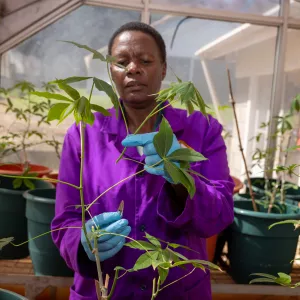
Crops to End Hunger (CtEH), funded by a consortium of donors since 2019, and delivered as a project* from 2023 to 2025 with funding from GIZ, has invested in upgrading breeding facilities, strengthening staff capacity to use advanced tools and techniques, and developing foundational resources that speed up the development of improved varieties globally. These varieties aim to meet the food, nutrition, and income needs of producers and consumers, respond to market demand, and boost resilience to pests, diseases, and climate change.
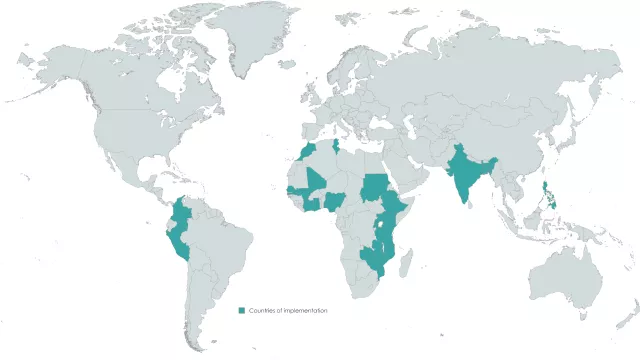
CtEH’s support spans 20 crops, including cereals, legumes, and root crops. Investments benefit both CGIAR and national research institutes’ breeding programs across Africa, South America and Asia, creating regional spillover effects that strengthen breeding capacity and impact well beyond individual countries.
*Other funders have remained committed to the modernization objectives of CtEH and contributed to modernization through grants or bilaterals.

Impact in action
Global investments
Investment pillars
Mechanization & Infrastructure
Across Africa, limited mechanization and outdated infrastructure slow progress in crop breeding, even as demand grows for climate-resilient, high-yielding varieties. CtEH is addressing this challenge by transforming key CGIAR-partner breeding stations into multi-crop innovation hubs through targeted investments in mechanization, irrigation, seed processing and storage, and sustainable shared services.
All upgrades are designed for long-term sustainability, combining new equipment with staff training, renewable energy solutions, and cost-recovery models. CtEH is building the physical and operational foundations for next-generation breeding, strengthening Global South’s breeding network and enabling local programs to deliver improved varieties to farmers faster and more reliably.
Watch the video “Crop neutral upgrades and staff motivation”

Partnerships
All CtEH projects share a defining principle: collaboration. Every research station refurbished and every piece of equipment delivered is designed to serve a network of partners working together. All the facilities are co-managed by CGIAR Centers and national research institutes, which hold the national mandate to release new crop varieties, ensuring that investments translate into impact at country level.
At each station, multiple institutions collaborate to maximize impact. This collaboration, through co-design, data sharing, and collective decision-making, goes beyond modernizing crop improvement; it reshapes the crops farmers grow. Breeding innovations cannot be transformative without equitable partnerships between CGIAR and national research systems. CtEH is therefore a partnership-based model that combines CGIAR’s global scientific leadership with the deep contextual knowledge and long-term commitment of national partners.
Watch the video “Upgrading infrastructure to accelerate collaborative crop improvement”

Inclusion
Crops to End Hunger investments have upgraded breeding facilities to create more inclusive environments for women, attracting both women technicians and women researchers who were previously discouraged by the remote locations of research stations. New amenities, such as breastfeeding rooms and field washrooms, reduce daily barriers and make it easier for women to work comfortably and safely on site.
These improvements are helping more women join and remain in the breeding workforce, with some stations now seeing women leading teams that were once entirely men. As a result, breeding programs benefit from a stronger understanding of gender-differentiated farmer needs and a more diverse, balanced workforce.
Watch the video “Inclusive breeding stations supporting women in science”

Target traits for climate-ready crops
Testing for traits is fundamental to crop breeding. Today’s breeding programs go beyond yield alone: they also target traits such as cooking time, disease resistance, and climate resilience. Combining all these characteristics into a single variety requires modern breeding technologies, which make it possible to select the right traits with greater accuracy and efficiency, ultimately improving the success rate of new varieties.
Through Crops to End Hunger, breeding operations are better aligned with farmers’ growing conditions, and new facilities are established to test and breed for priority traits that respond to the challenges of a changing climate.
Watch the video “Breeding climate-resilient crops for a changing world”

Analytics
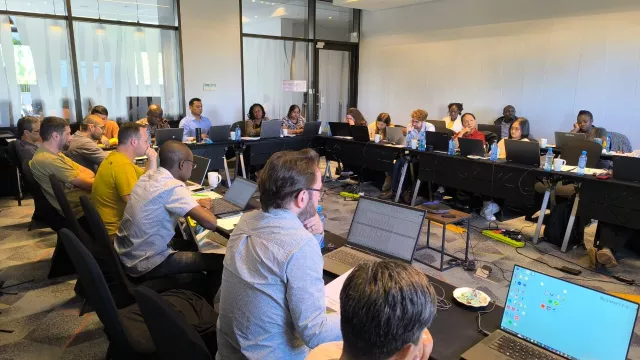
As breeders face immense time pressure, with little time to make data-driven decisions, Crops to End Hunger invested in the development of CGIAR Breeding Analytics Pipeline, Bioflow. The tool automates complex calculations, freeing up valuable time and allowing breeders to focus on making informed decisions that drive better outcomes.
The tool helps breeders understand how environments influence genotypes, identify the genes behind key traits, and predict plant phenotypes. It also harmonizes data and analyses across teams, closes computing gaps, and enables CGIAR and national partners to collaborate more effectively, even where local computing power or biometric expertise is limited.

Stories from Africa
Kiboko research upgrades
Program: CIMMYT | Region: East Africa
Kiboko has become a crop improvement research hub for the East African region, and investment in gender mainstreaming has also been discussed.
Root, Tuber and Banana East Africa Germplasm Exchange Lab (RTB-EAGEL) in Kenya
Programs: IITA/CIP | Region: East Africa
CtEH invested in building a new germplasm exchange lab for East Africa, which will test, clean, multiply and disseminate improve varieties of roots, tubers and bananas in the whole region, supporting food security and climate resistance.
Direct-seeded rice in Kenya
This video tells the story of Komboka, meaning "to liberate" in Swahili, a climate-smart, direct-seeded rice ceremony variety that delivers over 3x higher yields than traditional varieties, earlier maturity, lowering production costs and water needs, and resistance to major diseases like blast and bacterial leaf blight.
Partners

Events
- CtEH Project Update: Roots, Tuber and Banana Breeding - Phenotyping, and Germplasm Exchange Hub Upgrade
- Crops to End Hunger Case Studies in Africa and Beyond: Supporting CGIAR Partners through Genotyping Services
- Crops to End Hunger Project Update: Facilities Upgrade and Mechanization Improvement
- Crops to End Hunger Equipment Maintenance Workshop
News
-

A new guide supports native tree regeneration in the Sahel
A new practical guide developed by the Centre National de Semences Forestières (CNSF) in partnership with CGIAR Multifunctional Landscapes (MFL) has...
-

Accelerating wheat breeding, from Toluca in Mexico to the world
In Mexico, a Crops to End Hunger project has been completed to develop new elite parental lines of wheat with increased resistance to diseases. These...
-
Bioflow gets smarter with new modules and cloud features
The development of Bioflow, CGIAR’s open-source breeding analytics pipeline, funded by GIZ through Crops to End Hunger, has never slowed down since...
-

Kiboko Research Station in Kenya upgraded to accelerate East Africa maize and dryland crop breeding
The Crops Research Facility of the Kiboko Research Station, an essential agricultural research station in Makueni County, Kenya, has undergone a...