

IITA commissions advanced irrigation systems and mechanized farm equipment to boost research excellence
IITA–CGIAR commissioned newly installed advanced irrigation systems and state-of-the-art mechanized farm equipment at the Research Farm Unit on 4 December. The commissioning, with members of the IITA Board of Trustees present, reaffirmed IITA’s commitment to scaling climate-smart research through modern mechanization for the continent.
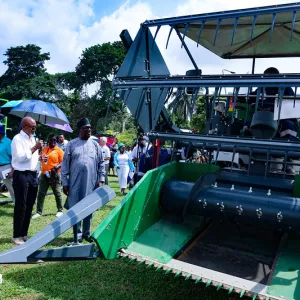
IITA–CGIAR commissioned newly installed advanced irrigation systems and state-of-the-art mechanized farm equipment at the Research Farm Unit on 4 December. The commissioning, with members of the IITA Board of Trustees present, reaffirmed IITA’s commitment to scaling climate-smart research through modern mechanization for the continent. The investment—funded by the German Federal Ministry for Economic Cooperation and Development (BMZ) and implemented by GIZ through the Crops to End Hunger (CtEH) initiative—represents one of the most significant upgrades to IITA’s research infrastructure in recent years.
The commissioning ceremony drew IITA leadership, scientists, farm managers, technical teams, and development partners who expressed pride in a project that strengthens IITA’s ability to deliver cutting-edge, climate-smart agricultural solutions for Africa. IITA Director General and CGIAR Regional Director for Continental Africa, Dr Simeon Ehui described the moment as “a proud step forward for our Institute,” noting that the infrastructure positions IITA to accelerate innovation and deliver improved varieties to farmers across the continent. He acknowledged the unwavering support of BMZ, GIZ, CtEH, and partners who “continue to stand with IITA in transforming African agriculture.”
The newly installed irrigation system expands the Institute’s irrigable land with an additional 70 hectares, enabling year-round experimentation and eliminating seasonal limitations that previously slowed breeding progress. The system features a modern filtration unit, lateral irrigation infrastructure, and mechanized solutions that enhance efficiency in field operations.