

Co-designing climate resilience: advancing drought risk financing in East Africa
Climate variability continues to affect pastoral communities across East Africa, increasing the need for practical, data-driven solutions that strengthen drought preparedness. On 3 October 2025, researchers, policymakers, and industry leaders met at the International Livestock Research Institute (ILRI) campus in Nairobi for the Anticipatory Drought Risk Finance Product Design Workshop organized in the framework of the NG’OMBE project. The event
Co-designing climate resilience: advancing drought risk financing in East Africa
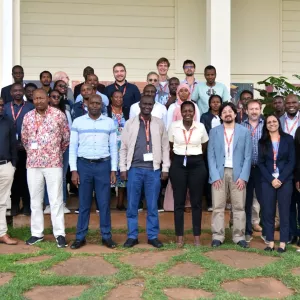
Climate variability continues to affect pastoral communities across East Africa, increasing the need for practical, data-driven solutions that strengthen drought preparedness. On 3 October 2025, researchers, policymakers, and industry leaders met at the International Livestock Research Institute (ILRI) campus in Nairobi for the Anticipatory Drought Risk Finance Product Design Workshop organized in the framework of the NG’OMBE project. The event brought together forty-four participants from government institutions, research organizations, and the private sector to discuss innovative ways to protect livelihoods and improve drought risk financing. The workshop emphasized shifting from product-driven approaches to solution-oriented approaches that directly respond to community priorities.
Discussions highlighted how Earth Observation (EO) data and artificial intelligence can improve drought monitoring and financing. Francesco Fava, NG’OMBE project lead and Associate Professor at the University of Milan. and Anton Vrieling, Associate Professor from University of Twente, shared advances in remote sensing and forecasting, showing how combining vegetation, rainfall, and soil moisture data enhances early warning systems.
Ambica Paliwal, a Senior Scientist working on remote sensing at ILRI emphasized the importance of connecting technology with local realities. “Digital tools can only succeed when informed by community experience,” she said. “Combining scientific precision with local knowledge ensures drought products are useful and trusted.”

Innovating for lasting impact
Speakers from the African Development Bank (AfDB), International Food Policy Research Institute (IFPRI), National Drought Management Authority (NDMA), Zep-RE, and World Food Program (WFP) presented examples of how climate risk insurance is helping smallholder farmers and herders build resilience.
Participants discussed about the Kenya Livestock Insurance Program (KLIP), which has provided more than KES 1.2 billion in payouts to 100,000 households (MoA, DRIVE, World Bank). They cited this as a successful model. Participants also discussed innovative approaches such as Risk Contingent Credit (RCC), which ties loan repayments to rainfall performance. This tool reduces financial stress for farmers during droughts while encouraging continued investment.
Participants called for greater integration of these tools into national and county frameworks to ensure long-term sustainability.
The workshop concluded with a clear roadmap for advancing anticipatory drought risk financing in Africa’s drylands. Key actions identified included:
· Embedding drought financing tools within county and national planning systems for sustainability.
· Strengthening data infrastructure to improve accuracy, transparency, and accessibility.
· Investing in local capacity to enhance ownership, implementation, and continuity.
· Establishing a Community of Practice (CoP) to connect stakeholders and promote co-learning and innovation.
Participants agreed that sustained investment in both people and systems is vital. They underscored the importance of continuous collaboration among researchers, policymakers, and communities to ensure that innovations remain inclusive, scalable, and effective.
The NG’OMBE workshop reaffirmed a shared commitment to translating research into practical solutions that enhance drought resilience. By combining scientific innovation, digital technology, and local knowledge, partners are helping build stronger systems for anticipatory drought response across East Africa.
The workshop was organized by ILRI in collaboration with the University of Milan and Jameel Observatory. It is part of the Next-Generation Earth Observation for Anticipatory Drought Risk Management in East African Pastoral Drylands (NG’OMBE) project, funded by Jameel Observatory and supported under the CGIAR Sustainable Animal and Aquatic Foods (SAAF) and Digital Transformation (DTA) Science Programs.
Authors: Geoffrey Njenga, Fredah Cherotich and Ambica Paliwal