

UAT Image with text: image sizes
Text-image component with small texts.
The Six CGIAR Regions
CGIAR's regional structure reflects the reality that challenges to agriculture, food systems, and natural resources are deeply rooted in local contexts. Each of the six CGIAR Regions faces distinct climate, environmental, and socio-economic pressures that require targeted responses.
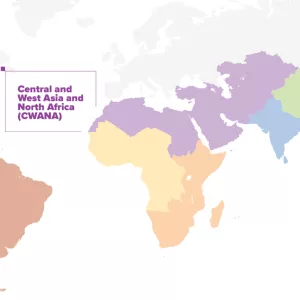
Central and West Asia and North Africa (CWANA)
As the most water-stressed region in the world, with annual average rainfall between 100 and 400 mm, climatic risks to water are the main constraint to agriculture-led development in this region, in both the highlands and in major deltas like the Nile.
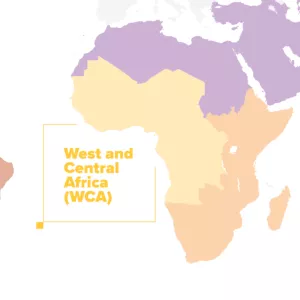
West and Central Africa (WCA)
In the wetter coastal and forested areas, hotter growing season temperatures and shorter rainy seasons are the key climate threats. In the drier Sahel, more frequent and severe droughts, including deadly dry spells within growing seasons, are driving changes in livelihoods, for example into livestock or out-migration to urban areas.
Areas of work
CGIAR's work spans a set of interconnected focus areas that drive impact across the entire breeding and product delivery continuum.
Market Intelligence
We will optimize the return on investment by driving institutional innovation in product design and investment prioritization, which will support the development and delivery of climate-resilient, nutritious, and market-preferred products.

Accelerated Breeding
We will accelerate the development of a new generation of climate-resilient, nutritious, and market-preferred varieties. We will also steer efficient, sustainable, and fair breeding processes and collaborations.

The Six CGIAR Regions
CGIAR's regional structure reflects the reality that challenges to agriculture, food systems, and natural resources are deeply rooted in local contexts. Each of the six CGIAR Regions faces distinct climate, environmental, and socio-economic pressures that require targeted responses.
Central and West Asia and North Africa (CWANA)
As the most water-stressed region in the world, with annual average rainfall between 100 and 400 mm, climatic risks to water are the main constraint to agriculture-led development in this region, in both the highlands and in major deltas like the Nile.

West and Central Africa (WCA)
In the wetter coastal and forested areas, hotter growing season temperatures and shorter rainy seasons are the key climate threats. In the drier Sahel, more frequent and severe droughts, including deadly dry spells within growing seasons, are driving changes in livelihoods, for example into livestock or out-migration to urban areas.

Areas of work
CGIAR's work spans a set of interconnected focus areas that drive impact across the entire breeding and product delivery continuum.
Market Intelligence
We will optimize the return on investment by driving institutional innovation in product design and investment prioritization, which will support the development and delivery of climate-resilient, nutritious, and market-preferred products.
Accelerated Breeding
We will accelerate the development of a new generation of climate-resilient, nutritious, and market-preferred varieties. We will also steer efficient, sustainable, and fair breeding processes and collaborations.
Areas of work
CGIAR's work spans a set of interconnected focus areas that drive impact across the entire breeding and product delivery continuum.
Market Intelligence
We will optimize the return on investment by driving institutional innovation in product design and investment prioritization, which will support the development and delivery of climate-resilient, nutritious, and market-preferred products.
Accelerated Breeding
We will accelerate the development of a new generation of climate-resilient, nutritious, and market-preferred varieties. We will also steer efficient, sustainable, and fair breeding processes and collaborations.