
Sandra Milach at the World Food Prize - Seeds of Insight series
Join Sandra Milach discussing the legacy of the Borlaug Dialogue in making food systems resilient. Sandra Milach at the Seeds of Insight series


Join Sandra Milach discussing the legacy of the Borlaug Dialogue in making food systems resilient. Sandra Milach at the Seeds of Insight series
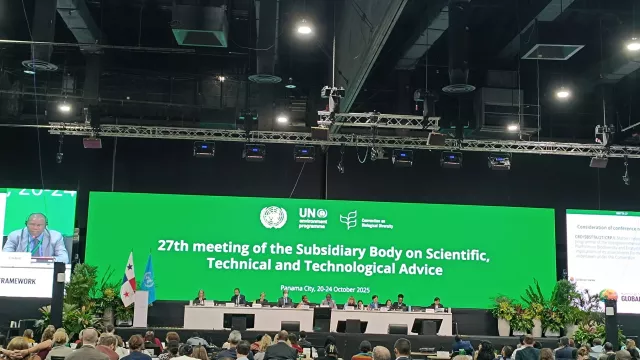
The world’s biodiversity goals will only be achieved if science, policy, and implementation move together and fast. With less than five years remaining to 2030, when the Kunming–Montreal Global Biodiversity Framework (KMGBF) is expected to deliver measurable outcomes, the coming period will be decisive. Hopefully, this time the world has learned from the shortcomings of past targets, such as the

Picture any fresh item in the supermarket, a head of lettuce or a bunch of grapes, sitting on a supermarket shelf. Before arriving there, they traveled through a web of processes: cooled in storage rooms, transported across long distances in fuel-powered trucks and wrapped in packaging designed to make them last longer and look attractive to buyers. Yet when

The Brazilian Presidency of COP30 has introduced a powerful new phrase to the climate vocabulary: Global Mutirão — a call to collective action rooted in solidarity and shared effort. In Brazil, a mutirão is when neighbors roll up their sleeves together to solve a challenge no single person can tackle alone. It is also a compelling lens for climate adaptation.

By Kristin Davis, Upeksha Hettiarachchi, Ryan Nehring, Wei Zhang, Claudia Ringler, and Aulo Gelli November 5, 2025 Farming today contributes to and is affected by the triple planetary crises of climate change, pollution, and biodiversity loss. Smallholders often lack incentives and technical support to adopt farming practices that can help them adapt to these challenges, improving their agroecosystem productivity and climate resilience while contributing to public goods,

Millions of farmers need billions of dollars to adapt to the fast-changing climate and extreme weather that threaten their soils and livelihoods. Climate finance offers them a pathway to build resilience through sustainable practices while earning financial rewards for proven environmental benefits. By documenting how their actions improve soil health and reduce emissions, farmers can access funds to invest in
The EAT-Lancet Commission recently published updated dietary recommendations for improved individual and planetary health, offering a useful roadmap to inform dialog on these issues. The International Food Policy Research Institute (IFPRI) and other research institutions provided inputs to that analysis. In related background work, a new study by researchers at IFPRI and collaborating institutions has found that global adoption of the 2025 EAT–Lancet Commission diet, which

In the department of Bolivar, malnutrition is not a cold figure in official reports, it is a reality that strikes thousands of families on a daily basis. According to the DANE, one in three households in the department (35.8%) lives in moderate or severe food insecurity. In other words, the food on the table of many households is insufficient