
“Disruptive Seeds” Approach to Radically Ignite Guatemala’s Food System Transformation through Local, Bottom-Up Solutions
CGIAR INITIATIVES Climate Resilience Primary Impact Area Climate adaptation & mitigation Related Impact Areas


CGIAR INITIATIVES Climate Resilience Primary Impact Area Climate adaptation & mitigation Related Impact Areas

by Mary Ng’endo, CGIAR Initiative on Climate Resilience (ClimBeR) Social Equity team, and Nyang’ori Ohenjo, the Centre for Minority Rights Development (CEMIRIDE) How can people’s knowledge inform climate action? More specifically, how can people bring their experience and knowledge of what works in a local context to global decision-makers? Doing so successfully may just lead to a better match between

By Ma. Eliza J. Villarino Are you a doctoral student from and doing your Ph.D. in the Global South? Are you doing research around measurement, modeling quantification and mitigation of greenhouse gas emissions, or carbon storage in agricultural systems relevant to developing countries? Are you looking for paid research stays? If you say yes to all of the above, we
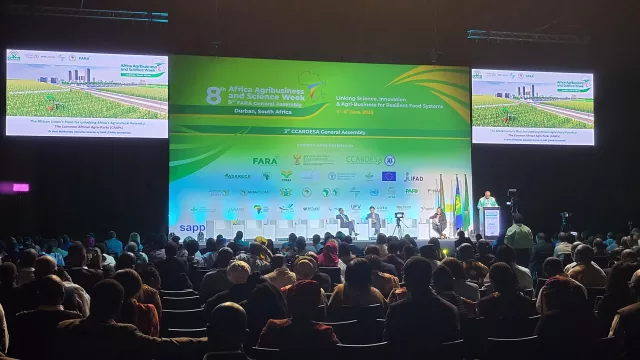
by Murat Sartas, Ph.D. CGIAR’s Climate Resilience Initiative (ClimBeR) team participated in the eighth African Agribusiness and Science Week (AASW8), which was held in Durban, South Africa, from June 5-8,2023. The team shared the innovative scaling approach the initiative implements, high-impact potential solutions co-developed by the initiative, and the learning in catalyzing science-based innovation and scaling efforts in Africa with

by Mary Ng’endo, CGIAR Initiative on Climate Resilience (ClimBeR) Social Equity team, and Nyang’ori Ohenjo, the Centre for Minority Rights Development (CEMIRIDE) How can people’s knowledge inform climate action? More specifically, how can people bring their experience and knowledge of what works in a local context to global decision-makers? Doing so successfully may just lead to a better match between

by Mary Ng’endo, CGIAR Initiative on Climate Resilience (ClimBeR) Social Equity team, and Nyang’ori Ohenjo, the Centre for Minority Rights Development (CEMIRIDE) How can people’s knowledge inform climate action? More specifically, how can people bring their experience and knowledge of what works in a local context to global decision-makers? Doing so successfully may just lead to a better match between

At the 2023 Bonn Climate Conference, the CGIAR Initiative on Low-Emission Food Systems organized a side event titled “Towards net zero food systems: how can low emission development strategies help achieve food security and economic growth?” This well-attended session featured the following presentations: “Food systems emissions and removals” by Lou Verchot of the Alliance of Bioversity International and International Center

by Mary Ng’endo, CGIAR Initiative on Climate Resilience (ClimBeR) Social Equity team, and Nyang’ori Ohenjo, the Centre for Minority Rights Development (CEMIRIDE) How can people’s knowledge inform climate action? More specifically, how can people bring their experience and knowledge of what works in a local context to global decision-makers? Doing so successfully may just lead to a better match between