
Building smallholder farmers’ resilience through index insurance in Kenya
Farmers in Kenya are facing growing impacts of climate change, including prolonged droughts, erratic rainfall, and sudden floods.


Farmers in Kenya are facing growing impacts of climate change, including prolonged droughts, erratic rainfall, and sudden floods.
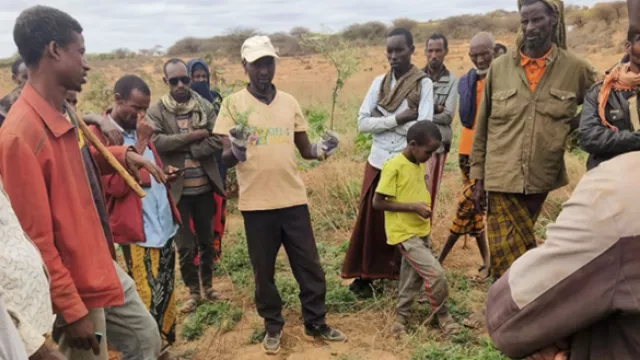
At the 33rd ESAP Annual Conference, ILRI presented a system of community rangeland health workers (CRHWs), offering practical and meaningful solutions for on-the-ground strengthening of pastoralist’s resilience to drought and other crises.
The HEAL project selected twelve Community Rangeland Health Workers (CRHWs) from Somali and Oromia, and trained and integrated them into existing OHUs, in order to provide coordinated services at the community level.

Two pilot District Technical Working Groups (DTWGs) were established to resolve water-related challenges impacting the resources serving districts in Prey Veng Province, addressing competition for water between rice farmers, fishers and other users.

The Government of Senegal and the Institut Sénégalais de Recherches Agricoles (ISRA), together with CIMMYT and CGIAR, have inaugurated a new state-of-the-art phytopathology and crop improvement greenhouse at ISRA–CNRA Bambey.

Across Africa, financial institutions are learning that accessing climate finance is not just about securing funds, but readiness, innovation, and inclusion. Through science-based tools and partnerships, the Alliance pf Bioversity and CIAT is helping financial institutions and development actors integrate climate intelligence into real-world decisions that reach farmers and strengthen food systems.

An ambitious new data platform is poised to strengthen the way the world understands and manages its vast rangelands – the grasslands, savannas, and shrublands covering nearly half of the Earth’s terrestrial surface. The development of the Global Rangelands Data Platform led by ILRI with technical support by GMV and Vizzuality seeks to tackle one of the most persistent obstacles

Communities across Africa are facing the combined pressures of climate change, conflict and forced displacement. These pressures are not occurring in a vacuum, but rather interact with and exacerbate each other. In many regions, climate hazards are deepening existing vulnerabilities, straining social cohesion, and undermining governance systems already under stress. Against this backdrop, CGIAR and UNHCR jointly organized a bilingual