

Reclaiming the Banana Island: How Ukerewe Farmers Are Restoring Production After Bunchy Top
Banana production on Ukerewe Island collapsed after Banana Bunchy Top Disease infected more than 85% of plants, driven by infected planting material and aphid transmission. A coordinated response led by IITA and national partners combined eradication, fallow periods, and local production of certified BBTV-free planting material using macro-propagation. By 2025, clean plantlets were back in farmers’ fields, restoring yields and establishing a community-owned model for long-term disease control.
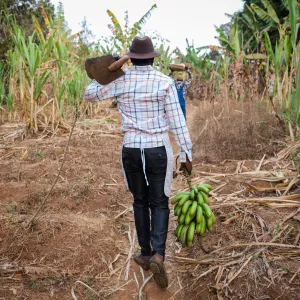
From Near Collapse to Coordinated Recovery
On Ukerewe Island in Tanzania, bananas are more than a staple crop; they underpin household food security, income, and cultural identity. Yet by 2023, Banana Bunchy Top Disease (BBTD), caused by the Banana Bunchy Top Virus (BBTV), had pushed the island's banana systems to the brink. Surveys revealed that over 85% of banana plants were infected, resulting in production losses exceeding 90% and leaving once-productive fields barren.
BBTD spreads primarily through infected planting material. In the absence of a formal seed system, farmers unknowingly recycled infected suckers that appeared healthy, allowing the virus to move rapidly across farms and villages. Once established, the disease spread further through the banana aphid (Pentalonia nigronervosa), which is present in virtually every plantation on the island.
A Science-Based Pathway to Recovery
BBTV survives only in living plant tissue. This biological constraint shaped a clear recovery strategy: eradicate all infected plants, observe a banana-free fallow period to eliminate virus reservoirs, and re-establish plantations using certified BBTV-free planting material.
In response, the International Institute of Tropical Agriculture (IITA), in partnership with the Tanzania Plant Health and Pesticides Authority (TPHPA), the Tanzania Agricultural Research Institute (TARI), and the Ukerewe District Council, launched a coordinated intervention combining island-wide awareness, systematic eradication, and local seed system development.
Central to this effort was the establishment of a banana macro-propagation unit at a BBTV-free site in Ngoma Ward, within Mwambuga Secondary School. Supported by USDA-FAS, the unit has the capacity to multiply 600 corms per cycle, producing between 6,000 and 12,000 plantlets of farmer-preferred varieties, including FHIA 23, TARIBAN 1, TARIBAN 4, Nyoya, and Nshakara.
All source material was obtained from TARI Maruku in Kagera, a known BBTV-free zone, and verified virus-free using laboratory molecular assays. The macro-propagation approach was selected for its simplicity, affordability, and suitability for smallholder systems, enabling rapid multiplication using locally available materials.
As George Mahuku of IITA emphasizes, "Science alone isn't enough. By using macro-propagation to produce clean planting material of farmer-preferred varieties, we're embedding disease control directly in communities—so farmers can protect their bananas from Bunchy Top for the long term."
Restoring Fields, Rebuilding Confidence
By August 2025, the macro-propagation unit had produced over 6,000 BBTV-free plantlets, with more than 4,245 distributed to farmers across Ukerewe District. Priority was given to women and youth, as well as to farmers in areas most severely affected by BBTD.
To qualify, farmers were required to:
- Eradicate all existing banana plants,
- Observe a two-month banana-free period,
- Participate in training on BBTV awareness and Good Agricultural Practices (GAP).
Each household received between 10 and 50 plantlets, with distribution coordinated by ward agricultural officers. Extension teams conduct regular field visits to monitor plant survival, provide agronomic guidance, and reinforce disease prevention practices.
A demonstration plot and banana mother garden established at Mwambuga Secondary School now serve as permanent training and multiplication sites. To date, no BBTV has been detected in these plots, demonstrating the effectiveness of combining clean seed with good field hygiene.
Proposed Recommendations for Sustainable BBTV Management
The Ukerewe experience offers important lessons for managing BBTV in endemic areas. Based on field results, the following recommendations are proposed:
- Institutionalize Local Clean Seed Systems
Governments and partners should invest in decentralized macro-propagation units linked to certified, clean-source material, thereby reducing dependence on informal seed exchange. - Enforce Eradication and Fallow Protocols
Recovery efforts must strictly combine eradication of infected plants with mandatory banana-free periods before replanting, supported by extension oversight. - Strengthen Farmer Awareness and Surveillance
Continuous training on BBTV symptoms, transmission pathways, and prevention is essential, alongside community-level monitoring to detect and remove new infections early. - Embed Ownership at the Community Level
Training local custodians, extension officers, teachers, and district staff ensures continuity, accountability, and long-term sustainability beyond project timelines. - Prioritize Inclusive Access
Targeting women and youth not only improves equity but also accelerates the adoption of clean planting material and good agronomic practices.
Reflecting on the broader impact, Mahuku notes: "Macro-propagation turns science into a farmer-owned solution, producing certified, disease-free planting material locally and safeguarding banana livelihoods for generations."
A Model for Scaling Resilience
Today, green banana fields are re-emerging across Ukerewe Island, replacing landscapes once defined by loss and uncertainty. More importantly, farmers now have the knowledge, tools, and local infrastructure to protect their crops against future outbreaks.
Ukerewe's recovery demonstrates that when Science is embedded within communities—and paired with strong institutions and farmer ownership—it can restore not only yields, but confidence and resilience. This model offers a scalable pathway for managing BBTV and strengthening banana systems across Tanzania and beyond.