

AI accelerates R&D across food, land and water systems
IWMI and CGIAR’s DTA hosted a consultation workshop in Colombo, Sri Lanka, bringing together the AI Champions from 11 CGIAR centers to take the next steps in integrating AI responsibly and effectively across food, land and water systems.

Early adopters of AI tools come together to share experiences and plot a roadmap to scale responsible AI of use in CGIAR
AI is rapidly impacting many fields, including research. Many researchers across CGIAR are already using AI to aid their research or developing AI-based solutions to real-world problems. As Ismahane Elouafi, CGIAR Executive Managing Director, noted earlier this year: “Given CGIAR’s mission and the increasing role of AI in agricultural innovation, these advancements raise important strategic questions for us.”
CGIAR’s Digital Transformation Accelerator (DTA) has begun a multi-year initiative on AI-accelerated food, land and water (FLW) systems research and development across CGIAR. The International Water Management Institute (IWMI) is coordinating part of the initiative, assessing, aligning and creating the conditions to responsibly scale AI for R&D across the CGIAR for greater impact on FLW systems.
As a first step, a working group of AI Champions has been convened, representing early adopters of AI tools and techniques across CGIAR centers. A CGIAR AI readiness survey developed by the International Food Policy Research Institute (IFPRI) was answered by 418 people identifying modest, but growing adoption of AI for research design, data management, and communication. At the same time, it noted that CGIAR researchers are not complacent about the challenges and risks of AI, with concerns such as data quality, capacity constraints and the lack of clear guidance on the responsible use of AI.
From 24 to 26 September 2025, IWMI and DTA hosted a consultation workshop in Colombo, Sri Lanka, bringing together the AI Champions from 11 CGIAR centers to take the next steps: mapping the present, envisioning the future, and planning the journey to integrate AI responsibly and effectively across FLW systems.

"This workshop will help us position CGIAR globally not just as users of AI but as leaders applying AI for sustainable food land and water systems in the climate crisis," said Rachael McDonnell, IWMI Deputy Director General, Research for Development.
Mapping the present
On the first day of the workshop, the AI Champions each presented a short pitch on AI at their center.
One tool presented was SNAP (Semantic Natural Language Processing Aggregator Platform), developed by the CGIAR System Office, which automatically provides summary reports from CGIAR's vast database of research results.
IWMI presented the Water CoPilot, an AI assistant for water management in the Limpopo River Basin, that can answer questions on water issues in the river basin using real world data and modelling, in multiple languages and even drawing relevant graphics.

Demonstration of IWMI's Digital Twin for the Limpopo River Basin.
Another tool, Ask the Data, developed by the International Potato Center (CIP), allows researchers to use natural language to query complex datasets. This directly impacts research, as data preparation can account for as much as 80% of a scientist's workload.
IFPRI presented the Topic-Specific News Agent, designed to constantly search for news on specific topics – for example export restrictions on commodities like wheat, rice, and fertilizer – and provide curated summaries in multiple languages.
For the AI Champions, this was the first comprehensive look at how AI is being used, the expertise available and the challenges faced by their peers across CGIAR. The workshop provided the opportunity to discuss these issues in depth.
Envisioning the future
A few weeks before, CGIAR experts convened in Cali, Colombia for a scenarios workshop hosted by the Alliance of Bioversity and CIAT, IWMI, and DTA. Unlike traditional foresight exercises focused on technological trends, the Cali workshop placed people at the heart of its approach. Using design thinking and speculative futures methods, participants built contextual scenarios that explored how emerging digital technologies might shape the lives of smallholder farmers, communities, policymakers, and researchers in the Global South.
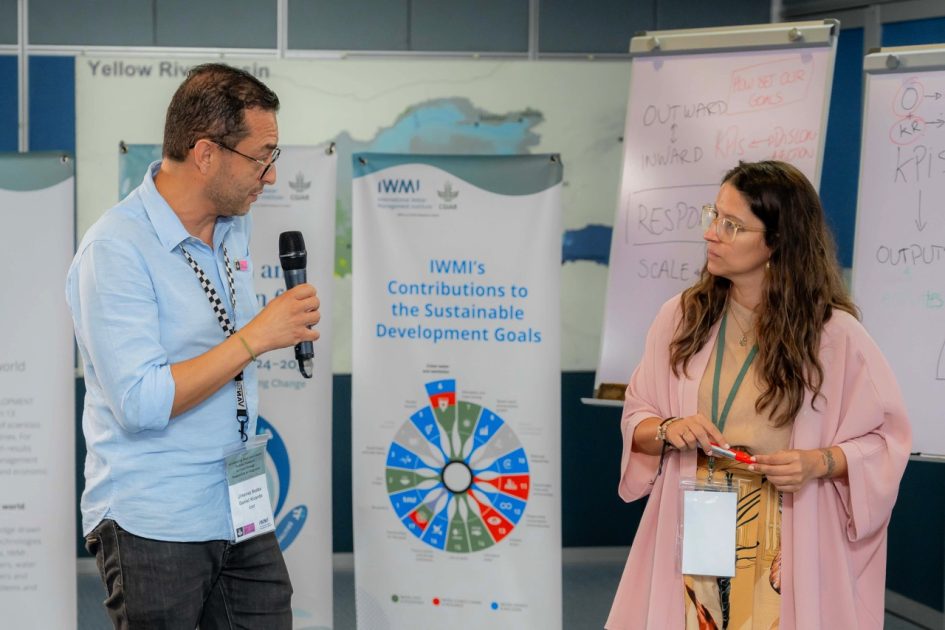
(L-R) Daniel Jimenez (Alliance of Bioversity and CIAT) and Carolina Martins (IWMI)
"Our goal was to explore plausible futures for food, land, and water systems under emerging digital technologies, looking not only at the opportunities, but also the risks; scenarios help us capture uncertainty and complexity in clear, thought-provoking ways, while fostering engagement, relationships, and fresh ideas," said Daniel Jimenez, senior scientist at the Alliance of Bioversity and CIAT. "CGIAR must identify strategic pathways in a rapidly evolving landscape. The diversity of backgrounds, nationalities, and centres involved was essential, because digital technologies are already shaping society and agriculture. CGIAR has to be part of that conversation."
The foresight coming out of the Cali scenarios workshop fed directly into the next question posed in Colombo: What will AI-powered R&D look at CGIAR in 3-5 years?
In groups, the AI Champions developed their vision for the future and how to make it real. Using tools like LEGO Serious Play, they built physical models showing the people, tools, workflows, risks and values that will be crucial to bringing their headline vision to life. They then discussed common objectives and key results that could be used to measure the success of operationalising CGIAR's vision for AI.
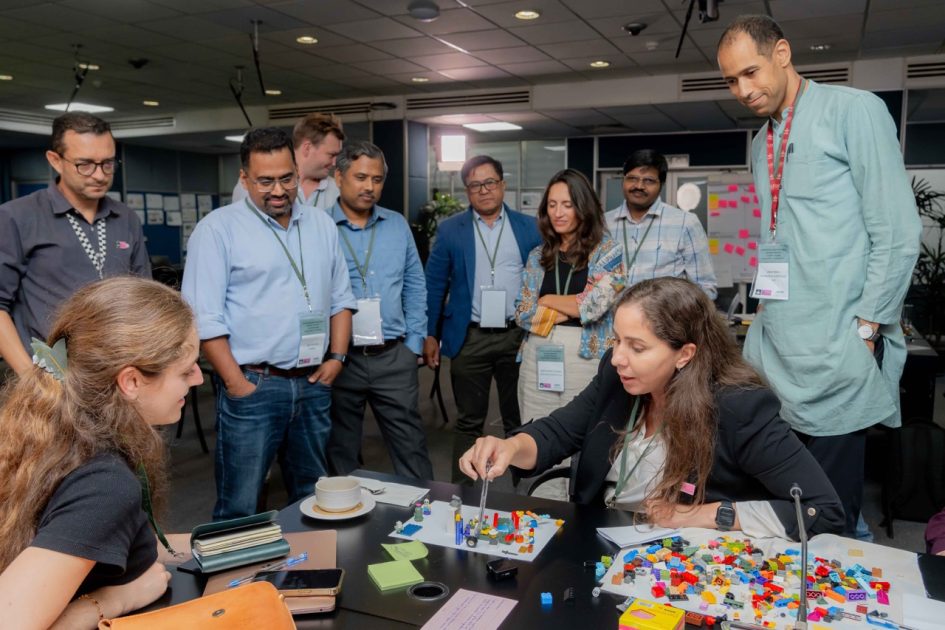
Mariangel Garcia (IWMI, center) discusses a co-developed vision for AI use in CGIAR
The Champions also looked at the concept of an AI Co-Scientist. Concepts researched as part of the initiative suggest that AI systems can speed up routine tasks, suggest and validate research hypotheses, and other tasks. By incorporating such tools into the R&D cycle, it could support researchers to achieve even greater impact.
Using “Design Thinking”, a human-centered design process, the AI champions worked on a prototype of how an AI Co-Scientist would work in the context of CGIAR workflows.
Bringing this work together, one outcome of the workshop was to co-develop a vision for AI-accelerated R&D in food, land and water systems, and define a supporting AI platform providing the tools and enabling environment needed for the vision to become a success.
“We have identified that across CGIAR there is a range of multidisciplinary skills and expertise in AI. With the collective vision we are developing, we can coordinate our efforts to achieve impact at scale,” said Angie Garcia, PhD, IWMI Research Group Leader – Water Futures Data and Analytics and Co-Lead of the DTA Digital Futures area of work.
The shared vision and roadmap defined at the workshop will be used to report back to CGIAR leadership to define an organisation-wide approach to responsibly scaling AI-accelerated R&D for FLW systems.
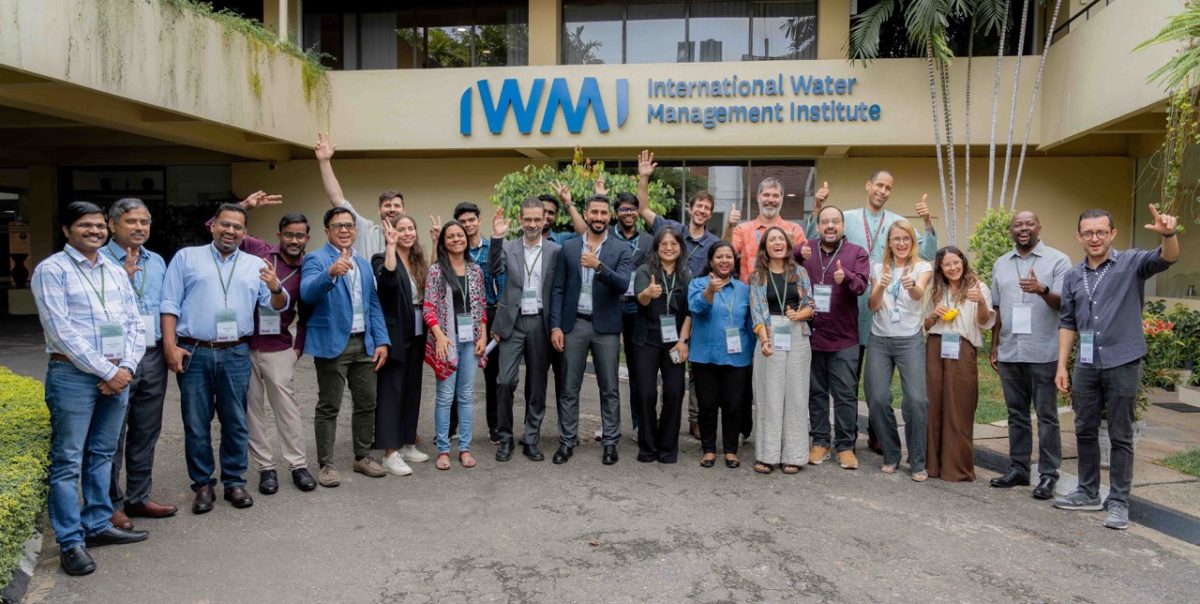
Group photo of participants at the workshop "Accelerating Food-Land-Water Systems Research in CGIAR through Responsible AI Integration", held 24-26 September 2025 in Colombo, Sri Lanka This work was supported with grants from CGIAR and Google through the CGIAR Accelerator on Digital Transformation.
This work was supported with grants from CGIAR and Google through the CGIAR Accelerator on Digital Transformation.