

Mainstreaming on-farm verification in CGIAR breeding
A meeting was held recently held in Nairobi to advance the design and integration of on-farm verification trials (OFVT) as a core component of breeding pipelines going forward.
- Enable
Mainstreaming on-farm verification in CGIAR breeding
Nairobi, November 2025 — A two-day meeting bringing together CGIAR’s Breeding for Tomorrow (B4T) Science Program, representatives of CGIAR–partner breeding teams, the 1000FARMS initiative, the Gates Foundation, and other key partners was recently held in Nairobi to advance the design and integration of on-farm verification trials (OFVT) as a core component of breeding pipelines going forward.
Bridging research and farmers realities
CGIAR and national partners have worked together for decades to ensure that new crop varieties are not only high yielding but also relevant to farmers.
However, over 80% of the world’s 570 million farms are smallholdings of less than two hectares. This means that new varieties must perform well across highly heterogenous environments – characterized by diverse soils, climatic conditions, farming practices and resources constraints – that are difficult to replicate on research stations.
For instance, common smallholder practices such as manual weeding, intercropping, and limited fertilizer use are rarely replicated on research stations. This mismatch can result in inaccurate predictions of variety performance under real-world conditions and, in some cases, the loss of promising candidates.
To address this, on-farm variety testing enables farmers to trial candidate varieties in their fields, providing breeders with feedback on crop performance under local conditions and helping identify varieties that farmers are most likely to prefer, adopt, and benefit from.
Defining why on-farm verification trials matter
At the Nairobi convening, participants agreed that OFVT will be used to identify new candidate varieties that outperform what most farmers currently grow, and to generate the evidence needed to support variety replacement cases, the documentation that convinces stakeholders such as ministries, seed companies, and farmers that investment in disseminating a new variety is worthwhile. As a result, it was agreed that OFVT will constitute the final step of the variety development process prior to officially releasing and commercializing a variety.
OFVT will also enable estimation of genetic trends, or the average annual rate of productivity gain achieved through varietal replacement. Even after release, new varieties can remain in OFVTs to validate their performance and provide extension agents and farmers with reliable, comparative data on the varieties available in the market. Measuring on-farm genetic trends is a critical key performance indicator for CGIAR-NARES breeding networks.
Mainstreaming on-farm verification across breeding programs
The Nairobi meeting also focused on mainstreaming OFVT across CGIAR and partner breeding programs, establishing a shared roadmap for design, data use, and implementation, defining roles and responsibilities, and clarifying how OFVT data can inform variety advancement and dissemination decisions.
Breeding for Tomorrow will coordinate the development of standard operating procedures (SOPs), OFVT manuals, and a community of practice to harmonize efforts across crops and regions. The Science Program will also lead integration of OFVT data into institutional systems, ensuring performance metrics are captured, reported, and accessible.
National partners will play a central role in planning and execution of OFVT as the primary users of the data. As such, various NARES representatives participated in the meeting to co-develop best practices to sustainably and cost effectively scale OFVT across various crop types such as roots and tubers, legumes and hybrid crops.
Building on past experiences
CGIAR and partners already apply several OFVT-related methods, successfully implementing trials on hundreds of farms each year at manageable costs. One such method, the Triadic Comparison of Technologies (Tricot) approach, led by 1000FARMS, invites farmers to test and rank three crop varieties using mobile tools. This approach generates valuable data and empowers farmers as co-researchers, producing large, geographically diverse datasets.
At the meeting, the CIMMYT maize team in Zimbabwe shared lessons from over 14 years of OFVT, including the value of reducing the number of entries tested per farm to encourage participation from a more diverse pool of farmers, including those with limited land. They also emphasized setting gender participation targets to ensure equitable representation.
“By embedding on-farm verification at the core of our breeding pipelines, we bridge the gap between research and farmers’ realities, ensuring that every new variety released is fit for purpose, outperforming other varieties”, said Dorcus Gemenet, Accelerated Breeding Accelerate Lead at Breeding for Tomorrow. “A major outcome of the meeting has been to agree to a standardized, scalable and cost-effective method of OFVT that all programs can adopt easily”, she added.

Coordinating efforts and scaling impact
Breeding for Tomorrow aims to integrate OFVT into future program design, leveraging unified data management and analytics infrastructure to ensure that OFVT is Findable, Accessible, Interoperable, and Reusable (FAIR).
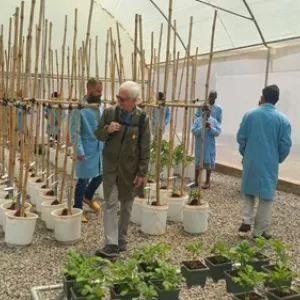
Following the convening, teams from the Gates Foundation and Breeding for Tomorrow visited two potential hubs for seed and planting material multiplication and sharing, the Kiboko research station and the Roots, Tubers and Bananas-East Africa Germplasm Exchange Lab (RTB-EAGEL), to explore practical steps for regional implementation.
“Our goal is to work alongside CGIAR and national partners to make breeding more data-driven, farmer-centered, and impact-oriented,” said Young Wha Lee, Senior Program Officer, Crops Research and Development, at the Gates Foundation. “On-farm verification is how science meets reality, and how innovation reaches the people who need it most.”
Implementing and scaling OFVT demands strong partnerships and alignment between CGIAR, NARES, sub regional organizations and farming communities.
John Mukuka, CEO of the Alliance for Commodity Trade in Eastern and Southern Africa (ACTESA) noted: “Late stage OFVT data can support variety release decisions by demonstrating value for use and cultivation (VCUs) and there may be opportunities to harmonize the generation and use of OFVT data regionally.”
Over the next ten years, CGIAR aims to accelerate the delivery of improved, outperforming varieties to smallholder farmers across low- and middle-income countries through aligned data systems, standards, and partnerships.
Resources:
- Blog: Small family farmers produce a third of the world’s food
- Blog: Farmers take the lead in shaping CGIAR crop innovations through the Tricot methodology
- Learn more on CGIAR Breeding for Tomorrow
- Learn more on 1000Farms
***
Main image: Teams from the Gates Foundation and CGIAR Breeding for Tomorrow visiting the Root, Tuber and Banana - East Africa Germplasm Exchange Lab (RTB-EAGEL) in Muguga, Kenya. Credit: CGIAR. Written by Julie Puech. This work contributes to CGIAR Breeding for Tomorrow Science Program.
This news story is based on a project funded in part by the Gates Foundation. The findings and conclusions contained within are those of the authors and do not necessarily reflect positions or policies of the Gates Foundation.