

Leveraging the Women’s Empowerment in Agriculture Index (WEAI) to design and implement more effective and inclusive community-based programs
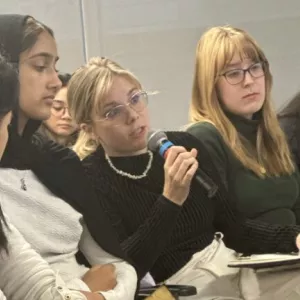
On November 13, 2025, nearly 50 students from Georgetown University and George Washington University convened at IFPRI headquarters in Washington, D.C., for a hands-on learning visit focused on the Women’s Empowerment in Agriculture Index (WEAI)
- gender
- women
- empowerment
By Samantha Chai and Daniel LamFebruary 10, 2026
On November 13, 2025, nearly 50 students from Georgetown University and George Washington University convened at IFPRI headquarters in Washington, D.C., for a hands-on learning visit focused on the Women’s Empowerment in Agriculture Index (WEAI). The survey-based tool measures women’s inclusion and empowerment across agricultural and food systems and is widely used in research, policy, and development programming.
The students learned directly from the WEAI team—Senior Research Fellow Jessica Heckert, Senior Research Coordinator Hazel Malapit, Senior Research Analysts Emily Myers and Flor Paz, and Senior Program Manager Ara Go—who shared insights on incorporating gender into research and development projects, the many dimensions of women’s empowerment, and how the WEAI can be applied to assess progress toward gender equality. The exchange highlighted IFPRI’s commitment to capacity building by equipping the next generation of researchers and practitioners with practical, evidence-based tools.
The visit offered students an opportunity to connect academic coursework in agriculture, development, gender studies, and environmental policy with real-world research applications. Daniel Lam, a Georgetown University Environment & International Affairs graduate student enrolled in Professor Ekin Birol’s course, “Agri-Food Systems and Economic Development,” noted, “The visit to IFPRI reinforced one of the key lessons of Prof. Birol’s class—that food system transformation and progress on the UN’s sustainable development goals are mutually reinforcing, especially when it comes to women’s empowerment.”