

Hidden in Plain Sight: Pastoralist ‘pioneers’ redefining resilience
Pastoralist communities in Ethiopia are redefining climate resilience through locally developed practices in animal health, grazing, and forage management. Recognizing and amplifying these local knowledge and solutions can help modify approaches towards pastoral resilience.
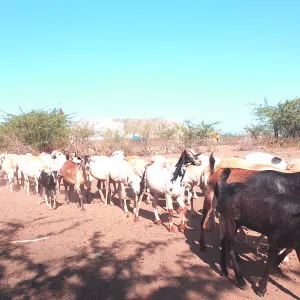
In South Omo Zone and the Afar Region of Ethiopia, pastoralist communities have shaped and reshaped their landscapes for generations. Long before climate change became a global concern, herders here were already adapting to rainfall variability, rangeland pressure, and shifting seasons. Yet despite this lived expertise, pastoralists are often treated as passive recipients of aid rather than as holders of solutions. Too frequently, development responses arrive packaged as external fixes, overlooking the knowledge already embedded within communities.
But, what if the answers to building resilience are already here - right in front of us? This question lay at the heart of the CGIAR Sustainable Animal and Aquatic Foods (SAAF) National Stakeholder Engagement Workshop, held at the International Livestock Research Institute (ILRI) campus in Addis Ababa. The workshop, held in November 2025, brought together government officials, researchers, NGOs, and development partners to explore the Pioneer Positive Deviance (P-PD) approach-an approach that challenges conventional problem-solving by focusing on what is already working.

Learning from what already works
The Positive Deviance (P-PD) approach starts from a simple but powerful insight: within any community facing hardship, there are individuals or households achieving better outcomes than their peers, despite having access to the same limited resources. These “positive deviants” are not outliers because of external support, they are ‘pioneers’ who find local solutions while using the same limited resources as their neighbors. Whether it is a specific way of managing animal health or a unique strategy for securing forage to cover droughts, these innovations are key to a more resilient future. For example, in Afar Regional State, some households have implemented timely rotational grazing to protect the availability and quality of their pasture. By identifying, understanding, and amplifying their practices, P-PD offers a pathway to resilience that is locally owned and socially sustainable. In her opening remarks at the workshop, Birgit Habermann, a scientist at ILRI, captured this shift in thinking succinctly.
“The idea is that you learn from solutions on the ground, solutions that have already proved to work here, and you work with those. And those solutions are not necessarily completely new innovations.”
Her words resonated with participants who have seen well-intentioned interventions falter when they fail to align with pastoralist realities.
The workshop built upon field data collected in pastoral kebeles (the smallest administrative unit of local government) such as Sabure and Dudub in Afar Regional State, where project teams identified 39 potential positive deviant households. These households demonstrated practices that improved animal health, protected forage, or strengthened livelihoods, even during drought. One pastoralist from Sabure kebele described how small adjustments made a big difference.
“By resting certain grazing areas early and moving animals at the right time, our pasture survived the dry season, and our animals stayed stronger than before,” he explained.
From individual practices to collective learning
The real power of the P-PD approach lies not only in identifying successful households, but in turning individual practices into collective learning. During the workshop, participants examined how positive deviant behaviours could inform broader strategies across three interconnected pillars: animal health, feed and forage systems, and social norms. In animal health, discussions emphasized moving away from dependency on sporadic external aid toward community-led wellness practices. For feed and forage, participants explored how local grazing management and forage harvesting and storage techniques could be scaled without undermining traditional systems. Social norms, focused on understanding the human side of how practices take hold, as a critical factor in determining whether innovations spread or stall. Livestock extension officers attending the workshop reflected on how this approach could reshape their role. One extension officer noted,
“For a long time, our job was to teach communities what to do. With P-PD, we learnt that in addition to teaching the community new practices, we can also facilitate learning among pastoralists themselves, because when advice comes from a fellow herder who has succeeded under the same conditions, it is trusted and adopted much faster.”
A recurring message from the room was that while data and technical evidence matter, they are not enough on their own. Real transformation happens through social learning—through dialogue, observation, and trust. The workshop itself became a microcosm of this process, blending scientific analysis with lived experience.
Scaling in, scaling out: The road to 2026
As the workshop ended, attention turned to what comes next. Feedback from participants is already being used to refine how the P-PD approach can be integrated into Ethiopia’s National Pastoral Extension System. A key milestone was the launch of new P-PD practitioner guidelines, designed to support real-world application and consistency across regions. Looking ahead to 2026, the strategy is “scaling in” locally—deepening impact within communities—while also “scaling out” regionally through structured partnerships. Central to this vision is the establishment of a Trainer of Trainers program. The opportunity is clear. By bridging research and reality, and by placing farmers and pastoralist expertise at the center, Ethiopia has a chance to turn local innovation into a national pathway for resilience.
Author: Abiy Rahel. Contributor: Tigist Worku
Acknowledgments
This work was conducted under the CGIAR Sustainable Animal and Aquatic Foods (SAAF) and Climate Action Science Programs, supported by contributions to the CGIAR Trust Fund. This research is also linked to the European Union funded project, Restoration of Livestock Services in Conflict and Drought Affected Areas of Ethiopia (RESTORE).
Further reading
Reimagining research Empowering producer-led innovation for climate resilient livestock