

From Awareness to Action: Students Building Ghana’s Circular Future
Two years ago, selected schools in Kumasi, Ashanti Region of Ghana, discovered a powerful truth: waste is not waste when we rethink its value. In 2023, the Resource Recovery & Reuse (RRR) Schools & Youth Program introduced waste segregation lessons in these schools.

From Awareness to Action: Students Building Ghana’s Circular Future
Dzifa Agbefu, Eric G. Nartey, Susanne Bodach – International Water Management Institute
Igniting a Circular Mindset
Two years ago, selected schools in Kumasi, Ashanti Region of Ghana, discovered a powerful truth: waste is not waste when we rethink its value. In 2023, the Resource Recovery & Reuse (RRR) Schools & Youth Program introduced waste segregation lessons in these schools, laying the foundation for what has since become one of Ghana’s leading student-driven circular economy initiatives. By 2024, it became evident that limited capacity, insufficient mentoring, and weak systems were constraining progress, underscoring the need for a more hands-on, practical approach.
Today, the RRR Schools & Youth Program has grown beyond teaching sustainability, it is evolving into a vibrant, student-led circular ecosystem where learners actively transform waste into resources and lead tangible change in their schools.

Hands-On Learning and Capacity Building
School clubs have been empowered in producing compost, running germination tests, growing vegetables, collaborating with recycling enterprises, and transforming their school waste into teaching and learning materials. It also created healthy competition among school peers, motivating them to continuously improve. Targeted training has driven progress toward the program’s 2025 goals. The program has supported Trash Smart as an enterprise partner, empowered 47 focal teachers to lead RRR clubs, and enabled 42 Engineers Without Borders, KNUST(EWB-KNUST) volunteers to mentor RRR school clubs. These volunteers now lead circular activities across 23 schools, ensuring safe, effective, and sustainable waste-to-resource systems.
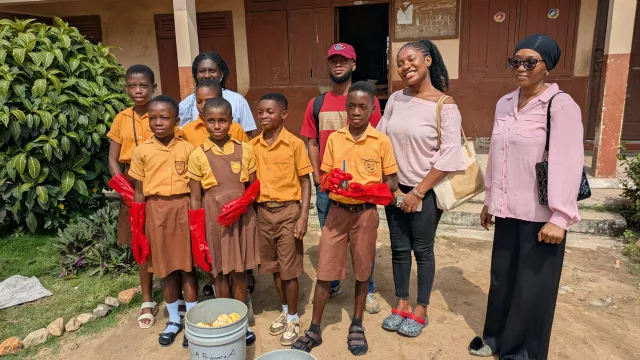
The holistic, Do It Yourself-focused training model blends circular economy and circular bioeconomy concepts with practical, hands-on instruction in composting science, plastics management, and system operations. Composting modules cover site selection, tools and logistics, proper use of PPE, health and safety protocols, process monitoring, quality checks, and full-cycle compost management, including germination tests to verify maturity. These new skills and the confidence gained have strengthened the foundation for sustained student-led innovation. The training model and lessons learned are being compiled into manuals to support the adoption of circular economy practices in schools across developing countries.

Students Taking Charge
Through the hands-on capacity-building approach, 15,612 students, including 8,094 girls and 7,518 boys, are now practicing daily source segregation. Supported by 67 committed RRR club patrons, these students are demonstrating that sustainable habits can indeed be nurtured at scale.
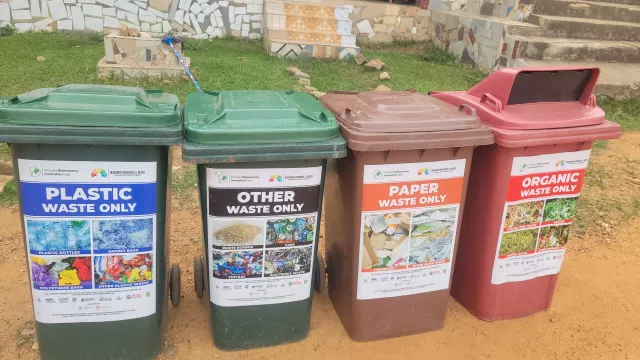
Schools are now working closely with local waste collectors and enterprises to generate both environmental and economic value. Paper waste, collected by informal workers, is recycled into toilet tissue or creatively repurposed into teaching and learning materials, with schools receiving payment in cash or in-kind. Plastics are collected by TrashSmart and upcycled into durable construction bricks.

Organic waste is transformed into nutrient-rich compost for gardening by the RRR club members, while residual waste is safely managed through strengthened school waste systems. Collectively, all 1,185 RRR Club members (609 girls, 576 boys) lead composting, gardening, and awareness campaigns across all 23 schools. Composting practices are tailored to each school’s context, from pit and barrel composting to innovative box composting using upcycled desks. Several schools have completed full composting, while others are conducting germination tests or initiating new batches.

Growing Demand
The impact of the RRR Schools & Youth Program is generating strong demand across educational institutions. This year, St. Louis Senior High School, the largest all-girls institution in Ghana with approximately 5,590 students, officially applied and became the first senior high school to be enrolled in the program. This milestone marks a major expansion of circular -economy education to older learners and strengthens efforts to empower young women in STEM and environmental leadership.
“With our large student population, managing waste sustainably has been a major challenge. We believe the RRR Schools & Youth Program will equip our girls with practical skills while helping the school adopt safer, more responsible waste practices”. Mrs Ama Kyerewaa Benefo, headmistress, St Louis Senior High School

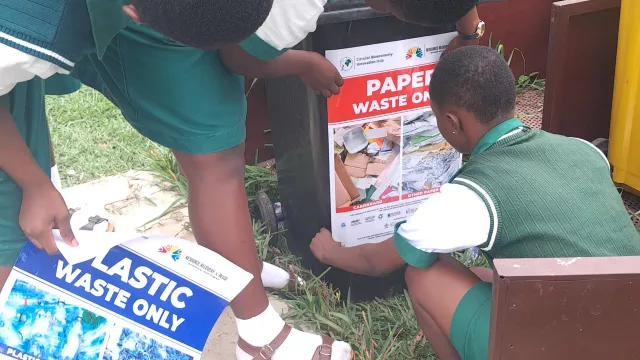
The enrollment process included a baseline assessment of the school’s waste management challenges, re-orientation on proper source segregation, donation of 46 context-appropriate bins, and relabeling of all existing bins to match the school’s waste streams. It also featured sensitization sessions for teachers and students, an introduction to circular bioeconomy concepts, and the formation of a structured, actively functioning school club.
Sustaining Impact
A dedicated Monitoring & Evaluation team, led by Water & Sanitation for the Urban Population (WSUP) and supported by EWB-KNUST (the program’s main implementation partners), Ghana Education Service (GES), and the Municipal Assembly, conducted comprehensive reviews across all 23 schools. These visits track progress, identify challenges, and ensure that segregation, composting, and value-addition systems remain active and effective. This structured review process is now embedded in the program, fostering continuous improvement and long-term sustainability. There are also planned inter-school competitions, exhibitions, and quizzes to enhance the sustainability of the program.

Next Generation Leaders
The RRR Schools & Youth Program continues to demonstrate what is possible when young people are empowered with knowledge, tools, and mentorship. Students are no longer just learning about sustainability, they are producing compost, growing school gardens, partnering with recycling enterprises, leading school-wide reforms and driving local circular solutions.
“The program is not just about teaching students how to manage waste but also about inspiring the next generation to see the world differently backed by science and research” Dzifa Agbefu, Innovation Hub Coordinator, IWMI.
With the inclusion of St. Louis Senior High School and strengthened volunteer support, Ghana is witnessing the rise of a new generation of girls and boys who are ready to shape a sustainable, circular future.
The Circular Bioeconomy Innovation Hub
The RRR Schools & Youth Program is anchored in the Circular Bioeconomy Innovation Hub which is supported by the CGIAR Science Programs on Multifunctional Landscapes and Food Frontiers & Security. The Hub is an IWMI-led multistakeholder platform advancing circular bioeconomy across Ghana. The Hub unites 16 public & private organizations, researchers, NGOs, and academia as co-owning institutions to leverage resources for a scaled and shared impact. By addressing challenges such as low adoption of circular practices, policy gaps, and fragmented efforts, Hub has become a national catalyst for innovation. Its work has already been internationally recognized in CGIAR’s inaugural flagship report.