

Foundation for transforming Kenya’s agriculture: KAOP-AgData Hub
Through AICCRA and CGIAR support, Kenya Agricultural Observatory Platform (KAOP) has been enhanced with a national AgData Hub integrating diverse data sources (climate, soil, market, crop info) to provide advisories to over 700,000 farmers to boost productivity and strengthen resilience.
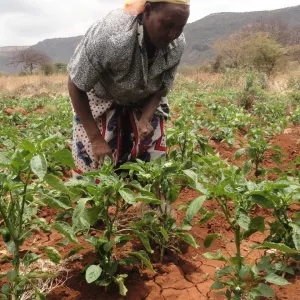
Kenya’s agriculture is undergoing a digital transformation through the Kenya Agricultural Observatory Platform (KAOP) enhanced with a national AgData Hub. By integrating diverse data sources—climate, soil, market, and crop information—the platform empowers over 700,000 farmers with precise, timely advisories that boost productivity, strengthen resilience, and drive sustainable agricultural growth.
Accelerating Impacts of CGIAR Climate Research for Africa (AICCRA) through the International Livestock Research Institute (ILRI) and CGIAR Digital Transformation Accelerator (DTA) supported Kenya Meteorological Department (KMD) and Kenya Agricultural Livestock Research Organization (KALRO) firstly, in the creation of a national AgData Hub, and secondly in the Hub's integration into the existing Kenya Agricultural Observatory Platform (KAOP), which was originally developed by KALRO, with support from the Kenya Climate-Smart Agriculture Project (KCSAP). The KAOP-AgData Hub now serves as a central repository, seamlessly integrating data from diverse sources with varying spatial and temporal resolutions. The integration enables the platform to deliver tailored, actionable insights for both crop and livestock aligned with Kenya's administrative divisions. By streamlining data management and optimizing resources, it significantly reduces the costs and efforts associated with traditional advisory systems.
What is an AgData Hub?
An AgData Hub is a national digital platform that connects, stores, and analyzes agricultural and climate data from multiple sources, meteorological services, research institutes, and extension agencies. Its goal is to make climate and agricultural information faster, more reliable, and easier to use for decision-makers, from national planners to local extension agents. Without these Hubs, data is scattered across institutions and shared manually, often arriving too late or incomplete to guide farmers’ actions. By automating data collection and analysis, AgData Hubs enable real-time, location-specific advisories that help farmers adapt to droughts, erratic rainfall, and shifting seasons, transforming climate information into actionable decisions for Africa's agriculture.
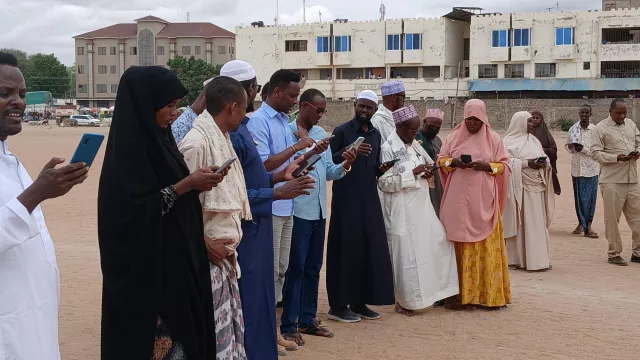
Launched publicly across six AICCRA focus countries (Ethiopia, Ghana, Kenya, Mali, Senegal and Zambia) and developed with a blend of technical, institutional, capacity, infrastructure, and policy support from the AICCRA project, national AgData Hubs are already extending the reach and range of climate information services and bundled advisories to hundreds of thousands of farmers. In Kenya, the integrated Hub is the result of long-term engagement with both KALRO and KMD that AICCRA has facilitated since 2021. The platform leverages the existing reach of KAOP to 700,000 farmers across Kenya, providing improved, customized digital advisories to help mitigate climate risks and enhancing decision-making for farmers and stakeholders. The broader aim of the integrated platform is to foster closer working relationships and synergies between the two institutions for lasting cohesion of national systems.
“When the KAOP platform started five years ago, it was only providing 14-day forecasts and some good agricultural practices. However, this was not enough information for a farmer,” says Morris Gatheru – from the digital products development department at KALRO.
“Through the help of AICCRA, the KAOP platform was enhanced with the AgData Hub and is now able to provide short term (monthly) as well as seasonal forecasts. This enables a farmer to decide, for example, whether to plant a short duration maturing crop varieties or a long duration maturing one.”
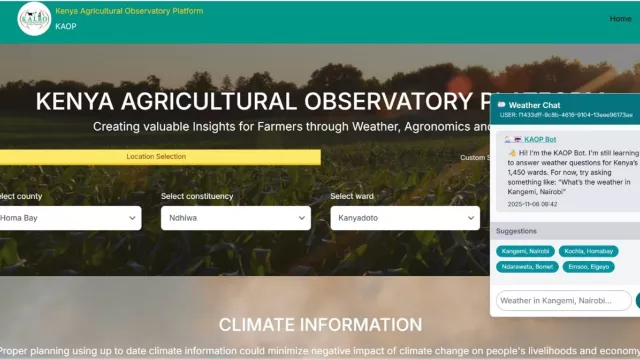
The AgData Hub integration has expanded KAOP’s functionality into a comprehensive hub that aggregates data from global sources such as:
· CHIRPS, the Climate Hazards Group InfraRed Precipitation with Station data, a quasi-global rainfall data set which combines data from real-time observing meteorological stations with infra-red data to estimate precipitation;
· TAMSAT data which provides satellite-based weather information, primarily rainfall estimates for Africa, along with soil moisture estimates and forecasts;
· Global Forecasts System (GFS), and
· International Research Institute for Climate and Society (IRI).
Through this Hub, users can now access 30-year historical climate records, seven-day forecasts from the Kenya Meteorological Department (KMD), and seasonal forecasts from IRI, including downscaled models for eight counties.
A holistic agricultural data ecosystem
Unlike traditional platforms that focus narrowly on weather, the improved KAOP-AgData Hub also integrates a wide spectrum of agricultural information - including data on soil, livestock and crops. The system brings together soil data from the International Soil Reference and Information Centre, satellite imagery provided through FAO’s global information and early warning system, market intelligence for crops from the Kenya Integrated Agriculture Management Information System (KIAMIS) and for livestock from KAZNET, another AICCRA-scaled platform, as well as comprehensive crop production statistics from Kilimo-Pesa, a KALRO digital platform for agro dealers and farmers in Western Kenya. With enhanced platform architecture, historical, real-time, and forecast data merge seamlessly through application programming interfaces. This technical backbone supports early warning systems, strategic crop planning, and decision-support tools that are critical for promoting climate-smart agriculture. By bringing together climate, soil, crop, and market data into a single ecosystem, the updated platform supports smallholder farmers to plan better, adopt climate-smart practices, and protect yields against the risks of unpredictable weather. This has a direct impact on household food security and contributes to the economic stability of farming communities.
Farmers as volunteer climate observers
To further strengthen Kenya's CIS ecosystem, AICCRA has also supported the KMD with the development of a mobile app component to the AgData Hub to support both collection and dissemination of localized weather information. The collected information is supplied by volunteer climate observers using rain gauges in eight counties. This timely, on the ground information is improving the quality and reliability of rainfall data to KMD. With this data and other sources, KMD is then able to provide local, specific forecasts through the same app.
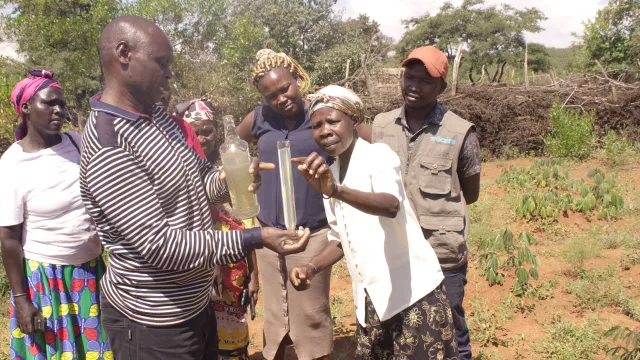
The success of the AICCRA-KMD app, lies in its innovative crowdsourcing model. We provide farmers with standard rain gauges, and they become active agents in collecting vital climatological and crop data. This gives them a powerful sense of involvement in climate information creation. Since our farmers are the backbone of this data collection, it is only right that they also become the primary recipients of tailored forecasts through the same app, empowering them to be champions who promote climate information services within their communities. Having proven its utility in 8 counties, the clear next step is to scale this transformative tool to all 47 counties of Kenya." — Paul Murage, Director at the Kenya Meteorological Department (KMD).
This inclusive approach ensures that the benefits of agricultural digitization reach farmers across different contexts, reducing inequality in access to critical agricultural information.
“Through AICCRA and other partners’ support, our system is now able to produce downscaled county-specific forecasts, containing information on amounts of rainfall that will be received in different locations and sub locations, up to a resolution of 0.5 kilometres. This downscaling can be done both at the headquarters and by the county directors in their respective counties,” says Jemimah Gacheru, Principal Meteorologist, Kenya Meteorological Department (KMD).
Focusing on robust climate information services platforms is positioning Kenya as a regional leader in digital agriculture transformation, offering a replicable model that can be adapted across East Africa. Beyond technology, its success lies in the practical, farmer-centered way the information is delivered and applied. The KAOP-AgData Hub and related support to farmers and climate volunteers creates an ecosystem for resilience, productivity, and transformation. By aligning tailored scientific data with the practical needs of farmers, the system demonstrates how digital innovation can tackle climate challenges, strengthen food systems, and improve livelihoods.
Authors
Polycarp Otieno Onyango, Communications Manager, AICCRA Kenya
Sidjese Makhoka, Research Associate - Digital Agriculture and Innovation, ILRI
This article was first published on the AICCRA website
Related content
1. Enhancing Kenya Agricultural Observatory Platform (KAOP) by integrating AICCRA’s AgDataHub
2. User Engagement with the AICCRA-KMD Mobile App and web Dashboard