

From evidence to action: BDN supports food systems transformation in Bangladesh through key policy engagements
- Bangladesh
- food systems
- nutrition
Food systems in Bangladesh are rapidly evolving in response to population growth, urbanization, and climate change. Diets, however, remain inadequate for many households, due in part to barriers in the food environment that limit the affordability, availability, and desirability of nutritious foods. Addressing these constraints has emerged as an urgent policy priority, requiring integrated approaches that translate research into actionable strategies.
In late 2025, the CGIAR Science Program on Better Diets and Nutrition (BDN), in collaboration with the Food Planning and Monitoring Unit (FPMU) of Bangladesh’s Ministry of Food, convened two key engagements with national stakeholders, aiming to strengthen evidence-informed policies for sustainable healthy diets.
Building on SHiFT’s foundation
BDN’s work in Bangladesh builds on partnerships established under the CGIAR Research Initiative on Sustainable Healthy Diets through Food Systems Transformation (SHiFT). In 2024, SHiFT formalized collaborations with FPMU and the Bangladesh National Nutrition Council (BNNC), supporting the development of the country’s National Action Plan for Food Systems Transformation (PoA-FST).
Through these partnerships, SHiFT contributed to reviewing and synthesizing evidence on consumer behavior, diet quality, and food environments, while also enhancing national capacity. A training-of-trainers program on food systems transformation for sustainable healthy diets was co-developed to support the rollout of the PoA-FST at sub-national and district levels. These efforts helped ensure sustainable healthy diets were embedded within Bangladesh’s food systems policy framework.
As CGIAR transitioned to its new research portfolio in 2025, these partnerships continued under BDN, particularly through Area of Work 1 on Consumers and Food Environments, maintaining technical support as Bangladesh moved from policy development and program planning to implementation and monitoring.
National workshop: Reviewing progress and implementation challenges
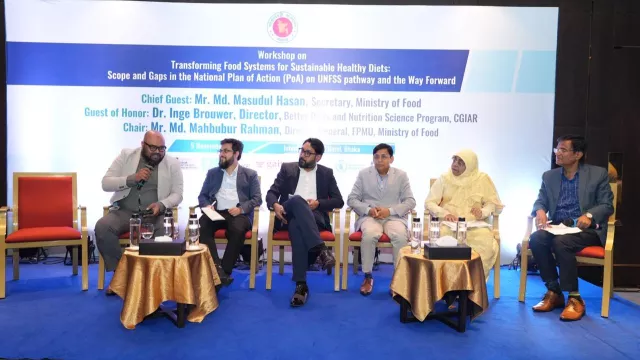
In November 2025, FPMU and BDN co-hosted a national workshop in Dhaka to review policies and actions related to sustainable healthy diets under the PoA-FST, aiming to identify implementation challenges and generate concrete recommendations for improvement. The event convened government officials, researchers, academics, development partners, NGOs, and the private sector to assess whether current policy options are sufficient to deliver sustainable healthy diets at scale.
Discussions highlighted persistent constraints, including limited dietary diversity, the high cost of healthy diets, weak regulations, and gaps in governance. In response, participants generated a list of prioritized recommendations to increase the affordability, availability, and consumption of sustainable healthy diets. These included strengthening regulations on food marketing, front-of-package labeling, and food safety; scaling up dissemination of food-based dietary guidelines and nutrition education; improving market infrastructure to reduce food loss and waste; and prioritizing production of nutrient-dense foods like fruit, vegetables, fish, and eggs. Participants also emphasized expanding nutrition-sensitive social protection—such as healthy diet baskets and vouchers—alongside efforts to enhance data systems, strengthen capacity, and improve inter-ministerial coordination.
These recommendations align with the five pillars of the PoA-FST: (1) nourish all people, (2) promote nature-based solutions, (3) advance equitable livelihoods, (4) build resilience, and (5) improve implementation and governance. FPMU indicated that the recommendations will inform ongoing monitoring and future adjustments to the PoA-FST.
Technical roundtable: Strengthening evidence for food environment policy
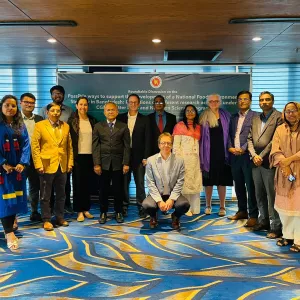
Building on the November workshop, FPMU and BDN held a technical roundtable in December 2025, bringing together national and international experts to discuss one of the PoA-FST’s priority areas: food environments. The roundtable was designed to support the development of Bangladesh’s National Food Environment Strategy—a commitment announced at the 2025 Nutrition for Growth Summit in Paris.
Discussions centered on findings from three BDN-supported research efforts conducted in Bangladesh in late 2025. These consisted of an FPMU-led analysis on the role of the food environment in supporting sustainable healthy diets, with a focus on sugar-sweetened beverage (SSB) taxation; a review exploring pathways for translating evidence into policy commitments for healthier diets; and an assessment of social and behavior change communication (SBCC) resources and opportunities for enhancing the implementation of Bangladesh’s Food-Based Dietary Guidelines (FBDG).
Through structured reflections, participants identified evidence gaps and policy actions to inform the National Food Environment Strategy. Priority research areas included assessing SSB intake, expanding food affordability analysis, testing SBCC strategies, and designing market interventions to support healthier choices. Key policy recommendations included establishing a strong multisectoral governance framework; introducing regulations such as food labeling, SSB taxation, and restrictions on marketing of unhealthy foods; and translating FBDG messages into practical, culturally relevant SBCC materials.
From dialogue to decision-making
Together, these recent engagements in Bangladesh demonstrate a clear progression from broader policy framing to more focused discussions on evidence, policy options, and implementation pathways. The dialogues convened by FPMU and BDN yielded actionable recommendations to strengthen the PoA-FST and inform emerging policies that respond to improving food environments and dietary patterns. These inputs contribute to the growing evidence base available to the Government of Bangladesh as policymakers work to advance national commitments on food systems transformation and sustainable healthy diets.
The CGIAR Science Program on Better Diets and Nutrition (BDN) identifies, co-designs, and tests food system solutions that tackle major constraints to delivering sustainable healthy diets and improving nutrition outcomes for people in low and middle-income countries. To learn more about BDN, visit https://www.cgiar.org/cgiar-research-portfolio-2025-2030/better-diets-and-nutrition