

At COP30, how billions eat matters
Global climate debates often focus on emission targets and dietary change. That framing leaves little room for places where a cow or a small catch of fish determines whether a household eats, earns income, or recovers after a shock.
Global climate debates often focus on emission targets and dietary change. That framing leaves little room for places where a cow or a small catch of fish determines whether a household eats, earns income, or recovers after a shock.
Across low- and middle-income countries, animal and aquatic food systems support billions of people. They underpin nutrition, livelihoods, and local economies, particularly for smallholders, women, and youth. Despite this central role, these systems remain highly exposed to climate stress and receive limited attention in climate finance and policy discussions.
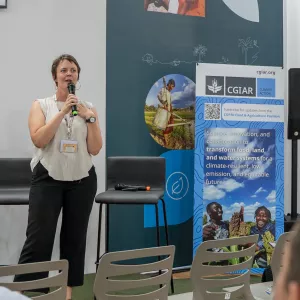
That gap featured prominently at COP30. Scientists from the CGIAR Sustainable Animal and Aquatic Foods and Climate Action programs, alongside policymakers, argued that climate strategies will fall short unless livestock and aquatic foods are approached through a solutions lens. A session on scaling resilient animal and aquatic food systems explored how science, policy, and finance can align to strengthen resilience while supporting national climate goals.
Rather than debating whether these systems belong in climate action, the discussion focused on how they can deliver adaptation, mitigation co-benefits, and food security.
Science grounded in real conditions
Researchers emphasized that climate impacts are already reshaping how food is produced. Rising temperatures, floods, droughts, and ecosystem shifts are affecting fisheries, aquaculture, and livestock systems unevenly, often hardest in regions with the least buffer against shocks.
Michelle Tigchelaar, a scientist with WorldFish, described how fish farmers and small-scale fishers are adapting through practical innovations already in use. These include integrated aquaculture systems that spread risk across species: rice–fish farming that maximizes land and water efficiency, and improved fish strains that deliver higher productivity with lower environmental pressure. In some communities, solar-powered cold storage managed by women’s groups is reducing losses and stabilizing incomes.
“These are not future concepts,” Tigchelaar said. “They are existing practices that help people manage climate variability today.”
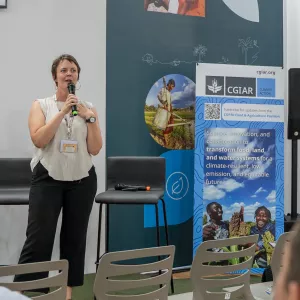
From the livestock side, Anthony Whitbread, program leader for livestock, climate, and environment at the International Livestock Research Institute, highlighted that resilience and efficiency often move together. Improved animal health, better feeds, and climate-resilient genetics can help farmers maintain productivity under stress while improving overall system performance.
Rather than framing livestock through aggregate emissions alone, the discussion emphasized emission intensity and productivity gains, particularly in systems where animals remain essential to livelihoods and nutrition.
“What matters is how food is produced and how efficiently resources are used,” Whitbread said. “That is where both resilience and climate benefits are found.”
Participants also stressed the importance of strong measurement and reporting systems, not to penalize farmers, but to ensure national climate plans reflect on-the-ground realities and credible progress.
When evidence shapes policy and finance
Several speakers pointed to a shift already underway. Governments are increasingly using detailed data to move from broad climate aspirations to targeted actions within their food systems.


In Kenya, improved emissions and productivity data have helped policymakers integrate livestock more clearly into national climate planning, opening pathways for climate-aligned investment. Similar approaches are emerging elsewhere as countries recognize that excluding major food sectors weakens both adaptation and mitigation strategies.
Finance is beginning to follow. Agricultural lenders are factoring climate risk into decision-making and expanding products that support adaptation and efficiency. Panelists emphasized that solutions must remain locally grounded, as global averages rarely capture national realities, such as the dominance of specific species or production systems.
Partnerships between public research and the private sector also featured prominently. These collaborations are helping scale proven innovations, from climate-resilient forages to improved seed systems, beyond the reach of research programs alone.
Inclusion shapes impact
Equity emerged as a recurring theme. Women play central roles in livestock and aquatic food systems yet often face barriers to assets, services, and decision-making. Climate strategies that overlook these dynamics risk reinforcing vulnerability.
Some countries are addressing this through gender-responsive climate planning, service delivery targets, and investments in safer, more efficient processing technologies. These measures may appear incremental, but they shape who benefits as climate solutions scale.
The session sent a clear signal. Animal and aquatic food systems are not peripheral to climate action. They sit at the intersection of adaptation, mitigation, food security, and economic stability.
As Todd Rosenstock, director of the CGIAR Climate Action Science Program, noted, “The science is there, and the pathways are clear. The challenge is ensuring these systems are fully reflected in climate decisions.”
Climate goals will remain abstract if they fail to account for how food is produced and consumed in vulnerable regions. The question raised at COP30 was not whether livestock and aquatic foods belong in climate action, but whether global climate efforts are ready to engage with the systems that feed much of the world.