

Strengthening resilience for 7,000 households in Mozambique
In conflict-affected Cabo Delgado, new CGIAR–WFP research is guiding the design of conflict-sensitive nature-based solutions. By linking ecosystem science with local conflict dynamics, the approach supports recovery efforts that strengthen livelihoods and resilience for 7,000 vulnerable households without worsening tensions.
- climate security
- Conflict sensitivity
- Nature-based solutions
- Fragile and Conflict-Affected Settings
- Resilience and recovery
- Ecosystem services
- Livelihoods and peacebuilding
- Cabo Delgado
Conflict-sensitive nature-based solutions strengthen resilience for 7,000 households in northern Mozambique
In northern Mozambique’s Cabo Delgado province, years of violent conflict and environmental degradation have combined to erode livelihoods and deepen vulnerability. New research is now helping recovery efforts avoid reinforcing tensions, by grounding nature-based solutions in both ecological evidence and local conflict dynamics.
Since 2017, Cabo Delgado has faced a protracted insurgency that has displaced communities, disrupted markets, and weakened already fragile social structures. At the same time, the region has been exposed to cyclones, erratic rainfall, and environmental degradation that undermine farming, fishing, and forest-based livelihoods. Competition over land, forests, and coastal resources has intensified sometimes becoming a driver of local tensions rather than a pathway to recovery.
As World Food Programme expanded recovery and resilience programming in Palma and Mocímboa de Praia districts, it recognized a central risk: well-intentioned livelihood and environmental interventions could inadvertently exacerbate conflict if they failed to account for local power relations, grievances, and resource pressures.
Building an integrated evidence base
To address this challenge, CGIAR researchers at the Alliance of Bioversity International and CIAT, working through the Food Frontiers and Security Science Program, partnered with WFP Mozambique to generate an integrated analysis linking ecosystem services with conflict dynamics.
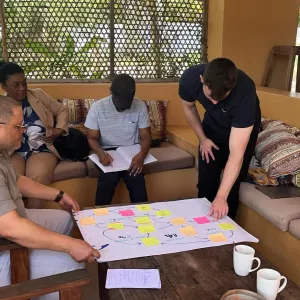
The research combined two strands. First, an ecosystem assessment examined inland and coastal systems, mapping how communities depend on natural resources for food, energy, and income. Household surveys across ten communities were complemented by spatial and hydrological modelling to analyze land cover change, water availability, carbon storage, and pollination services. Second, a participatory conflict analysis explored social relations, governance structures, and trust networks, identifying how factors such as youth unemployment, weakened traditional leadership, and displacement interact with competition over resources.
“We have done ecosystem services assessments in Mozambique before, but not in Cabo Delgado and not in a fragile and conflict-affected area,” said Christian Grassini, Head of Climate Change Adaptation and Resilience Building at WFP Mozambique. “The study gave us a holistic overview of both the landscape and how communities interact with their environment and natural resources.”
Identifying conflict-sensitive pathways
Bringing these strands together allowed the team to identify entry points for conflict-sensitive nature-based solutions (NbS). The analysis showed that livelihoods in Palma and Mocímboa de Praia rely heavily on ecosystem services such as woodfuel, fisheries, and wild food products. Yet unsustainable extraction of these same resources risks degrading ecosystems and heightening social tensions.
Scenario modelling helped compare conservation-oriented and development-oriented pathways, clarifying which interventions could restore ecosystem services while minimizing conflict risks. The result was a set of practical recommendations tailored to local conditions.
“The study helped us identify the most relevant types of nature-based solutions for our communities,” explained Dinara Abzhamilova, Policy and Programme Officer for Resilience Building and Climate Change Adaptation at WFP Mozambique. “Based on the findings, we are now consulting with communities, developing technical guidelines, and clarifying the roles of different implementing partners.”
Recommended interventions include mangrove and coastal restoration, agroforestry and native tree integration, sustainable charcoal production, beekeeping to support pollination and diversify incomes, and improved water catchment and treatment systems. Each option was assessed not only for environmental benefits, but also for its implications for equity, access, and local power dynamics.
From research to operations
These recommendations have been incorporated into WFP’s recovery and stabilization programmes in Palma and Mocímboa de Praia, including SCYP-Palma and CREFONS-MdP. Together, they are expected to benefit approximately 7,000 conflict-affected households.
To support implementation, CGIAR and WFP also invested in capacity building. Findings were shared with WFP leadership, field teams, local partners, and government representatives in Maputo and Pemba, creating a shared understanding of how climate, environment, and conflict intersect in Cabo Delgado.
In September 2025, CGIAR facilitated a dedicated conflict-sensitivity training workshop with the MASC Foundation and the Peaceful Change Initiative. Forty-two WFP and partner staff were trained in practical tools such as the Conflict Sensitivity Matrix and Conflict Sensitivity Interaction Typology, enabling teams to assess risks and adapt interventions throughout the programme cycle.
“The workshop helped cultivate a new mindset,” noted Abzhamilova. “We are now using these tools to review and, where necessary, adjust our interventions to make them as conflict sensitive as possible.”
Informing next steps
As implementation begins, the integrated analysis continues to inform operational planning in some of Mozambique’s most vulnerable districts. By linking ecosystem science with an understanding of local conflict dynamics, the collaboration is helping align environmental sustainability with livelihood recovery and social cohesion.
Beyond Cabo Delgado, the methodology offers a model for replication in other fragile and climate-affected contexts. It demonstrates how evidence-led, conflict-sensitive design can help ensure that nature-based solutions contribute not only to resilience, but also to stability and peace.
This work is carried out with support from the CGIAR Climate Action Science Program (CASP) and the CGIAR Food Frontiers and Security (FFS) Science Program. We would like to thank all funders who supported this research through their contributions to the CGIAR Trust Fund: https://www.cgiar.org/funders/