

From Commitment to Capability: Insights from the first national NDC Capacity Scorecard Pilot Workshop
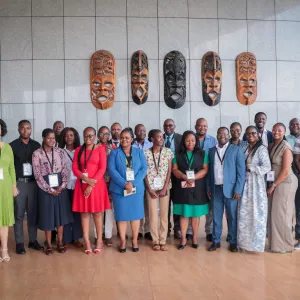
A two-day pilot workshop (5–6 November 2025) in Lilongwe brought together government, technical experts, civil society, and partners to test the NDC Capacity Scorecard and ask a hard question: is Malawi institutionally ready to deliver NDC 3.0? Led by the Ministry of Natural Resources/EAD with support from UNFCCC RCC ESA, IWMI, and AGNES, the process shifted from “scoring” to an honest diagnosis of readiness across finance, technical systems, governance, and M&E. Participants surfaced real bottlenecks—especially local financing gaps, weak coordination, and data hoarding—and then co-designed improvements to make the tool practical for government use. The pilot helped reposition validation as a strategic moment for alignment and stronger implementation, showing that Malawi’s challenge is no longer ambition, but capability to execute.
Authors::
- Winnie Kasoma-Pele, Research Associate, International Water Management Institute (IWMI)
- Mahlatse Nkosi, Research Officer - Inclusive Agricultural Finance, IWMI
- Greenwell Matchaya, Senior Researcher and Deputy Country Representative South Africa, IWMI
- Minky Groenewald, NDC/LTLEDS Expert and Coordinator, UNFCCC Regional Collaboration Centre for Eastern and Southern Africa (RCC ESA)
- Roberta Makoko, Malawi NDC Coordinator, NDC Partnership
On November 5–6, 2025, the President Hotel in Umodzi Park, Lilongwe, pulsed with enthusiasm as government officials, technical experts, civil society members, and development partners convened to what may have seemed like another technical workshop. In reality, the conversation shifted toward by understanding the capacity required to achieving Malawi’s set climate action ambitions in preparing to implement NDC 3.0. This pilot revealed that Malawi’s main challenge is no longer ambition, but the institutional capacity, coordination, and systems required to turn NDC 3.0 commitments into implementable and measurable action.
Convened by Malawi’s Ministry of Natural Resources through the Environmental Affairs Department (EAD), in partnership with the UNFCCC Regional Collaboration Centre for Eastern and Southern Africa, International Water Management Institute (IWMI), and African Group of Negotiators Expert Support (AGNES), the Southern Africa pilot of the NDC Capacity Scorecard created a space for a deeper question to be asked, that being: Is Malawi institutionally ready to deliver on its climate commitments?
As the country prepares its NDC 3.0, this question could not be timelier. Malawi has no shortage of climate ambition, as policies, strategies and supporting frameworks are in place. Yet, like many other African countries, the persistent challenge observed is translating these commitments into coordinated, well-resourced, and measurable action across institutions and levels of government.
The NDC Capacity Scorecard was developed not to serve as a compliance exercise but rather a self-diagnostic mirror, meant to guide institutions in reflecting on their readiness to implement Nationally Determined Contributions (NDCs), across four interconnected dimensions: financial, technical, governance and monitoring and evaluation (M&E) capacities. Over the two days, the process shifted away from scoring toward an honest assessment of institutional readiness, with the pilot focusing on three strategic outcomes:
- Introduce stakeholders to the framework and scoring methodology of the scorecard
- Conduct a participatory self-assessment of institutional capacity
- Generate actionable recommendations to reconfigure the tool to be reflective of institutional realities of governments and thus culminating in a co-design a roadmap toward uptake.

Confronting the Real Constraints
Discussions quickly moved beyond methodology toward participants observation in reference to implementation constraints. Participants spoke openly about the structural realities shaping climate implementation in Malawi. A recurring theme was the limited financial support at the local level inhibiting project sustainability. In the same accord, data sharing was rather topical, noting institutional reluctance to share data, frequently, owing to fear of lack of accountability of origin of data, is weakening coordination and reporting.
“Without a foundation of confidence, our planning efforts will always be hampered. We need to be able to share information freely”. ~ Workshop participant
These constraints mirror long-standing challenges in Malawi’s NDC monitoring and reporting systems, where weak coordination and unclear data ownership continue to undermine effective implementation and reporting.
This observation reframed the conversation, highlighting that climate action is not only constrained by resource availability or technical skills, but rather institutional culture, stemming from coordination among institutions, thoughts and perceptions around accountability and confidence built across the system, resultantly, add to implementation constraints.
In addition, the role of civil society organizations (CSOs) in reporting national NDCs came into question, while they are deeply embedded in implementation on the ground, their formal role remains limited and unclear. As a result, participants echoed the need for clearer avenues for inclusion, and institutionalized pathways as a priority, to ensure timely engagement and feedback.
The sectoral discussions that followed reinforced the same notion. Within the energy sector, the focus was on hydropower, this wasn’t owed to it being a low carbon energy source, but because electricity access remains limited despite hydropower’s dominance in the national energy mix. In Agriculture, Forestry and Other Land Use (AFOLU), Malawi’s largest emitter, participants called for clearer guidance on which mitigation and adaptation measures would be prioritized and how they would be resourced under NDC 3.0.

When the Tool Became the Catalyst
The turning point of the workshop came when participants engaged directly with the scorecard itself. Consequently, this resulted in them reshaping the diagnostic tool, question by question, with the intention being to reflect the realities of how government and associated institutions work. In doing so, it meant that the tool was not viewed as a fixed instrument but one that needed to be evaluated by the target audience and thus making it adaptive.
Finance questions were refined to distinguish public and private actors and to clarify funding timeframes, such as annual or five-year funding cycles. Governance questions were simplified to remove any underlying ambiguity. Technical capacity questions were adjusted to separate existing systems from their effectiveness and monitoring and evaluation sections were strengthened to standardize data needs thus clarifying institutional responsibilities in terms of understanding whether or not an M&E entity has been identified to support NDC implementation.
Through this co-design process, the scorecard evolved into a practical and context-responsive tool that institutions could realistically adopt and use. Due to the diversity of participants, it created a common reference point across institutions where it is not a common practice or incentive to evaluate readiness in unison.
Beyond Tools: A Shift in Mindset
Participants emphasized the need for a more profound change, extending beyond technological solutions, as institutional readiness also extends to culture. They emphasised the importance of adopting a mindset that values openness, transparency, and collaboration, recognizing that tools alone cannot compensate for fragmented systems and guarded information flows.
“Information hoarding is a bigger barrier than funding.” ~ Workshop participant
A shift in mindset matters, as it is foundational to reframing climate governance as simply a checklist of actions, toward an evolving system that must be deliberately strengthened if commitments are to translate into tangible results.
From Reflection to Action: UNFCCC Support to Malawi’s NDC 3.0 Validation Process
Building on the momentum and insights generated through the NDC Capacity Scorecard piloting, with support from the UNFCCC and its Regional Collaboration Centre (RCC) for East and Southern Africa, direct country assistance is set to be provided to the Government of Malawi, this support is focused on advancing NDC 3.0 and, critically strengthening readiness and implementation.
Rather than treating validation as a procedural step before submission to the UNFCCC, Malawi is using it as a strategic moment of institutional alignment. Resultantly, to ensure broad ownership of NDC 3.0, the Government of Malawi, through the Environmental Affairs Department in the Ministry of Natural Resources, is convening validation meetings at multiple levels designed to bridge national ambitions with sub-national and sectoral realities.
Malawi has identified two critical validation processes where UNFCCC support will be instrumental:
- Central Region Validation Meeting, engaging stakeholders from district councils in the Central Region.
- Sectoral Validation Meeting , involving NDC sector focal points at the central level, including representatives from line ministries, academia, research institutions, civil society organizations, and the private sector.
The validation workshops are intended to: 1) integrate inputs from key sector stakeholders into NDC 3.0, 2) strengthen ownership and buy-in across all levels of implementation and 3) facilitate smoother implementation and resource mobilization through inclusive participation.
It is important to note that, this validation process is complementary to the lessons learned during the scorecard piloting, that being the need for shared information, trust and coordination. The scorecard piloting and the validation process, represent two parts of a single transition, that supports moving from ambition to execution.
COP 30 Engagement and Next Steps

Building on this country-level work, the NDC Capacity Scorecard was subsequently showcased at COP30 in Belem, Brazil, through a joint session co-organized by CGIAR/IWMI, the Government of Malawi, the UNFCCC Secretariat, and the African Group of Negotiators Expert Support (AGNES). This engagement positioned the scorecard as a practical, government-facing tool to support NDC implementation tracking and institutional capacity strengthening, firmly embedded within ongoing UNFCCC processes rather than as a standalone analytical exercise.
The presence of government counterparts, negotiator groups, and the UNFCCC Secretariat was instrumental in reinforcing the legitimacy of the approach and demonstrating how country-led piloting can inform global transparency, implementation, and capacity-building discussions. Moreover, these engagements generated interest from several countries, including but not limited to Gambia, Madagascar, and Brazil, particularly around adapting scorecard-type approaches to diagnose implementation bottlenecks and guide capacity support for NDC delivery.
A Signal Beyond Malawi
As Malawi finalizes its Climate Change Management Bill, updates its NDC Implementation Plan, and prepares to submit NDC 3.0, a clear but powerful signal is being sent, climate action is not only about setting ambitious targets, but it also requires the complementarity of building institutions that can deliver. The scorecard now provides Malawi with a practical entry point for strengthening institutional readiness, informing capacity-building investments, and aligning NDC 3.0 implementation with financing and accountability requirements. Resultantly, all participant recommendations will be incorporated into the scorecard and the scorecard redeployed, the modified tool will be hosted digitally and continue to be open access, and the Ministry will lead institutional adoption and translate findings into capacity-building actions.
Together, the Malawi pilot and the COP engagement demonstrate how continuous feedback between national implementation and global climate processes can close the gap between NDC ambition, institutional preparedness, and on-the-ground delivery.