

Charting a unified path to transform the small ruminant market in Mali
Sheep and goat value chains in Mali sustain millions of people, yet they continue to face pressures from climate variability, uneven animal health coverage, fragmented trade networks, and limited market access. To boost incomes, build resilience, and enhance product quality across the sector, CGIAR is supporting sustainable models that foster environmental protection and maximize productivity.
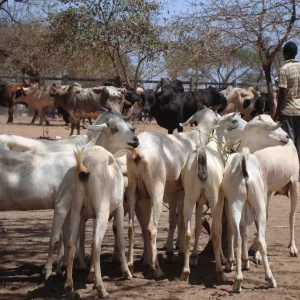
Sheep and goat value chains in Mali sustain millions of people, yet they continue to face pressures from climate variability, uneven animal health coverage, fragmented trade networks, and limited market access. To boost incomes, build resilience, and enhance product quality across the sector, CGIAR is supporting sustainable models that foster environmental protection and maximize productivity.
During a series of workshops in Bamako, the CGIAR Sustainable Animal and Aquatic Foods (SAAF) program and the International Livestock Research Institute (ILRI) brought livestock experts together to identify priorities and develop effective action plans. These strategies are not only crucial for the national economy and food and nutrition security, but also for the rural families that bank on small ruminants as a steady source of cash.
As one farmer from Sikasso put it: “When everything else fails, the sheep saves the family. But accessing quality feed and getting fair prices are constant challenges.”
From diagnosis to action
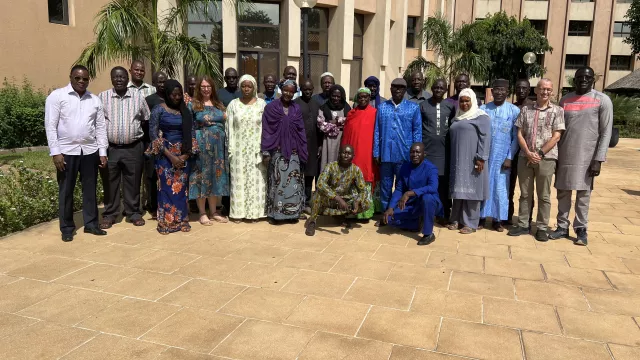
More than 30 stakeholders from Sikasso, Ségou, and Bamako attended a market systems analysis (MSA) workshop in July 2025 at the International Crops Research Institute for the Semi-Arid Tropics (ICRISAT) in Bamako. Participants included herders, traders, transporters, butchers, leather processors, veterinarians, regulators, financial service providers, and consumers. Together, they mapped out priority bottlenecks:
- Vaccination remains insufficient against diseases such as peste des petits ruminants (PPR) and sheep pox.
- Animal feed is costly and highly seasonal.
- Livestock transport is still informal, with little traceability.
- Enforcement of sanitary rules and price transparency needs strengthening.
As a representative of a national consumer association emphasized: “We must build an environment where information flows from herder to consumer. Without transparency, trust cannot grow.”
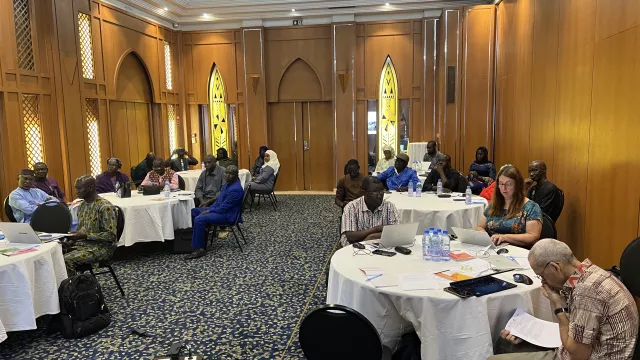
On 7–8 October 2025, a second workshop focused on co-designing interventions. Producers, aggregators, and input and service providers (animal health, feed, finance, technology) worked through a structured process in:
- reviewing lessons from the market systems analysis;
- assessing the current system;
- identifying underperformed functions and capacities or incentive gaps; and
- defining expected behavioral changes, i.e. “who does what, why, and who pays”.
Sessions helped forge partnerships based on desired attributes in commercial relationships, while envisioning a future system with new roles and measurable commitments. A dedicated discussion on tailored financing to reduce producer risk brought together buyers, input suppliers, and financial institutions.
Facilitation aimed to align rather than replace actors. Hippolyte Affognon, deputy chief of party and program coordinator at CORAF - West and Central African Council for Agricultural Research and Development , stressed the importance of methodical progression: “Start from the function each actor truly performs, clarify who bears the cost today, then reorganize incentives to make those functions effective tomorrow.”
Michel Dione, ILRI scientist and SAAF coordinator in Mali, added: “It is not only about identifying bottlenecks; we must build trust to co-create solutions with all stakeholders.”
Concrete proposals from stakeholders
Livestock feeding was central to many of the deliberations and proposed solutions. Participants proposed the following:
- Increase forage availability, improve processing, organize storage, and optimize distribution.
- Better integrate the “health and feed” nexus by synchronizing vaccination campaigns with critical feeding periods to secure productivity.
- Establish clearer rules on traceability, price information, and sanitary protocols.
- Ensure meaningful inclusion of women and youth, with defined roles (management, data collection, basic services), targeted training, and improved access to small equipment.
To accelerate progress, they recommended the short-term actions:
- Support small local feed units with business plans, tailored formulations, and quality control.
- Install low-cost solutions for storage and drying.
- Organize short market meetings between feed sellers, traders, and veterinarians to adjust supply and services.
- Align credit cycles with seasonal sales to reduce risk.
As one livestock trader summarized: “Herders need reliable buyers and clear rules. With those in place, they invest and improve their practices.”
Looking ahead to 2026
The outcomes of these activities are feeding into the design of a national intervention to be co-deployed with local partners in 2026 across the Ségou and Sikasso regions. The vision is of modern, inclusive, and resilient small ruminant markets, delivering safe, high-quality products while improving incomes and local employment, especially for women and youth.
This work is part of CGIAR’s mission to transform food systems so they are healthier, fairer, and climate-resilient, driven by scientific innovation co-designed and owned by communities.