

CGIAR initiates the development of a Product Design Standard for breeding
Breeding for Tomorrow transdisciplinary teams synthesized learnings from over 130 national stakeholder consultations and defined a Product Design Standard for breeding that follows best practices and is aligned with CGIAR 5 impact areas.

CGIAR initiates the development of a Product Design Standard for breeding
Designing crop varieties that farmers will adopt years into the future requires one essential ingredient: accurate and timely insight into what farmers and consumers will need. Yet public breeding programs across the Global South often lack this market intelligence, leaving breeders without systematic feedback loops to guide decisions about product design, trait prioritization, and product advancement.
To help close this gap, CGIAR’s Breeding for Tomorrow (B4T) Science Program and the Digital Transformation Accelerator (DTA) convened a two-day workshop in Nairobi to align efforts between Market Intelligence (MI) and Enable, the Areas of Work respectively responsible for product design and partnership coordination across B4T Science Program.
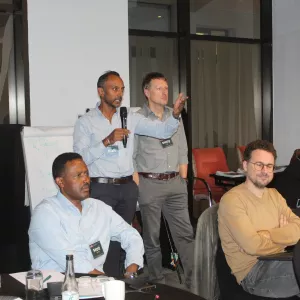
The workshop, facilitated by the Digital Product Team of DTA, brought together breeders, market specialists, nutrition and gender experts from across CGIAR. Its purpose: to initiate the development of CGIAR’s Breeding Product Design Standard and reinforce collaboration between Breeding for Tomorrow’s market intelligence efforts and coordination engine.
Why market intelligence matters for breeding
Commercial seed companies invest heavily in sales, marketing, and customer research to ensure that breeders are aware of emerging market trends and development needs. Teams collect information on farmer demand, consumer preferences, purchasing behavior, and future needs, data that feeds directly into R&D to shape new varieties.
Public breeding programs, comprising CGIAR and national partners, often lack a dedicated market intelligence function and maintain fewer direct touchpoints with farmers and consumers. This has contributed to a common criticism: many public varieties “remain on the shelf,” failing to meet real market needs to be widely adopted.
Breeding for Tomorrow has addressed this in two ways. Its Market Intelligence Area of Work collects the data breeders need to understand farmer and consumer demand at the start of the breeding cycle. Enable, another Area of Work, conducts Product Design Team (PDT) meetings where stakeholders (CGIAR, national partners and value chain actors) review user needs and jointly define which varieties should be bred.
Over 130 PDT consultations have been conducted in over 20 countries and 17 crops since 2022. The objective of the workshop was to synthesize learnings from this effort and define a Product Design Standard that follows best practice and is aligned with CGIAR 5 impact areas.
“Understanding future market demand is essential for breeding, not optional,” noted Matty Demont, MI Lead. “The Standard we started developing in the workshop aims to ensure that the design of future varieties follows standardized processes where the voices of multiple stakeholders – CGIAR, national partners, and value chain actors – are systematically taken into account to ensure products are in-demand, impactful, gender intentional and feasible.”

Building a shared framework for product design
The workshop actively sought input and feedback from Centers in order to co-develop a Product Design Standard that is appropriate and practical. The integration of market intelligence, breeding prioritization and partner roles and responsibilities within regional breeding networks was discussed and anchored around three pillars:
- Clarifying how market intelligence informs breeding decisions, ensuring insights are timely, actionable, and systematically integrated.
- Ensuring a transdisciplinary approach that incorporates stakeholder voices across the value chain that is aligned to CGIAR impact areas.
- Mapping the current workflow from market intelligence => market segmentation => Target Product Profile Design => Product Advancement, identifying gaps and agreeing on what a consistent process requires.
Participants worked through interactive exercises to compare practices across Centers, identify bottlenecks, and co-design the components of standardized Product Design and Advancement Standard, including documentation standards, governance, data interoperability, and metrics.
A key contribution from DTA was demonstrating how Human-centric (UX) design in digital product development parallels product design in breeding. As Lina Yassin, Product Lead at CGIAR AI Hub, and the workshop facilitator, explained, “Developing breeding products follows the same principles as developing digital products in that impactful varieties also require human-centric design. DTA’s product development framework can directly support CGIAR breeding teams, which is why we facilitated this workshop for Breeding for Tomorrow. This also shows the strong portfolio linkage within CGIAR; we’re all here to support each other!”.

Addressing long-standing gaps
Participants recognized the need to systematically address communication and market intelligence gaps that have been identified since 2022 when broader stakeholder engagement have been institutionalized in CGIAR breeding priority setting through PDTs. Central to this are strong feedback loops to MI specialists to resolve key MI gaps that are identified in PDTs. As an example, Biswanath Das, Enable Lead highlighted the fact that:
“Over 130 Product Design Team meetings have been conducted since 2022 and over 150 market intelligence gaps have been identified across crops and countries. However, we still don’t have a clear system to resolve these knowledge gaps and ensure updated information is fed back to breeding programs, so that they can update their target market segments and product profiles”.
A key example is quantifying the demand and current trend for hybrid seed of several crops in West Africa such as sorghum. “This is exactly the kind of knowledge gap that Market Intelligence can help us resolve, so that CGIAR and national partner breeders can take corrective action. It is important that we establish clear feedback loops so that the various bits of work that are ongoing across the B4T Areas of Work come together in a coherent manner.”, Bish added.
What the workshop delivered
CGIAR breeding programs will enter their next planning cycle in early 2026. At present, Centers use different templates, metrics, and workflows, creating delays and limiting comparability. The workshop provided the opportunity to begin harmonizing these approaches. By the close of the meeting, participants had produced several concrete and shared outputs.
1. A shared understanding of why PDS is essential
Representatives from Centers, MI, and Enable came together to take stock of current practices, exchange perspectives, and identify areas for alignment. Discussions clarified the value of Product Design Standards (PDS) and highlighted the need for stronger, more systematic feedback loops between MI and Enable. Participants broadly agreed that effective PDS implementation depends on improved, ongoing communication between breeding teams and MI. Cohesion was further reinforced through joint team-building exercises that intentionally brought MI and Enable staff together, helping foster a shared culture, trust, and a stronger sense of collective ownership.
2. Agreement on the core components of the PDS structure
Participants agreed to co-develop a product design standard that defines best practice, building on lessons learned over the past three years. This includes clear governance arrangements as well as data and KPI requirements. An initial outline for future PDS documentation was jointly developed during the workshop.
3. Clear identification of priority metrics and KPIs
Teams agreed that tracking progress will require harmonized indicators across the PDS workflow. While many potential success indicators were discussed, the group deliberately adopted a “less is more” approach for Version 1 of the PDS, identifying a small set of mandatory KPIs as a starting point.
4. A unified roadmap for 2025–2026
Centers’ timelines were consolidated into a shared roadmap covering MI tasks, PDS versioning, data contributions, and reporting milestones. Participants also identified the need for a coordinated calendar of activities and engagements to ensure visibility, alignment, and sustained collaboration across teams.

Importantly, the workshop strengthened relationships across teams and Centers. Through group activities, scenario exercises, and cross-disciplinary discussions, participants built trust and established clearer communication channels, an essential first step in an incremental approach that relies heavily on continuous feedback, learning, and experimentation, to drive continuous alignment and improvement.
***
This work contributes to CGIAR Breeding for Tomorrow Science Program and CGIAR Digital Transformation Accelerator. Written by Julie Puech.