

Building a national pool of trained facilitators to support food systems transformation in Bangladesh
Building a national pool of trained facilitators to support food systems transformation in Bangladesh
-Sydney Honeycutt, IFPRI
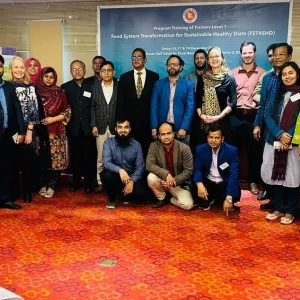
On December 15, 17, and 18, 2025, 23 participants from government agencies, research institutions, and international organizations gathered in Dhaka, Bangladesh, for a three-day training of trainers (ToT) workshop on food systems transformation for sustainable healthy diets. The workshop aimed to build transformative capacities among food system actors and their organizations, equipping them to lead and facilitate change processes in Bangladesh’s food systems.
Co-organized by the CGIAR Science Program on Better Diets and Nutrition (BDN), the Food Planning & Monitoring Unit (FPMU) of the Bangladesh Ministry of Food, the International Food Policy Research Institute (IFPRI), and Wageningen University & Research (WUR), the event was part of a broader effort to support food systems transformation in Bangladesh through capacity strengthening.
Food systems transformation in Bangladesh
Bangladesh has participated in the United Nations Food Systems Summit (UNFSS) process since 2021, making national commitments to advance sustainable, inclusive, and nutrition-sensitive food systems. To guide progress toward these goals, FPMU led the development of the country’s Plan of Action on Food Systems Transformation (PoA-FST).
Effective implementation of the PoA-FST depends on strong political support, multisectoral collaboration, sustained investment, and ongoing community engagement. Strengthening national capacity to facilitate learning, dialogue, multistakeholder partnerships, and coordination across the food system is therefore critical.
Training of Trainers (ToT) approach
Building off of engagement under the former CGIAR Research Initiative on Sustainable Healthy Diets (SHiFT), BDN collaborated with FPMU and the Bangladesh National Nutrition Council (BNNC) to design a tailored learning trajectory for food system actors in Bangladesh. The trajectory was informed by a design workshop held in Dhaka in October 2024 and mirrors similar ToT programs delivered in Vietnam and Ethiopia.
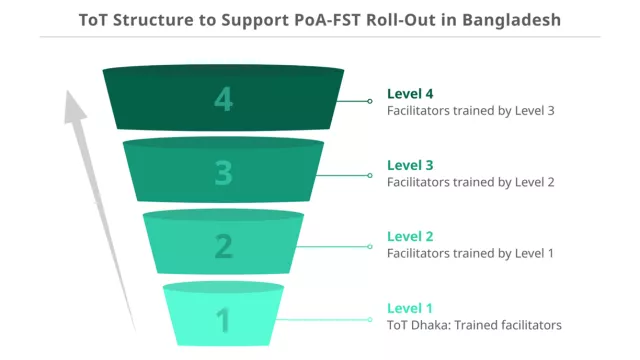
The purpose of the ToT approach is to build a pool of trained facilitators equipped to guide learning and change processes on food system transformation with diverse stakeholders. Structured across four cascading levels, the approach begins with a core group of Level 1 facilitators who receive intensive training on food system analysis, including practical application to local cases, as well as multi-stakeholder collaboration and facilitating change in food systems. These facilitators then deliver trainings within their own networks, progressively expanding capacity to support PoA-FST implementation.
The ToT program in Bangladesh commenced with a Food Systems Governance e-course featuring modules on sustainable healthy diets, food system analysis, multistakeholder partnerships, and the food system transformation process, tailored to the country’s context. This occurred alongside online workshops, in which participants interacted with guest speakers on Bangladesh’s PoA-FST, covering topics like food system dynamics, multistakeholder collaboration in complex spaces, and gender and social inclusion. These activities culminated in the in-person workshop in Dhaka, allowing participants to apply knowledge and enhance their facilitation skills.
Workshop highlights
Over three days, participants engaged in hands-on sessions that allowed them to practice skills in food system analysis, multistakeholder collaboration, and facilitating change using practical tools and techniques. Group work and discussions stimulated an exchange between participants and their institutional perspectives, which increased the learning effect of the ToT.
Day 1 focused on the current status of food systems transformation in Bangladesh. In groups, participants applied a food system analysis to different local case studies. They explored key challenges, leverage points, trade-offs, and synergies to achieve the outcomes of the PoA-FST and discussed pressing issues such as the triple burden of malnutrition and food safety in urban contexts.
Day 2 centered on multi-stakeholder partnerships in practice, with sessions on multi-stakeholder analysis and engagement, negotiation and influencing, institutional change, designing for gender and social inclusion, and working with power. Participants gained experience applying practical tools to strengthen collaboration across Bangladesh’s institutional landscape toward the envisioned outcome of Bangladesh’s PoA-FST.
Day 3 focused on building awareness and skills in facilitating change, with sessions on the principles of neuroscience, working with group dynamics, and using effective communication. Participants applied their skills using roleplays, and put their learning into practice by designing a one day training or awareness-raising program on a food system challenge.
Supporting PoA-FST implementation
As Bangladesh continues to advance its food systems transformation agenda, capacity strengthening efforts like the ToT program play an important role in supporting implementation. With the initial cohort of facilitators now trained, the program is positioned to scale to sub-national levels, reaching a broad range of stakeholders and accelerating the implementation of Bangladesh’s PoA-FST.
Beginning in 2026, the next phase will focus on in-country follow-up and the launch of Level 2 trainings. During this phase, the trained facilitators will be supported to develop local training materials and plans through peer exchange and feedback from the ToT trainers, ensuring the dissemination of knowledge and skills in support of food systems transformation nationwide.
-----------------------------------------------
The CGIAR Science Program on Better Diets and Nutrition (BDN) identifies, co-designs, and tests food system solutions that tackle major constraints to delivering sustainable healthy diets and improving nutrition outcomes for people in low and middle-income countries. To learn more about BDN, visit https://www.cgiar.org/cgiar-research-portfolio-2025-2030/better-diets-and-nutrition
Header image: Group photo during ToT training. Anowarul Islam, Independent Consultant.