

Building Local Research Capacity through Time, Trust, and Knowledge Transfer
This blog explores how hybrid mentorship models expand access to research training in Africa. Using the African Climate Mobility Academy, it shows how local hubs, global mentors, and alumni networks reduce barriers for women and early-career researchers.
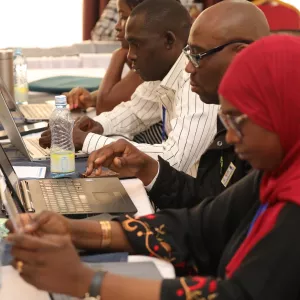
- research mentorship
- climate mobility academy
In this third contribution to our blog series, we frame mentoring modality as a pathway to equal access. Hybrid design is more than a logistical choice, it actively lowers barriers for women, caregivers, and researchers outside capital cities and regional hubs.
The African Climate Mobility Academy (ACMA) model combines minimal in-person convenings with sustained online engagement to widen access, reduce travel burdens, and preserve quality.
The result is a design that is replicable across contexts and disciplines. Local hubs hosted by universities or research centers, global mentor pools, and structured online peer review provide reliable and regular guidance for mentees. A growing alumni community comprising both mentors and mentees becomes the impact multiplier.
But a core question shapes any hybrid learning architecture: Which outcomes require in-person interaction, which can be delivered online, and which benefit from both?
Hybrid by Design: Local Hubs, Global Mentors, and Alumni Networks
In many research ecosystems across Africa, access to mentorship, training and publication pathways still depends heavily on mobility: traveling to capital cities, attending international conferences, or joining specialized workshops. These opportunities remain out of reach for many early-career scholars, particularly women, caregivers, and researchers based in rural or resource-constrained institutions.
ACMA was designed with this inequity in mind. Its foundational principle is simple but bold: excellence should not depend on who can secure a visa, afford travel, or leave their caregiving responsibilities for a week.
Why hybrid matters for women in science
Globally, women remain underrepresented in scientific careers, not because of capability, but because of structural barriers: unequal caregiving demands, limited institutional support, safety concerns around mobility, and deeply embedded expectations about gender roles.
When professional advancement hinges on being physically present – multi-day workshops, conferences far from home, field visits, or residency programs – women are disproportionately excluded. Even when they attend, the personal cost can be high: juggling childcare, long absences from home, and additional financial burdens.
A hybrid mentorship model directly challenges these constraints.
By shifting much of the intellectual, collaborative, and feedback-driven work online, ACMA reduces the reliance on travel without diminishing depth. Regular virtual meetings over several months allowed fellows to clarify expectations early and build confidence gradually. Female participants in particular appreciated the value of these online touchpoints and recommended even more frequent virtual engagements for future cohorts.
The catalytic power of selective in-person engagement
The strength of the hybrid model lies not only in what happens online but in the intentional sequencing of both modes. In ACMA, virtual mentorship laid the foundation, but the in-person write-shop delivered a catalytic moment; diversity of expertise in one room, uninterrupted writing time, and relationship-building that digital platforms cannot easily replicate.
Participants consistently highlighted the value of face-to-face mentorship, the energizing “shut up and write” sessions that unlocked unexpected breakthroughs, and the collegial atmosphere that accelerated learning and strengthened networks.
The Academy’s small-group structure was central to this success, creating safe, personal, and supportive interactions that built trust and sustained momentum. In short, ACMA uses in-person convenings for what they do best: deep work, confidence-building, intense collaboration, and interdisciplinary exchange, while reserving iterative, feedback-heavy tasks for online settings.
A model designed for replication
ACMA’s first year demonstrates a scalable architecture that can be tailored across regions, disciplines, and institutional contexts:
- Local hubs hosted by universities or research centers, provide accessible physical anchors for periodic convenings.
- A global mentor pool paired with structured online peer review, ensures high-quality intellectual guidance unconstrained by geography.
- Reliable, consistent online guidance maintains momentum, from manuscript development to skill-building sessions.
- An alumni layer becomes the multiplier, expanding networks, co-authoring publications, supporting new cohorts, and ultimately evolving into future mentors.
Integrating this hybrid architecture into CGIAR’s already significant capacity development efforts across its centers and Science Programmes aligns with the CapSha ambition: turning a successful pilot into a repeatable platform for system-wide research capacity strengthening.
It contributes to a shift that funders increasingly value: measuring success not through attendance metrics but through durable outcomes: manuscripts submitted, skills transferred, networks formed, and confidence gained.
Hybrid design as a pathway to equity and scale
The question is no longer whether hybrid works, but what hybrid makes possible. It democratizes access to mentorship, opens doors for women, lowers costs, and cultivates communities of practice that extend far beyond any single event.
ACMA’s experience shows that when hybrid design is intentional, it can produce stronger science, broader participation, and more resilient research ecosystems.
This work is carried out with support from the CGIAR Climate Action Science Program (CASP) and the CGIAR Capacity Sharing Accelerator. We would like to thank all funders who supported this research through their contributions to the CGIAR Trust Fund: https://www.cgiar.org/funders/