

Beyond policy and tech: New framework argues human transformation is critical for climate-resilient food systems
A new opinion piece published in Climate Research argues that effectively tackling the climate crisis requires a radical shift in focus: moving beyond technological fixes and institutional policy to prioritize human and societal transformations.

Beyond policy and tech: New framework argues human transformation is critical for climate-resilient food systems
By Glenn Concepcion
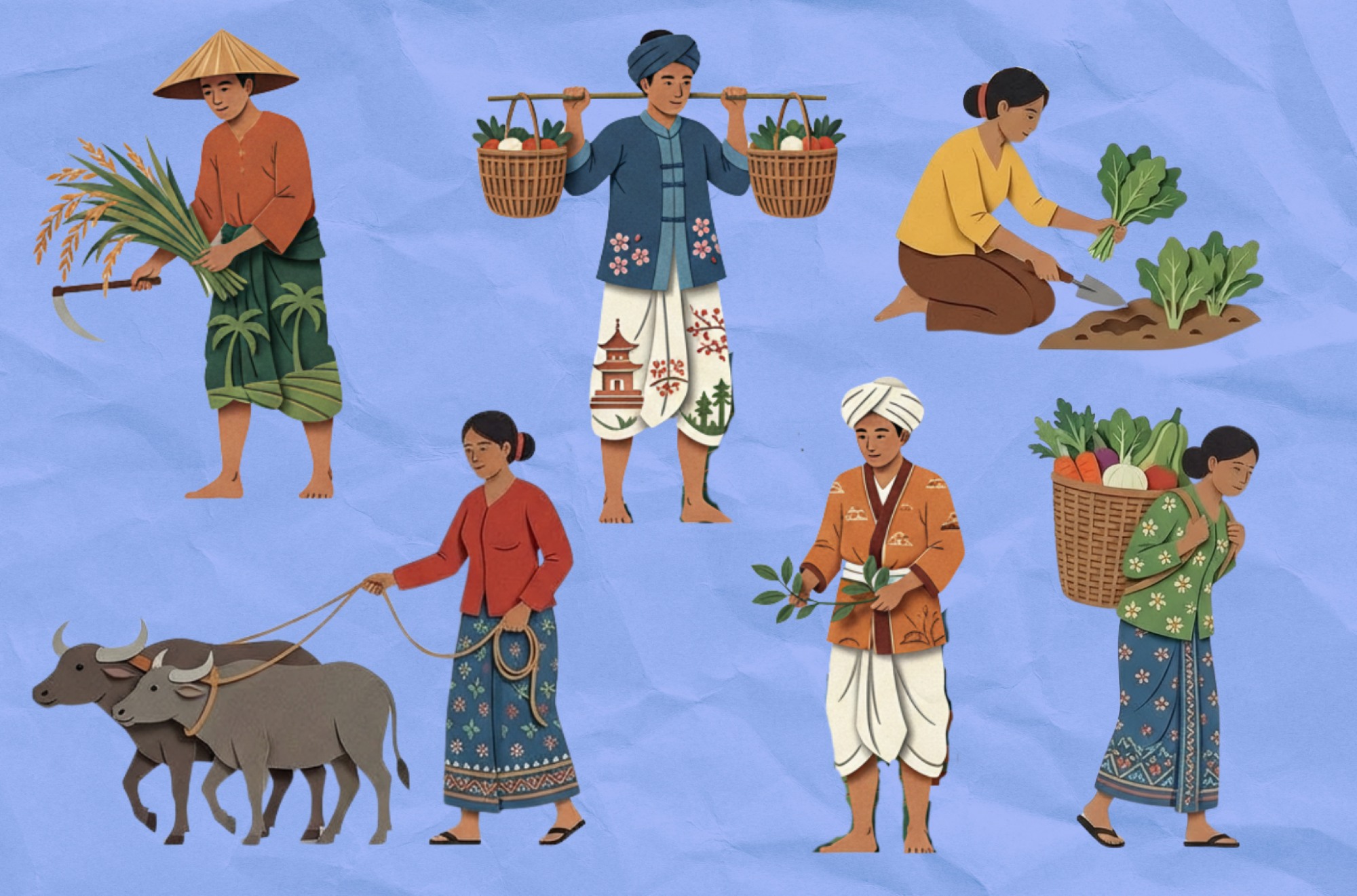
A new opinion piece published in Climate Research argues that effectively tackling the climate crisis requires a radical shift in focus: moving beyond technological fixes and institutional policy to prioritize human and societal transformations.
Authored by a multidisciplinary team from various organizations, including climate scientist Dr. Jon Hellin from the International Rice Research Institute (IRRI), the paper contends that a grand vision integrating climate and sustainability thinking with human psychology, beliefs, and values is essential for resilient food systems.
The context for this urgent call is dire. Climate change severely threatens global food security through increased droughts, floods, and rising temperatures, simultaneously worsening poverty and malnutrition. The agricultural sector is both a significant source of greenhouse gas emissions and a primary victim of climate impacts. Furthermore, risks to food availability, conflict, and public health can interact and cascade across communities, acting as a risk multiplier.
The Intergovernmental Panel on Climate Change (IPCC) Sixth Assessment Report already calls for a paradigm shift from an incremental climate response to a transformative one. This transformative adaptation must address the root causes of vulnerability and necessitates radical change in food systems, including shifting power dynamics among value chain actors. Recent global shocks, such as the COVID-19 pandemic and the food system reverberations of the invasion of Ukraine, starkly revealed the low levels of resilience in global food systems, especially impacting the poorest.
The transformative framework: changing habits and minds
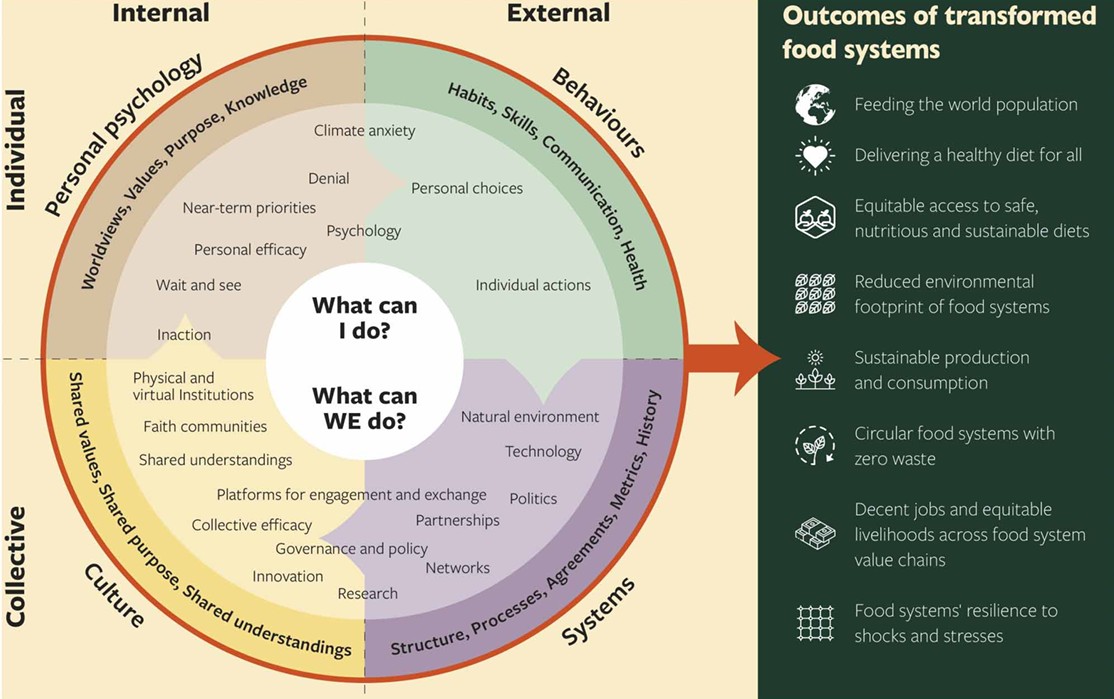
While most previous analyses have focused primarily on external aspects of transformation, such as regulatory instruments, system changes, or individual behavioral patterns, the paper focuses on the internal aspects of transformation, including personal psychology and the collective cultures that drive change. The authors propose a framework (adapted from Ken Wilber’s ‘Four Quadrants’ model) that illustrates the essential interplay between internal and external dimensions of both individual and collective change.
The ultimate vision is a transformation of food systems that minimizes vulnerability to shocks while delivering environmental, social, and economic benefits. The authors emphasize that this drive must embrace food system change as a process of social and individual evolution.
Critically, government and governance are responsible for profound structural changes, but these changes are themselves underpinned by shifts in the mental models, or the values and assumptions of the individuals who compose those structures. Therefore, fostering conditions that support individual transformation and the development of collective understanding must be core parts of any strategy.
Individual agency and the worldcentric shift
The framework highlights that internal personal psychology (the ‘upper left’ quadrant of their model) is a key driver of external change. This involves an expansion of conceptual awareness, moving beyond a self-centered perspective to a greater concern for social and global issues.
This personal development can be viewed as a progression from an ‘egocentric’ worldview (preoccupied with self-needs) to a ‘sociocentric’ view (prioritizing group needs) and finally to a ‘worldcentric’ worldview, where the individual identifies with humanity as a whole, transcending boundaries of nationality, ethnicity, or religion. This psychological shift increases empathy, altruism, and a connective orientation, leading the individual to feel a shared identity with other living beings and the natural world. This heightened sense of socio-ecological connection instills a sense of responsibility and is argued to be an essential element of sustained social change, such as transformative climate change adaptation.
Scaling change through collective understanding
Individual transformation is complemented by the collective dimension, asking, ‘What can we do?’. Large-scale societal change is more effective in the long term when underpinned by a collective vision and shared understanding about the world. Collective understandings define what is individually and collectively imaginable, desirable, and viable.
To achieve this, the authors stress the importance of dialogues that respect community rights and forge common interests, rather than entrenching opposing positions. This kind of pluralism and diversity of values is central to progress. The paper notes that faith communities, to which about 84% of the world’s population belongs, are an under-utilized resource, often possessing traditions that foster personal transformation towards wider solidarity with others and the natural world.
Pathways to scale
While the scaling of internally driven change is challenging, the paper points to several reasons for optimism. Examples exist where local-level innovation spurred by natural disaster, such as land management changes in Honduras following Hurricane Mitch, proved resilient years later. Furthermore, internal collective pressure led to successful divestment from fossil fuels by a major pension fund in the Netherlands.
Research suggests that societal tipping points can occur when as little as 3.5% of a national population is actively engaged in protest to effect change. Moreover, modelling shows that shifts towards sustainable diets result from positive feedback between social norms and self-efficacy, underscoring the importance of value-driven actions and group dynamics.
The framework provides a lens to better understand the complexity of transformation, allowing researchers and policymakers to perceive the roles played by various agents of change and identify the blockages or enablers on the path to sustainable and equitable climate futures. The challenge now is to foster the conditions for these transformative societal changes to be scaled up and out.
Read the paper:
Andrew Juan Challinor, Jon Hellin, Vanessa Meadu, Charles Spillane, Peter C. McKeown, Stephen Whitfield, Steve Taylor, Carmody T. Grey, Marieke Veeger, Lucas Rutting (2025)
Human and societal transformations are critical for food system responses to the climate crisis
Climate Research 95 (2025): 19-26.
https://doi.org/10.3354/cr01758