

Reshaping youth aspirations in agrifood systems
Young people’s aspirations for gaining a greater income than their parents, and the barriers facing them in agriculture for achieving this, are not new. However, speakers at a recent conference indicated that it is not that one-dimensional. Youth also value their connection to place, well-being and food security.
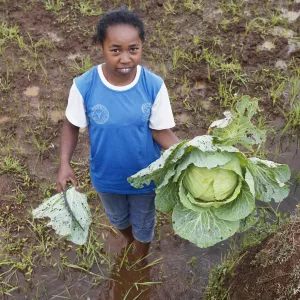
A parallel session focusing on Youth Inclusion in Agrifood systems during the Gender in Food, Land and Water Systems 2025 conference discussed the richness of youth aspirations and well as research, tools and interventions for promoting youth inclusion in agrifood systems.
“Youth are vital to the future. As the next generation of changemakers, they hold potential to drive sustainable innovation in agri-food systems and society at large. But we need better tools and methods to include youth in agrifood systems. We need quality evidence to inform policy, to inform programming… and we need better understanding of youth realities,” said Kristin Davis [Senior Research Fellow, International Food Policy Research Institute] at the start of her presentation reviewing research methods and tools for youth inclusion in food, land and water systems.
Understanding youth perceptions is critical to including them in agrifood systems
Two presentations at the conference specifically highlighted the importance of understanding the perceptions of youth for developing more inclusive policies and practices.
Anne Rietveld [Scientist at Alliance of Biodiversity International and CIAT] spoke about youth perceptions and engagement with agroecology in Tunisia, Zimbabwe, India, Kenya and Peru. Using photovoice and semi-structured interviews, the research team from across CGIAR centers were interested in how youth responded to agroecology’s less industrialized and more nature focused approach to farming. They looked at youth’s understanding of the three different dimensions of agroecology: techno-scientific, social-political and experiential (lifestyle, well-being, sense of autonomy, connection to the land).
The researchers found that while some young people were disinterested in farming, not necessarily in relation to agroecology, others were interested. Not surprisingly, the level of interest was strongly related to their perception of the profitability of farming and whether they could build a livelihood.
“But we found that a lot of young people talked about feeling connected to the land, feeling a cultural, historical connection, having their family there, longing to be on that land. These could be pivotal factors in sustaining youth interest in agriculture,” said Rietveld.
These findings were echoed in the presentation by Sara Bonilla [Postdoctoral Fellow, World Fish] which explored youth perceptions and aspirations in Kenya’s marine food systems.
“Youth aspirations are shaped by so many factors… by parents’ aspirations, parents’ expectations, by community norms, institutional settings, structures, governance, and formal and informal environmental factors,” said Bonilla. “One of the fears and concerns of youth is investing capital in the ocean that is being degraded.”
A review of research methods and tools for youth engagement in agri-food systems, based on 46 selected studies and presented by Davis, revealed that an intersectional analysis of factors influencing youth aspirations within agri-food systems is rarely considered.
Open Young people have different aspirations but want diversified livelihoods configuration options
Young people have different aspirations but want diversified livelihoods
Young men and women will likely have different aspirations for their involvement in agrifood systems. Bonilla’s study found that this was often shaped by the parental division of livelihoods: “Fathers take young men out fishing with them and women train their daughters to process fish… for young women, seaweed farming is perceived as reliable and accessible as they just have to enter shallow water and they don’t know how to swim”.
Rietveld’s project also found that youth, especially young women, were motivated by having quality, diverse and nutritious food available on their farms. Agroecology was more likely to appeal to young women compared to men because it required fewer external inputs, which reduced their cash needs and financial barriers.
Another interesting finding from the study presented by Rietveld was that youth wanted diversified livelihoods. They didn’t want to only be involved in farming: “We cannot live from farming alone”.
“We don’t take that into account often enough. We need to better design and organize [opportunities for] part-time agroecological livelihoods,” added Rietveld.
This was backed up by the findings from Bonilla’s research team, which found that youth engagement in marine aquaculture (mariculture) was often necessarily part-time: “They just don’t have the capacity to invest their whole labor time because they need income, immediate income”.
Importance of supporting youth with knowledge and networks
One of the big obstacles for youth inclusion in agrifood systems is access to knowledge and networks that will help them in their farming. “We found that youth were very interested in working with groups and making relations and building networks on farming that could support knowledge building,” said Rietveld during the discussion following her talk.
Bonilla’s study also found that a lack of technical knowledge and visible role models were important barriers to young people’s involvement in mariculture, especially for young women. However, many young people aspired to leadership roles requiring knowledge and networks. They wanted to “have the spaces to influence community decision-making… to be able to create jobs for other youth, to mentor their peers”.
The importance of knowledge was also illustrated by a talk given by Mesay Yami Gurmu [Agricultural Market Economist, International Institute of Tropical Agriculture] on the youth-led delivery of specialized agricultural services to vegetable farmers in northern Nigeria. His research found that knowledge-based services were preferred over spraying, which could be supplied through family labour. Gurmu concluded his talk by saying that the study demonstrated, “a potential for diversifying user-led specialized agricultural services beyond pesticide spraying, which has implications for the sustainability of youth employment as well as food safety, [but this requires] institutional, financial and market incentives”.
Bonilla concluded her talk with a call to action: “We have to work with youth and development institutions to create demonstration farms so youth can go to a place and learn with hands-on activities and demonstrations [on] how to run a farm and support cooperative models to reduce costs and risks. Youth aspirations go beyond income. They want autonomy, they want recognition, they also want leadership. Unlocking the potential for youth requires intentional, integrated, gender-responsive and youth- focused interventions”.