

A new kind of deal-making for climate and ag investment
CGIAR Climate Action played an integral role at the 6th Global Climate-Smart Agriculture Conference, steering discussions away from mere pledges toward concrete deals and financial commitments for scaling up solutions.
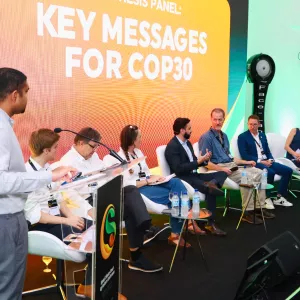
CGIAR Climate Action joined the 6th CSA Conference in Brasília
Brasília, November 5–7, 2025 —Fifteen years after the phrase “climate-smart agriculture” entered the policy lexicon, the movement returned to its birthplace with something that sounded almost radical in climate diplomacy: deals. Not glossy pledges. Not panel platitudes. Actual deals.
At the 2025 Global Climate-Smart Agriculture Conference — a critical milestone on the road to COP30 — scientists, policymakers, and investors sat in the same rooms and did the kind of uncomfortable, necessary work normally saved for closed-door donor summits. CGIAR Climate Action didn’t just attend; it helped steer the conversations toward concrete results.
The week’s watchword was “business-unusual” — and for once, that phrase meant something.
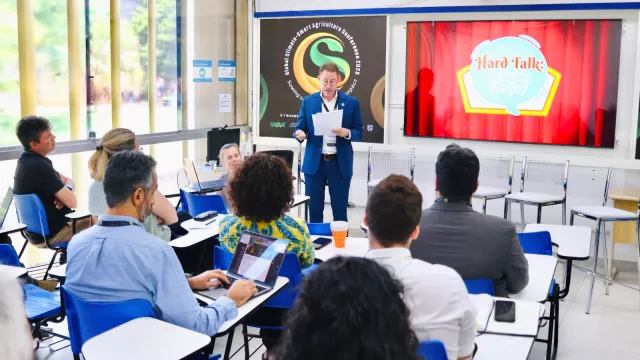
The Next Crop Revolution: From Lab Bench to Rice Paddy
The climate crisis is already rewriting the rules for what crops must do. Survive drought. Emit less methane. Thrive in heat. Feed booming populations.
Brazen ambitions like these demanded a rethink, and the sessions on “Next-Generation Crops” did just that.
Co-led by the International Rice Research Institute, Global Methane Hub, and Novo Nordisk Foundation, the two-day discussion was unapologetically practical: Which genetic traits matter most? How fast can precision breeding deliver results? What regulatory models could get new varieties into farmers’ hands before 2030, not after?
Then came the money.
The Global Methane Hub put USD 30 million on the table to accelerate research on low-emission rice — with a public target of reaching USD 100 million. That wasn’t just science; that was scale.
Foundation for Food & Agriculture Research added USD 2 million to expand the CropSustaiN initiative, focusing on biological nitrification inhibition in winter wheat — an elegant trick of nature that may slash fertilizer emissions. Fifteen years ago, CSA was a concept. In Brasília, it was a market proposition.
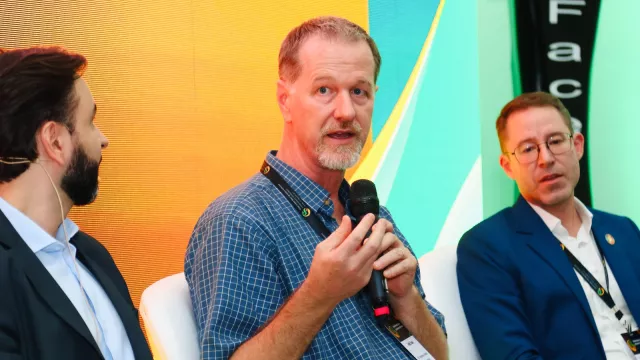
Livestock, Without the Guilt Trip
Livestock has always been the third rail of climate agriculture. This time, the conversation was different.
The Alliance of Bioversity and CIAT and International Livestock Research Institute (ILRI) co-led a session that rewired how livestock is discussed: not as a climate enemy, but as a climate opportunity. Pastoralists, mixed systems, and smallholders took center stage.
The big idea? “Innovation bundling.” Not singular silver bullets, but packages of solutions that farmers will actually adopt — because they also improve animal health, reduce risk, and increase incomes.
The star moment wasn’t a PowerPoint. It was a partnership.
The Climate & Clean Air Coalition, ILRI, the Alliance, and GIZ struck an agreement to build a South–South platform linking Africa and Latin America on sustainable livestock. Knowledge sharing as infrastructure. Evidence as a network. A deal rooted not in theory, but in need.
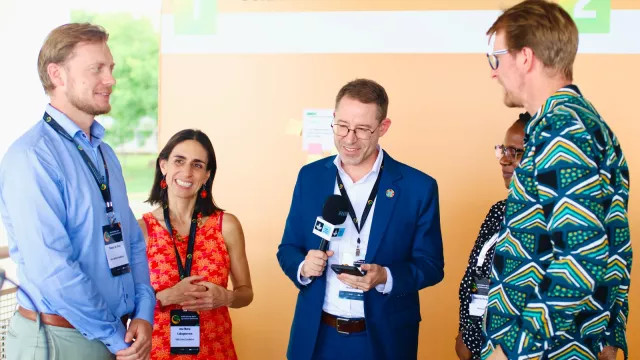
Nutrition, Equity, Climate: One Conversation, Not Three
One side event exploded the assumption that climate policy sits in one silo while nutrition and gender sit in others.
Led by IFPRI, the session unpacked examples from the GCAN Initiative and Living Labs that showed a straightforward truth: climate adaptation that ignores women, children, or vulnerable groups isn’t adaptation at all.
The takeaway felt obvious but rarely practiced: climate solutions must work in real households, not just in models and ministerial memos.
In Climate and Food Systems, Playing It Safe Is the Biggest Risk
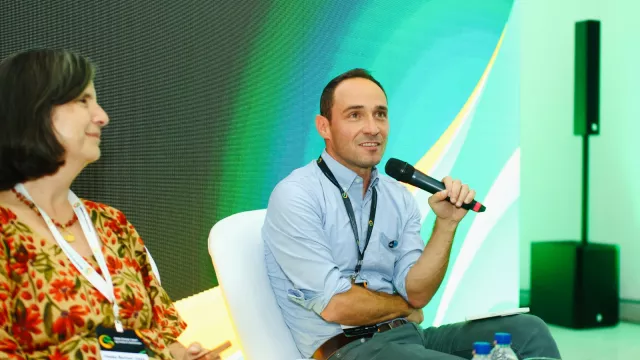
Failure is usually edited out of conference agendas. Panels are built to showcase breakthroughs, success stories, and neat pathways from innovation to impact. But at the “Fail Fair: Lessons from the Frontlines” session, failure was not a footnote—it was the main event.
Dr. Todd Rosenstock, Director of CGIAR Climate Action, began with a premise that runs counter to how institutions usually operate: if you are not failing, you are probably not trying hard enough. Real progress, he argued, requires risk. And risk, by definition, carries the possibility—indeed, the likelihood—of things going wrong.
Rosenstock spoke about failure not as a personal flaw but as a structural feature of innovation in complex systems like agriculture and climate action. Over the course of his career, he has come to see failure falling into three broad categories.
The first is execution failure, when ambition outpaces capacity. These are the failures born of complexity: projects that are too big, timelines that are too optimistic, systems that refuse to behave as models predict. Rosenstock pointed to Evidence for Resilient Agriculture, now the largest meta-analysis of climate-smart agriculture, which took nearly a decade to complete. What is now seen as a flagship achievement began as something much closer to a cautionary tale—saved not by perfection, but by persistence.
The second category is assumption failure: the moment when a good idea collides with bad timing. Early in his career, Rosenstock pushed for the use of detailed activity data in greenhouse-gas inventories, an idea that was met largely with indifference. A decade later, the same concept is widely discussed as essential. The failure, he suggested, was not intellectual but temporal. Some ideas do not fail because they are wrong; they fail because institutions are not yet ready to hear them.
Then there is systemic failure—the most difficult, and the most consequential. These are the failures that no amount of individual effort can overcome: incentive structures that punish experimentation, funding models that reward caution, institutions designed to minimize risk rather than confront existential threats. In these cases, failure is not an accident. It is the system working exactly as it was built to.
Rosenstock’s conclusion was less a reflection than a challenge. CGIAR and its partners, he argued, must fundamentally rethink how success is measured and rewarded. Incremental wins are no longer enough in the face of accelerating climate and food-system crises. What is needed are riskier bets, backed by organizations willing to absorb failure—and cultures that protect people who take calculated risks in pursuit of transformative change.
In a world that increasingly demands certainty, the session offered a different kind of wisdom: that learning to fail well may be one of the most important skills institutions can develop.
Brasília’s Legacy: When Science Meets Power
It would be easy to write off the conference as just another pre-COP checkpoint. But something unusual happened here.
Scientists weren’t merely explaining science. They were shaping finance. Investors weren’t just nodding along. They were writing checks. Policy people weren’t stuck in abstraction. They were drafting pathways.
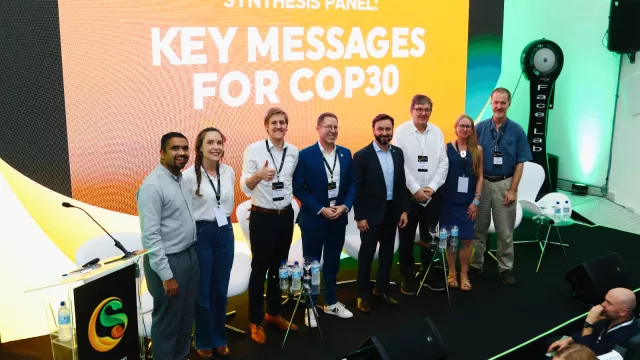
CGIAR’s role — holding science, equity, and farmer needs in the same frame — mattered. It helped ensure that the coming negotiations in Belém will not start from zero, but from momentum.
The Global CSA Conference made climate-smart agriculture feel less like a slogan, more like a project plan. And in a sector where progress is usually measured in committee reports, Brasília delivered something refreshingly tangible: deals, commitments, and a sharper sense of direction ahead of COP30.