

How citizen science is transforming pastoral resilience
In northern Kenya, KAZNET - a CGIAR digital platform - is empowering herders to collect, share, and act on real-time data about rangelands, markets, and livestock, blending traditional knowledge with technology for stronger, climate-smart livelihoods.
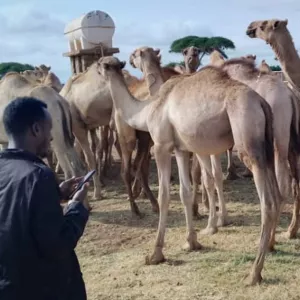
In the arid plains of northern Kenya, life often hangs on a delicate balance. Pastoralist families wake each morning to weigh tough decisions: whether to move their herds in search of pasture, to sell livestock in markets they know little about, or whether to keep them through the dry season. For years, these choices were made with fragments of important local information sources, for example word of mouth, traditional weather forecasting methods, or the instincts of elders.
However, as climate extremes intensify and conflicts shrink traditional grazing routes, there is a need for innovative approaches to build on indigenous knowledge and for better diffusion of reliable and relevant information to pastoralists. It is here that a community-dependent innovation is quietly reshaping life in the drylands of Kenya. The digital platform, KAZNET is built on the simple principle that the best information often comes from the people living closest to the land. By turning pastoralists into citizen scientists and local information providers, the KAZNET platform transforms everyday observations about pasture, livestock, markets, and household food security into real-time data that communities can trust and use.
KAZNET is implemented by the International Livestock Research Institute (ILRI) through Accelerating Impacts of CGIAR Climate Research for Africa (AICCRA) project. The project has also been supported by the CGIAR’s Science Programs on Climate Action, Sustainable Animal and Aquatic Foods, GGIAR’s Digital Transformation Accelerator and the ASAL Adapt project. Since its implementation in 2019, KAZNET has been scaled across Marsabit, Samburu, Isiolo, Wajir, and Garissa counties. The platform now supports real-time monitoring of rangelands and markets, directly reaching over 6,000 pastoralists through more than 400 producer groups.
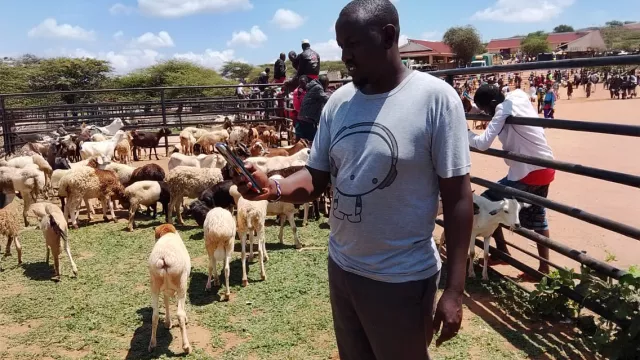
Moses Leisono Torongen, a KAZNET contributor from Isiolo County shares about the role:
"As a KAZNET contributor my work is to get data on rangelands, household, and markets - every week. In the markets, I take data on the number of livestock brought in, those sold, as well as their body condition, and take their pictures. I also take data and pictures of the rangelands every week and at the household level I check the number of livestock in each household, those that have calved, those being milked, and milk yield they are getting and the price at which they sell it. I also do arm measurement on the children to see how their health is progressing every week."
The value of KAZNET not only lies in the collection of high-frequency data but also in the timely and trusted feedback loop: communities receive back tailored information that they have helped to generate, empowering them to act on it.
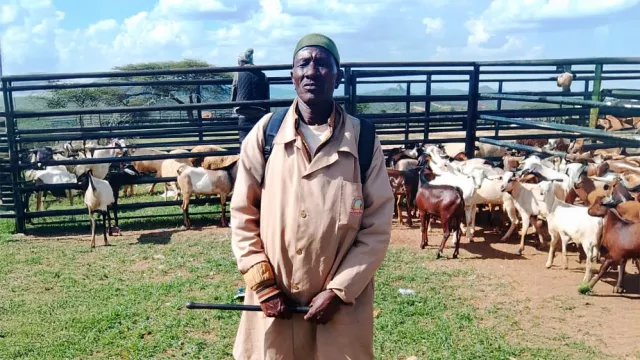
Mengeno Lenawasae, chair of Ol Donyiro livestock market association, from Satiman village, Ol Donyiro sub location, says:
“We were taught how to use KAZNET to check and compare livestock prices in our neighboring communities and markets like Lolkuniyiani and Lekuru markets in Samburu, Merille market in Marsabit and Isiolo markets. We do this so that we don’t underprice our livestock and lose money or overprice our livestock and lose sales. KAZNET helps us to price our livestock competitively.”
More than markets
Impact evaluation of KAZNET in Kenya showed that individuals in the KAZNET initiative had 15 percentage points higher probability of using crowdsourced information, increased social learning by 27%, had a higher likelihood of adopting improved livestock management practices, chose more profitable selling markets for goats, sheep, and camels, and experienced 55% increase in livestock income. Women and youth have become particularly active in the networks that carry KAZNET information. In many groups, women make up the majority, meeting regularly to share updates and discuss strategies. Young herders have also begun using KAZNET updates on pasture and water availability to guide their movements. One young female pastoralist, Nkeleson Lerimanto from Raap Ngambo village, Ol Donyiro sub location, described how her and her peers choose where to graze based on information from KAZNET:
“As a livestock keeper, I learn from KAZNET the condition of pasture in the neighboring areas. When I learn that there is good pasture somewhere else, I tell my neighbours and we go to those better grazing areas so that our livestock remain healthy. Since they do arm measurements of children every week, it also helps me to gauge if I am feeding my children correctly."
Of course, challenges remain. Not everyone owns a smartphone to access the platform directly, and digital literacy levels remain low in many remote areas. Some users find the technical terms difficult to understand, while poor network coverage leaves others excluded. Yet, even here, social networks step in. Word of mouth, elders’ gatherings, and community meetings remain powerful tools for spreading information from those with digital access to those without. As one elder put it:
“Even if I do not hold a phone, the knowledge comes to me through the people I trust.”
The promise of KAZNET lies in its ability to build trust while bridging gaps between traditional knowledge and modern technology.
· County governments are beginning to see its potential, with Garissa County exploring how to weave the platform into formal rangeland monitoring plans.
· The National Drought Management Authority (NDMA) is also exploring ways to combine KAZNET’s real-time data with its early warning bulletins, creating a more responsive system for crisis preparedness.
· KAZNET also feeds information to the government managed Kenya Agricultural Observatory platform (KAOP) that presently reaches 700,000 farmers.
For now, early signs of transformation are felt most in the lives of the herders themselves. Over eighty percent of users in Wajir and Garissa say the information has improved their decision-making, from selling livestock at competitive prices to planning movements that safeguard both animals and the land.
Partnerships that strengthen resilience
The current and continued success of KAZNET depends on partnerships. Collaboration with the national and county governments, non-governmental organizations such as Mercy Corps, and local rangeland management committees has anchored the platform within existing structures. For instance, Garissa County is exploring how to embed KAZNET into its Rangeland Condition Monitoring Plan and County Integrated Development Plan (CIDP). In Wajir, a geographic information system (GIS) laboratory has been established to integrate KAZNET data into broader decision-making systems. Citizen science, backed by supportive ecosystems, is giving pastoralists a voice and agency, and the means to face an uncertain climate with relevant and reliable knowledge.
Related content
Use of citizen science and crowdsourced information to support resilient pastoral systems
Launching, maintaining, expanding and disseminating crowd-sourced information in drylands: KAZNET manual
This article was first published on the AICCRA website
Author: Polycarp Otieno Onyango, Communications Manager, AICCRA Kenya (International Livestock Research Institute, ILRI)
Contributor: Watson Lepariyo, ILRI Research Associate - Livestock, Climate and Environment